Get Chosen
Your Product Page Has Two Readers Now. One Can't See the Hero Shot.
You spent the budget on the photography. The reader who decides your shortlist can't see a pixel of it.

You spent the budget on the photography. The reader who decides your shortlist can't see a pixel of it.
Two shoppers land on your product page now. One of them reads your photography the way you built it to be read. The other can't see a single pixel of it.
The second reader is a model doing the shopping for a person. Someone asks it for a black merino crew under $150 that runs true to size, and it goes and reads product pages, yours included. It skips the hero shot and the lifestyle video. It reads the words and the numbers behind them: title, fabric, fit, price, whether the thing is in stock. Then it hands the person two or three options, and more and more, the person only ever sees those two or three.
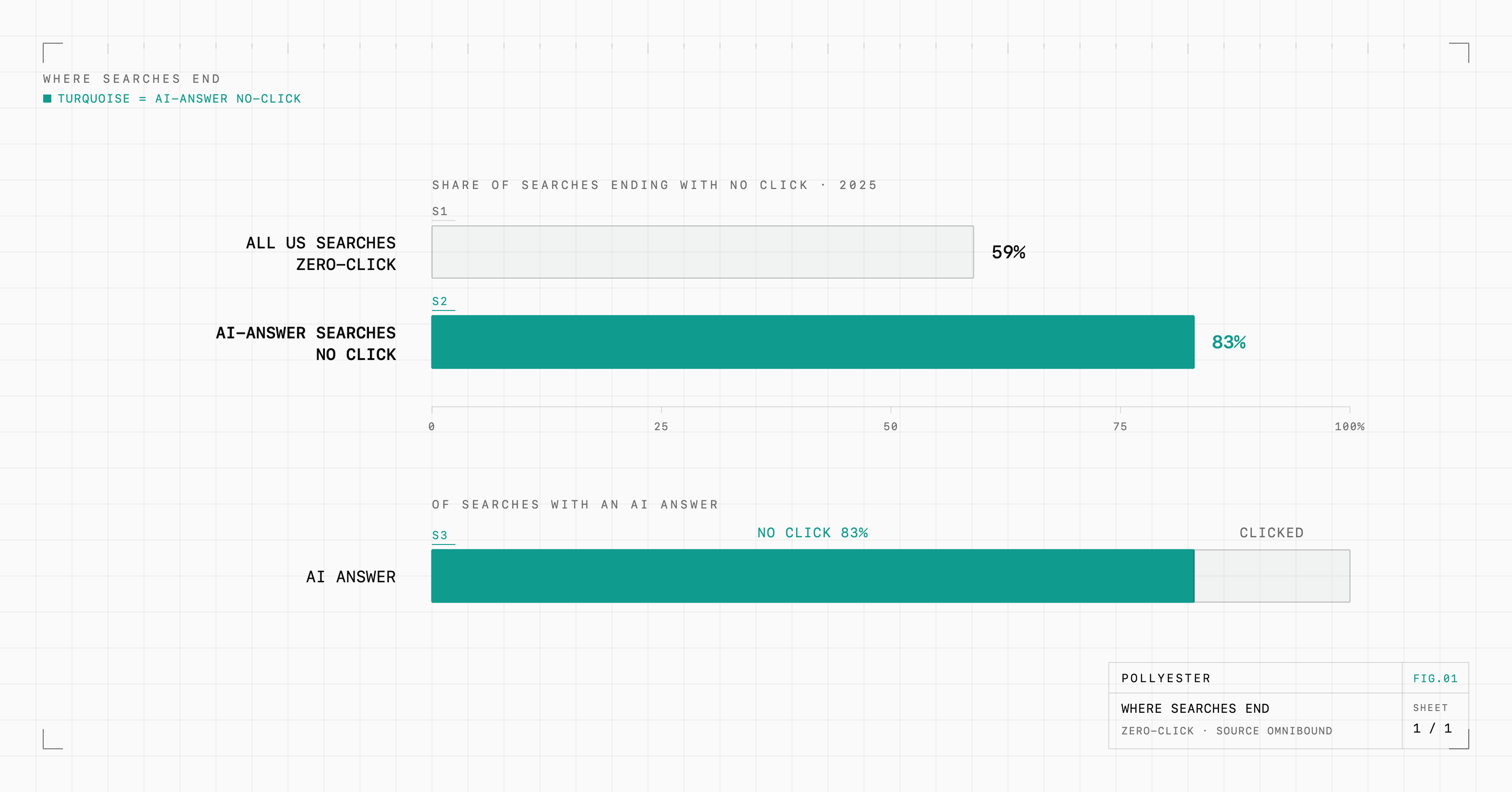
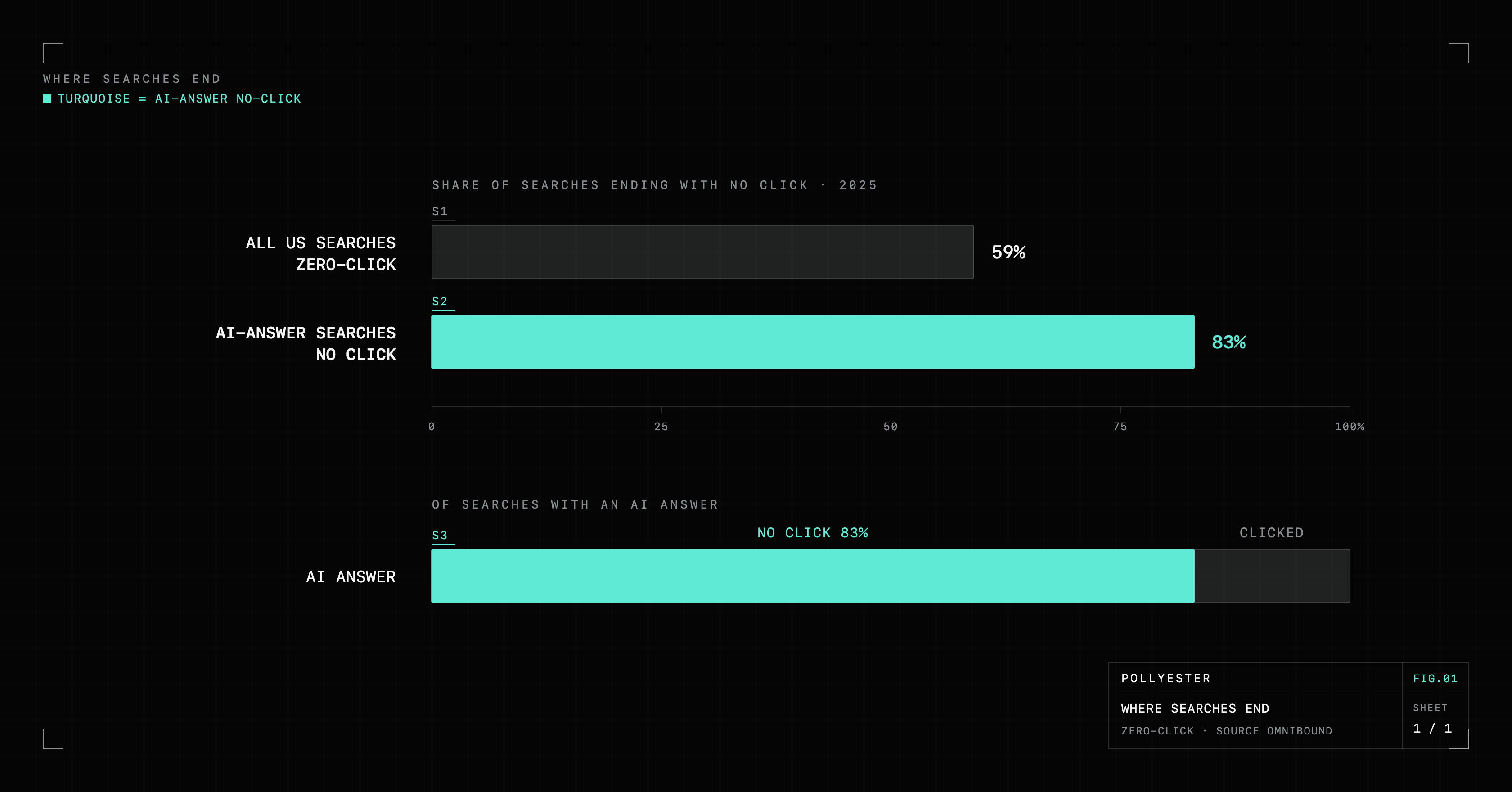
Sit with that. For a decade the whole game was getting a human to your product page and then getting out of their way. A lot of that traffic now stops one step earlier. The machine builds the shortlist, and if you're not on it, the person you spent all that money to impress never reaches the page at all. Zero-click searches hit about 59% of US queries in 2025, and roughly 83% of the searches that trigger an AI answer end with no click (Omnibound).
This is early, and I'll say so plainly. AI-driven sessions are still under 0.2% of ecommerce traffic today (Kaiser & Schulze, via MetaRouter). But it's the fastest-growing slice and the high-intent one. AI-referred traffic to US retail grew 805% year over year on Black Friday 2025, and those shoppers were about 38% more likely to buy once they landed (Adobe, via MetaRouter). Small channel, steep curve. Worth getting ready for before the traffic shows up.
The machine builds the shortlist, and if you're not on it, the person never reaches the page at all.
What flips
Everything you learned about conversion still holds for the human. The clean page, the fit guidance, the reviews below the fold, the returns policy stated like you mean it. All of it still does its job the moment someone is looking.
None of it gets you looked at. The data record does that now. Your product data is what gets you into the comparison in the first place, and the page is what closes the person once the machine sends them over.
That's a real change in where the work sits. So it's worth being precise about what the machine is reading.
Truthful, matching price and stock across every channel used to be housekeeping. It's a ranking input now.
What the second reader weighs
Start with completeness. The model prefers what it can confirm over what it has to guess (Marpipe). For apparel that's the fields you think of as boring: exact fabric composition, fit, real measurements, care, the color named the way a person would search for it. Leave a field blank and you don't get the benefit of the doubt, you get passed over. 42% of shoppers already abandon a purchase over missing product information (Mirakl). The machine is stricter than they are. Poor product data quietly costs the average business around $15M a year (Mirakl), and that was true before anything started reading your feed on a shopper's behalf.
Then consistency. Your product shows up in more than one place. Your own site, a shopping feed, a marketplace, a listing somewhere you half forgot about. If the price says one thing here and another thing there, or you're marked in stock when the warehouse is empty, the model reads that as a brand it can't trust and moves to the next one. Truthful, matching price and stock across every channel used to be housekeeping. It's a ranking input now.
And reviews, weighted by how far they can be trusted. A 4.6 average from 1,200 people is a stronger signal than a 4.8 from 12, and a machine reads it that way even when a person might get dazzled by the higher number. Volume and recency carry the weight, not the top-line score.
Put it together and the picture is clear. When ChatGPT lines up two brands selling roughly the same thing, it weighs availability, price, quality signals, whether you're the primary seller, and whether you've switched on its checkout (OpenAI). Not one of those is your homepage copy.
The twist that makes both mandatory
Here's what makes this less scary than the headlines. For a while it looked like the buy button itself was moving inside the assistant. OpenAI shipped checkout right inside ChatGPT in early 2026 with brands like Glossier, SKIMS, and Vuori, then pulled most of it back within weeks, after only about a dozen of Shopify's millions of merchants had gone live (Digital Commerce 360, CNBC). Google did a version of the same thing, cutting its AI answers on shopping queries from around 29% of them down to 3% because the answers weren't turning into sales (Omnibound).
Where the industry regrouped is the useful part. The shape now is discover in the AI, buy on your own site. The assistant helps assemble the shortlist and then sends the person to you to check out. Which means both jobs are load-bearing at the same time. Your data has to be good enough to make the shortlist, and your own page and checkout have to be good enough to close the person the assistant just handed you. Neither one covers for the other.
The good news for a brand your size is that most of this is already yours. One study of 6.8 million AI citations found 86% came from sources the brand controls directly, its own site and its own listings (Yext). You don't need a bigger budget than you have. You need your own house in order.
Which is the trap to name. You'll get sold an "AI visibility" dashboard for exactly this problem. Most of it is the old search-optimization business with a new sign on the door, and a scoreboard doesn't fix a thin product feed sitting underneath it. Put the money into the feed.
Keep the page beautiful
So keep the page beautiful. The person on the other end is still a person, and the photography, the fit notes, the reviews all still earn their keep the second someone is looking.
Just remember there's a second reader now, and it decides whether that person ever gets to look. It can't see any of your work. It only reads your data. Give it the truth, all of it, and the shortlist takes care of itself.