Get Found
Citation Share Is a P&L Line: How to Measure Getting Found by AI
Rank tells you nothing now. The number that matters is your share of the AI answer, measured like any other line on the P&L.

Rank tells you nothing now. The number that matters is your share of the AI answer, measured like any other line on the P&L.
The number you're missing
You've been told to invest in AI visibility. Fine. Now say what you're buying.
Most teams can't. They can quote their Google rank, their impressions, their ad spend down to the keyword. Ask what share of AI answers name their brand on the questions their buyers actually type, and most go quiet. That gap is the problem. You're spending against a channel you have no scoreboard for.
Here's the shift underneath it. For twenty years, getting found meant ranking on a page a person then clicked. That's breaking. Zero-click searches hit about 59% of US queries in 2025, and when Google shows an AI summary, users click a traditional search result just 8% of the time, versus 15% when there's no summary (Pew Research Center, 2025). A fast-growing share of buyers now begin their research inside an AI chatbot rather than a search box. The engine reads your page, writes the recommendation, and hands it to the shopper. You never see the click, so rank stops telling you anything.
You're spending against a channel you have no scoreboard for.
Why this bites supplements harder
Every DTC brand is dealing with this. Supplements got there first, because the cheap channels already turned expensive.
You sit under four regulators at once. The FTC watches your marketing, the FDA watches your labels, and Google and Meta both cap what you can say and how you can target. Together they add a meaningful cost-per-lead premium over brands selling something unregulated. Then in January 2025 Meta turned off the ad targeting that optimizes for purchases, not just clicks, for health advertisers, and paid efficiency dropped almost overnight. Across ecommerce, acquisition cost kept climbing between 2023 and 2025.
So the math is simple. Your paid channel got more expensive and less precise at the same moment a new discovery channel opened, one the ad platforms don't gate the same way. When an AI answer recommends your product, you're not renting a placement you have to keep paying for. You earn it, and right now it's still cheap to win. A few brands are already treating it as real estate and counting it. Most aren't.
Rank is the wrong scoreboard
What matters isn't your rank but whether you get named in the answer, how often, and against the brands you actually compete with.
Call it citation share. You're asking two questions on a schedule. Of the buyer questions that matter, what share of AI answers mention you at all? And when the engine goes past a mention to recommend a specific product, how often is it yours? Call the first your share of voice and the second your recommendation rate. Track both, per engine, against a named set of competitors, and you have a get-found number you can put in front of a board.
This beats rank because it matches how buying now works. Brands cited inside AI results earn about 35% more organic clicks and 91% more paid clicks on the same queries (The Digital Bloom). That citation pulls the rest of your funnel with it, which is why it's worth counting.
How to build the scorecard
You don't need a tool with a new acronym. You need four things and a calendar.
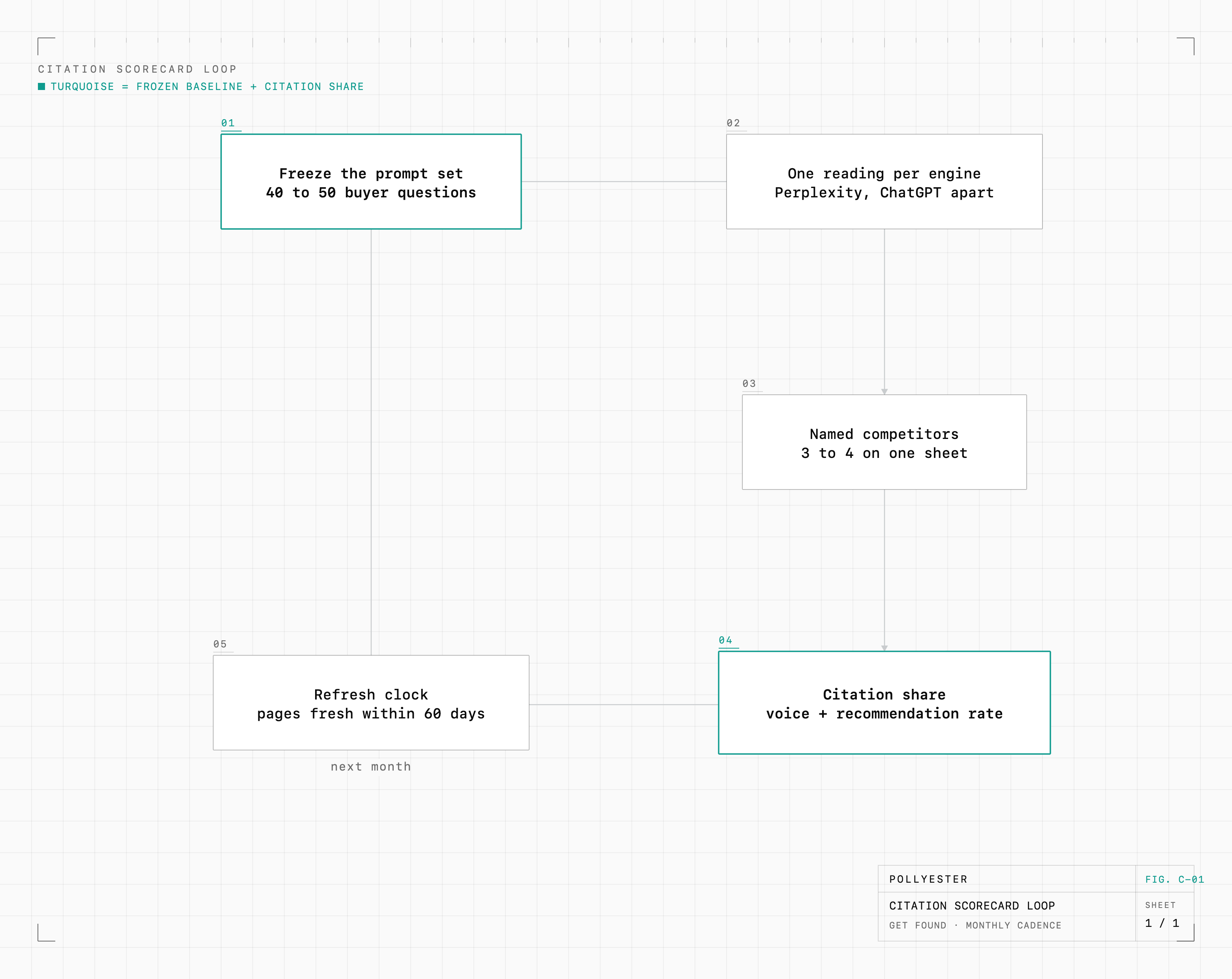
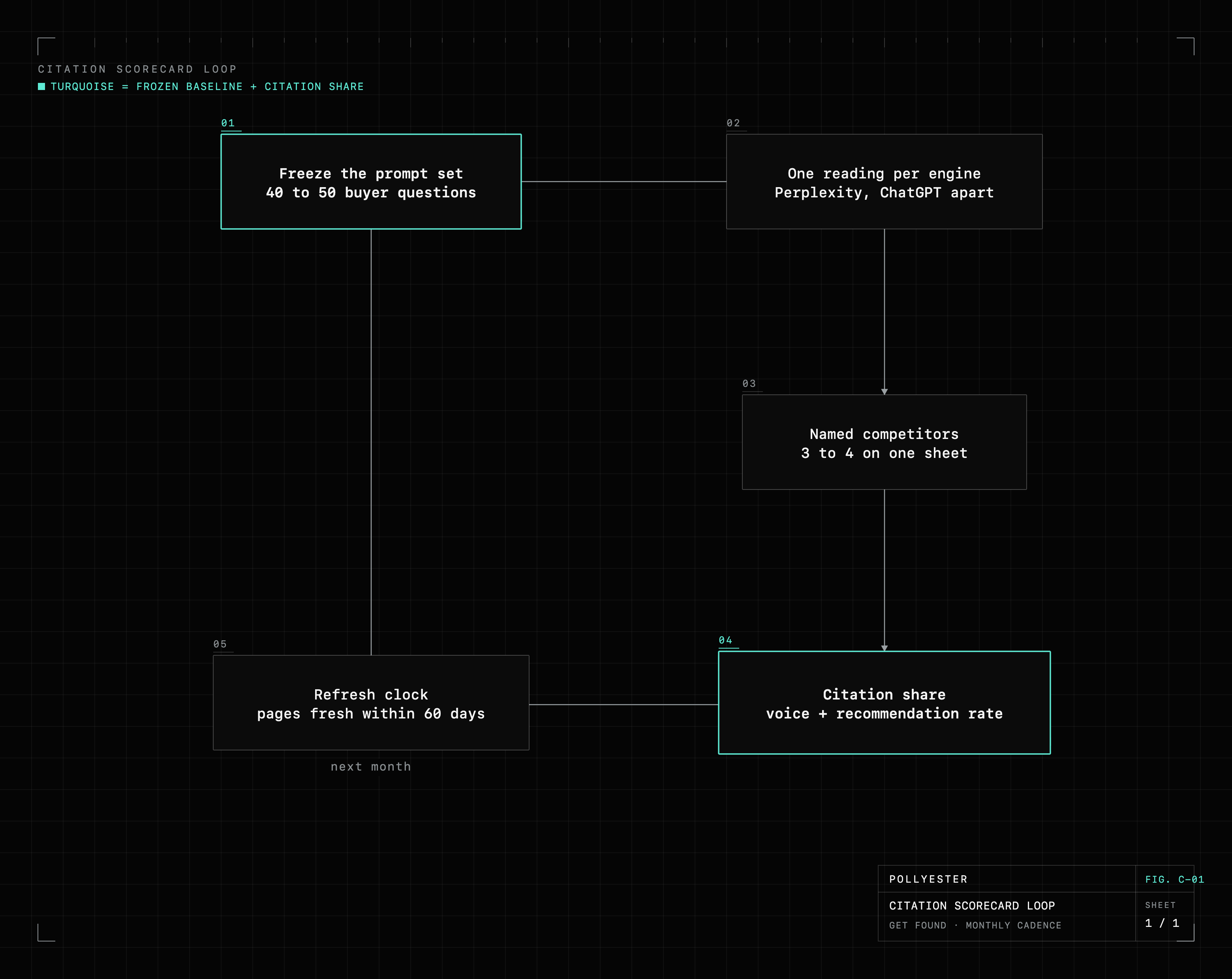
A fixed prompt set. Write down the 40 or 50 questions a real buyer asks before they buy your category. "Best magnesium for sleep." "Is creatine safe long term." "Magnesium glycinate versus citrate." Then freeze the list. Asking the same questions every month is what makes this quarter comparable to last. Change the list and you've lost the baseline.
One reading per engine. Perplexity and ChatGPT don't cite the same way. Perplexity leans on focused question-and-answer pages and reviews, while ChatGPT prefers clean, structured explanations. A single blended score hides which engine you're losing, so score each on its own.
Named competitors on the same sheet. Citation share means nothing on its own. Twenty percent looks like a loss if two rivals sit at forty, and a strong position if the field is scattered. Put three or four competitors next to your own line every month.
A refresh clock. Fresher pages get cited more often, so treat a roughly 60-day update cadence as the target and keep the important pages current. Structured product data does the same work: the labeled feed of your prices, ingredients, and policies shows up on a large share of the pages AI engines cite. This is the unglamorous part, clean and current product data plus honest answers to real questions, and it's what compounds.
One warning while you're at it. When a vendor sells you "AI ranking" with a fresh acronym and a countdown timer, slow down. Google's own John Mueller said the higher the urgency and the harder the push of new acronyms, the more likely it's spam (TheAdSpend). You also don't need a special machine-readable file to show up in Google's AI answers. Google says so directly. The work is plumbing and honesty, not a product you buy.
Asking the same questions every month is what makes this quarter comparable to last.
Why it's a P&L line, not a vanity metric
Here's where citation share turns into money.
A visitor who arrives from an AI answer converts about 42% better than one from anywhere else, as of March 2026 (Adobe). A year earlier that same traffic converted 38% worse, so this is a real reversal, not a blip. Put it plainly. If 100 sessions from paid give you 2.5 orders, 100 sessions from an AI answer give you about 3.5. Same session count, 42% more revenue, and you didn't bid on a keyword to get it.
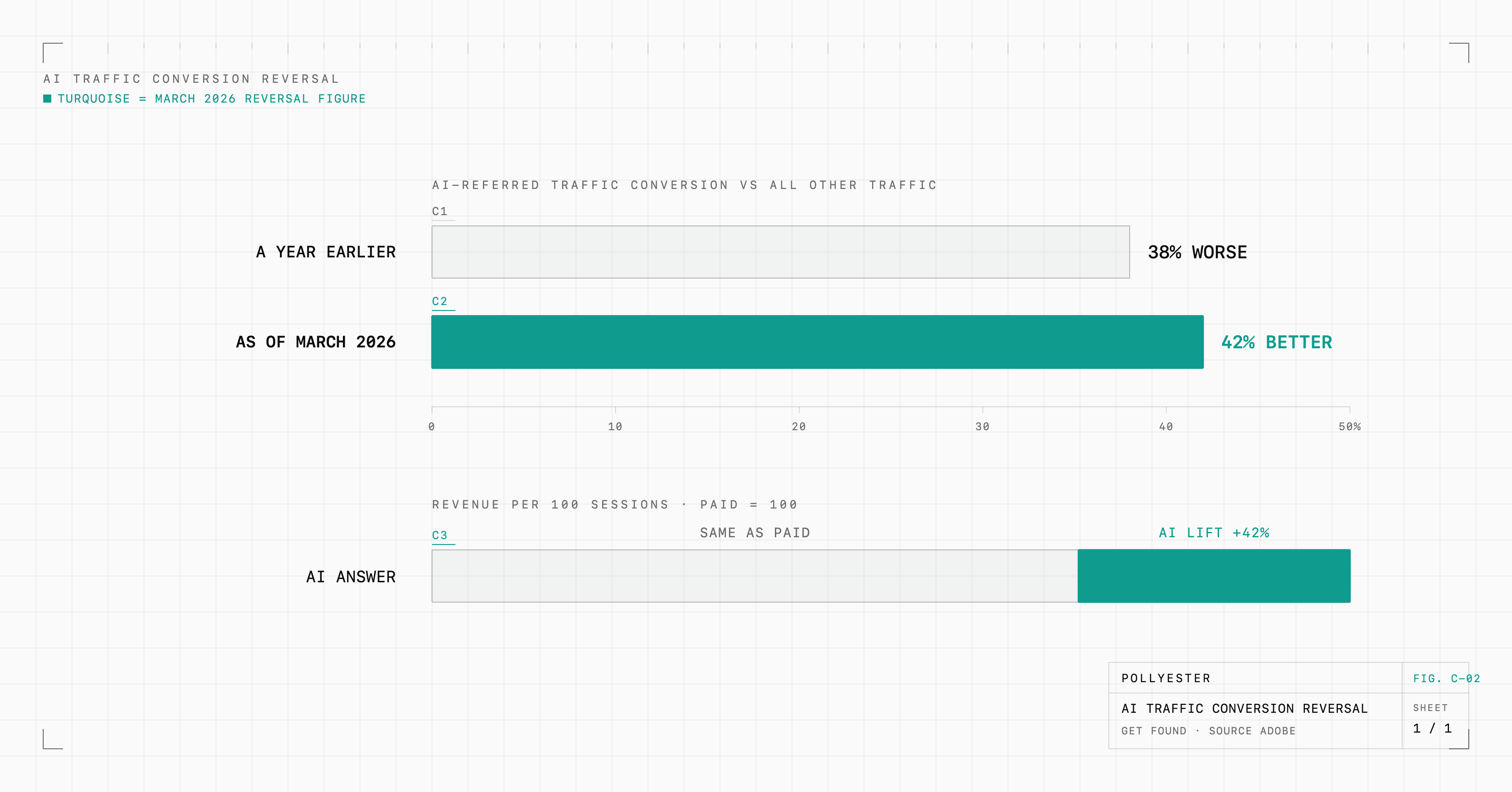
That's why early citation share is worth more than the raw traffic suggests. AI still sends under 1% of most sites' visits today (Search Engine Land). It's a small channel, but it's the highest-intent slice of discovery, it converts far better than old organic, and it's growing while paid keeps getting more expensive. You're buying a claim on a channel before the price goes up.
Now tie it to the number your board cares about. Citation share is a lever on CAC, not a report that sits next to it. Every order from an AI recommendation is an order you didn't pay Meta or Google to win, on traffic that converts better than the traffic you did pay for. Watch citation share climb while blended CAC holds or falls, and you've shown the channel is doing real work. That's the sentence a CMO wants in the room: earned AI recommendations grew orders this quarter while blended CAC came down.
A scoreboard you can audit
Track citation share the way you track any P&L line, monthly, against a baseline, next to named competitors, and the retainer conversation changes shape.
You stop paying someone for a mysterious "AI visibility" service you can't audit. The prompt set, the scorecard, and the product data underneath it all sit in your systems, readable end to end. And you can walk into the board meeting knowing your share of the answer this quarter, that it moved, and that it's pulling CAC down instead of adding another line to the spend.
Run it like any other line on the P&L. That's what it is now.