Earn Advocacy
Advocacy Is the New Distribution
In the answer layer you can't outbid your way to the recommendation. You earn it, one real customer at a time.

For twenty years, growth was something you could buy. You rented traffic, tuned the funnel, won the auction, then did it again the next month. That loop still works. What's changed is that a second one is forming underneath it, and it doesn't move with your ad budget at all.
Here's the shift. A growing share of how people find products now happens inside an answer, not on a page of blue links. ChatGPT handles around 50 million shopping-related questions a day, roughly 2% of its 2.5 billion daily prompts, and in November 2025 OpenAI shipped a feature that reads across the web and hands the shopper a recommendation instead of a list to sort through (Dataslayer; Azoma). Sixty-one percent of consumers say they've already used it to shop, and one in four think it recommends better than Google (Dataslayer).
The machine treats your marketing copy as one more claim, and treats a thousand real customers as the evidence.
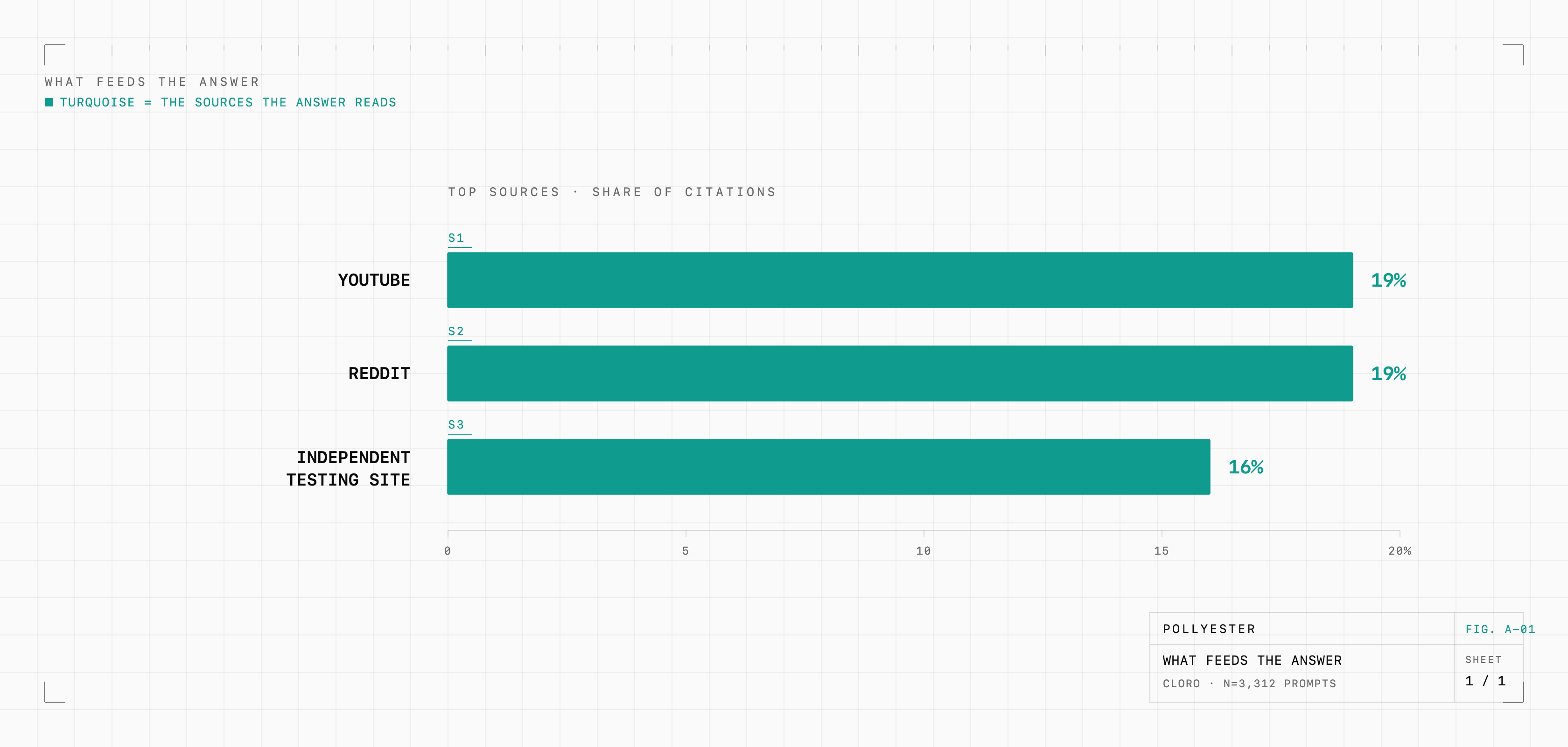
Now look at where those recommendations come from. In a study of 3,312 product-intent prompts, ChatGPT returned a clean product card 87% of the time, and the top sources feeding those answers weren't retailers or brand sites. They were YouTube and Reddit, tied at 19% each, and an independent testing site at 16% (Cloro). Other people's words, not your product page. The machine treats your marketing copy as one more claim, and treats a thousand real customers as the evidence.
What the machine is actually reading
This is the part worth sitting with. These models don't just count stars. They read reviews as a dataset and pull out what people actually say, the specific phrases that repeat: "true to shade," "no pilling," "didn't break me out," "arch support." Ask for the foundation that matches olive skin and doesn't oxidize, and the answer surfaces the brand where that language shows up often, and positively, in real reviews (Yotpo). Your page can say "buildable, breathable coverage" all day. It doesn't move the answer. A few hundred customers using the same three words does.
None of this is new behavior, only newly consequential. Ninety-two percent of people already trust a peer's recommendation over any form of advertising (Nielsen, via Loop.fans). Shoppers who see reviews and real customer content convert about 161% higher than those who don't (Yotpo). And referred customers tend to be worth more and stay longer than the traffic you buy. What changed is that advocacy is now the raw material feeding an automated system that sits between you and the buyer and decides what to recommend. Unlike an ad auction, you can't pay your way in.
In beauty, the proof is loud
Beauty shows this earlier and louder than any other category, because beauty discovery already left the brand site years ago. TikTok Shop grew more than 60% year over year and became the UK's number four beauty retailer, while beauty e-commerce overall grew 16%, about four times the pace of the broader industry (BeautyMatter; GCI). By the time a shopper decides what to try next, the creators, reviewers, and community threads have already shaped the choice.
That's the material the answer engine has to read when it builds a recommendation, and it's where the specific, credible language lives. A studio shot of the product tells the model nothing it can quote.
The shortcut that backfires
The obvious reaction is to manufacture the evidence yourself, buy the reviews, seed the praise, plant the language. That's now both a legal problem and a losing move.
The FTC's rule against fake reviews took effect on October 21, 2024, on a unanimous vote. It bans buying or selling reviews, insiders posting as customers without saying so, brand-run sites dressed up as independent, and burying negative reviews. Penalties run up to $53,088 per violation, and this stopped being theoretical: on December 22, 2025, the FTC sent its first warning letters to ten companies (FTC; Inside Privacy). Per violation, per review, the math turns ugly fast.
Set the law aside and it still doesn't work for long. The same models reading your reviews keep getting better at spotting the ones that don't sound like people. A wall of uniform five-star copy reads as manipulation, not quality, and it gets discounted. Whatever games the answer this quarter tends to get discounted the next. That's the trap in treating any of this as a new channel to game. You're writing for a reader that rewards the real thing and sees through the rest.
You're writing for a reader that rewards the real thing and sees through the rest.
What actually builds it
So the work isn't tricks. It's building the machinery that produces genuine advocacy at volume, and owning it.
Concretely, a review flow that asks at the right moment and captures the specific language customers use, so those phrases are there to be read at all. Loyalty and referral programs that turn buyers into repeat buyers and repeat buyers into advocates. Loyalty members generate 12 to 18% more revenue, churn 47% less, and refer 39% more often (EY / LoyaltyLion, via SellersCommerce). Churning half as often means you keep a customer roughly twice as long, which is twice the window for them to review, refer, and reorder. That's not a soft metric. That's contribution margin and word of mouth compounding off the same base.
It also means a real relationship with the places the models read, the subreddit, the creator, the independent tester, earned rather than bought. And a product page built so a machine can parse your reviews, specs, and questions cleanly, because half of getting cited is being legible in the first place. In the case studies, no brand got recommended on its own content alone. It took reviews, roundups, and community presence (Digital Agency Network).
Notice what this actually is. It's retention and community work, the same thing that already sets apart the brands that hold onto their customers. What's new is the consequence. Keep customers longer and turn them into advocates, and now the answer engine has something to quote you on.
The point
Advocacy is becoming distribution. In the answer layer you don't buy the recommendation, you earn it, one real customer at a time, and the earning compounds. That's an asset on your side of the table: your reviews, your community, your loyalty base, your relationships with the people the models trust. It doesn't reset when you pause spend, and it doesn't belong to a platform that can change the rules on you. Which makes it exactly the kind of thing worth building to own, not renting.