Earn Advocacy
Build a Review Flow That Captures the Words the Model Reads
In apparel, an AI recommends on phrases like 'true to size,' not on your star average. Here's how to design a review flow that captures the language customers actually use.

In apparel, an AI recommends on phrases like "true to size," not on your star average. Here's how to design a review flow that captures the language customers actually use.
Your review flow collects stars, but the model reads sentences. A five-star rating with no words props up your on-site average and gives an AI nothing to recommend you on.
Here's what's underneath that. When a shopper asks ChatGPT for "the best true-to-size chino," the model isn't averaging your rating. It's reading across real reviews for a phrase that shows up often and shows up positively. Yotpo calls this aspect-based sentiment: the model pulls repeated mentions of one attribute, "true to size," "runs narrow," "holds its shape after washing," and treats the pattern as proof. Your product copy can say "perfect fit" all day and it won't move the answer. A hundred customers writing "fits exactly like my usual medium" will.
So a flow that only collects a rating leaves the most valuable thing on the table. In apparel the exact phrases matter, and they decide the sale.
What the machine actually pulls out of a review
Fit is the whole game in this category. Returns run about 25% in apparel overall, 30 to 40% in some subcategories, against 14.8% across DTC, and 67% of those returns come down to size and fit (Eightx, Richpanel). At a $10M brand, a 25% return rate is roughly $2.5M in goods coming back and $375K to $625K in processing alone (Eightx). So the customer who writes "I'm normally a medium and the medium fit perfectly" is doing two jobs at once. She tells the next shopper which size to order, which keeps the product out of your returns pile, and she hands the model the exact phrase it needs to surface you for fit.
A star rating carries none of that. Same score on the same product tells a machine nothing about whether it runs narrow. The words are the asset.
You want a review written from experience, not from the unboxing.
Ask when they can feel the product, not when the box lands
Most flows fire the review request on delivery, or a couple days after. For apparel that's too early. Nobody can tell you whether a shirt holds its shape or whether the waistband gives out after a few hours until they've worn it a while.
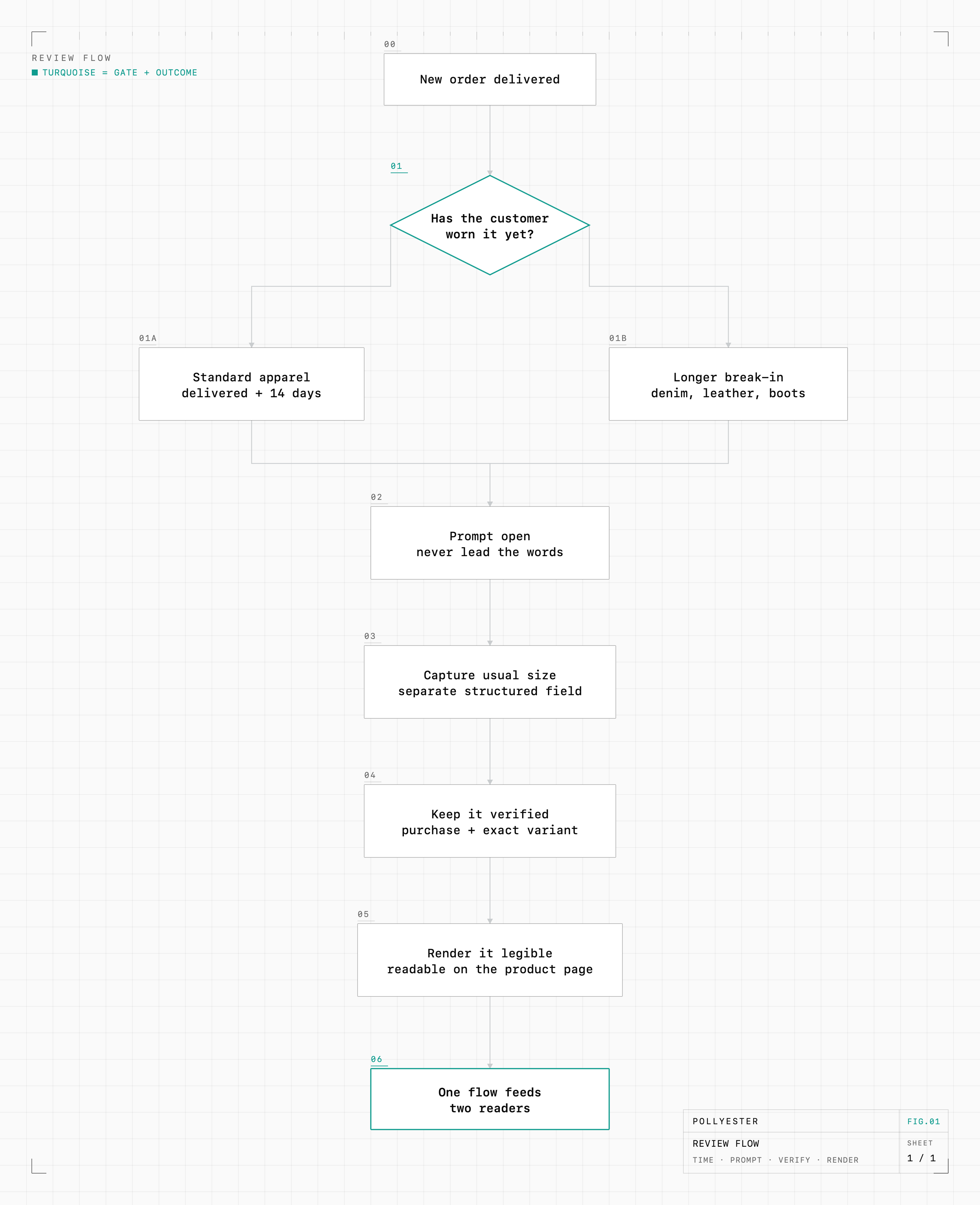
Time the ask to the wear. For most apparel that means ten to fourteen days after delivery, long enough that the customer has washed it once and worn it a few times, short enough that the memory is fresh. If you sell something with a longer break-in, denim, leather, boots, push it out further. You want a review written from experience, not from the unboxing. That's where the fit-and-feel language lives, and that's what the model reads.
One practical note. The delivery timestamp you need is already sitting in your order data. Trigger the ask off "delivered plus fourteen days" instead of "shipped," and you've fixed the timing for free.
Prompt for the attribute, don't put the words in their mouth
This is the part most flows get wrong, and it's the part the regulator watches.
If you want fit language, ask about fit, and ask it open. A prompt like "How did the fit compare to your usual size?" gets you a real sentence in the customer's own words. Ask "Was this true to size?" with a yes/no box and you get a checkbox, which teaches the model nothing, because a tick isn't a phrase it can pull out. And if you feed people the exact words you want and reward the ones who use them, you're manufacturing the language instead of capturing it. That's the line the FTC now enforces.
That rule took effect in October 2024 and it has teeth. It bans fake reviews, undisclosed insider reviews, and suppressing the negative ones, at up to $53,088 per violation, and the agency has already begun enforcing it. The models are moving the same way on their own. A review set that's thin, uniform, and five stars only reads as manipulated to the exact reader you're trying to win. So this discipline isn't a compliance chore, it's what makes the reviews worth reading.
A structure that works: one open question on fit, one on feel or quality, one on how they're using it. Give the shopper a light nudge on what to talk about, never the sentence to write. Ask for their usual size in a separate structured field so the model can tie "fit perfectly" to an actual size on a real body.
A review set that's thin, uniform, and five stars only reads as manipulated to the exact reader you're trying to win.
Keep it verified, keep it legible
Two things make a review usable to a machine, and both are on you to capture.
First, proof it's real. Tie every review to a verified purchase and the exact variant bought, the size and the color. A model leans much harder on a review it can trust as a real buyer, and a fit comment is worthless if you can't say which size it's about. You already have this data at the moment of the ask. Don't drop it.
Second, structure. Ninety-two percent of consumers trust peer recommendation over any other form of advertising (Nielsen), but that trust only turns into a citation if the review sits somewhere a model can read it cleanly. That means the review text, the star rating, the verified-buyer flag, the size purchased, and the fit response all rendered on the product page as readable content, not locked inside a widget the model can't open. Half of getting cited is being legible. You can collect the best fit language in your category and still lose the recommendation because the words are trapped where a machine can't reach them.
What the flow is worth
Run the math on both ends of it.
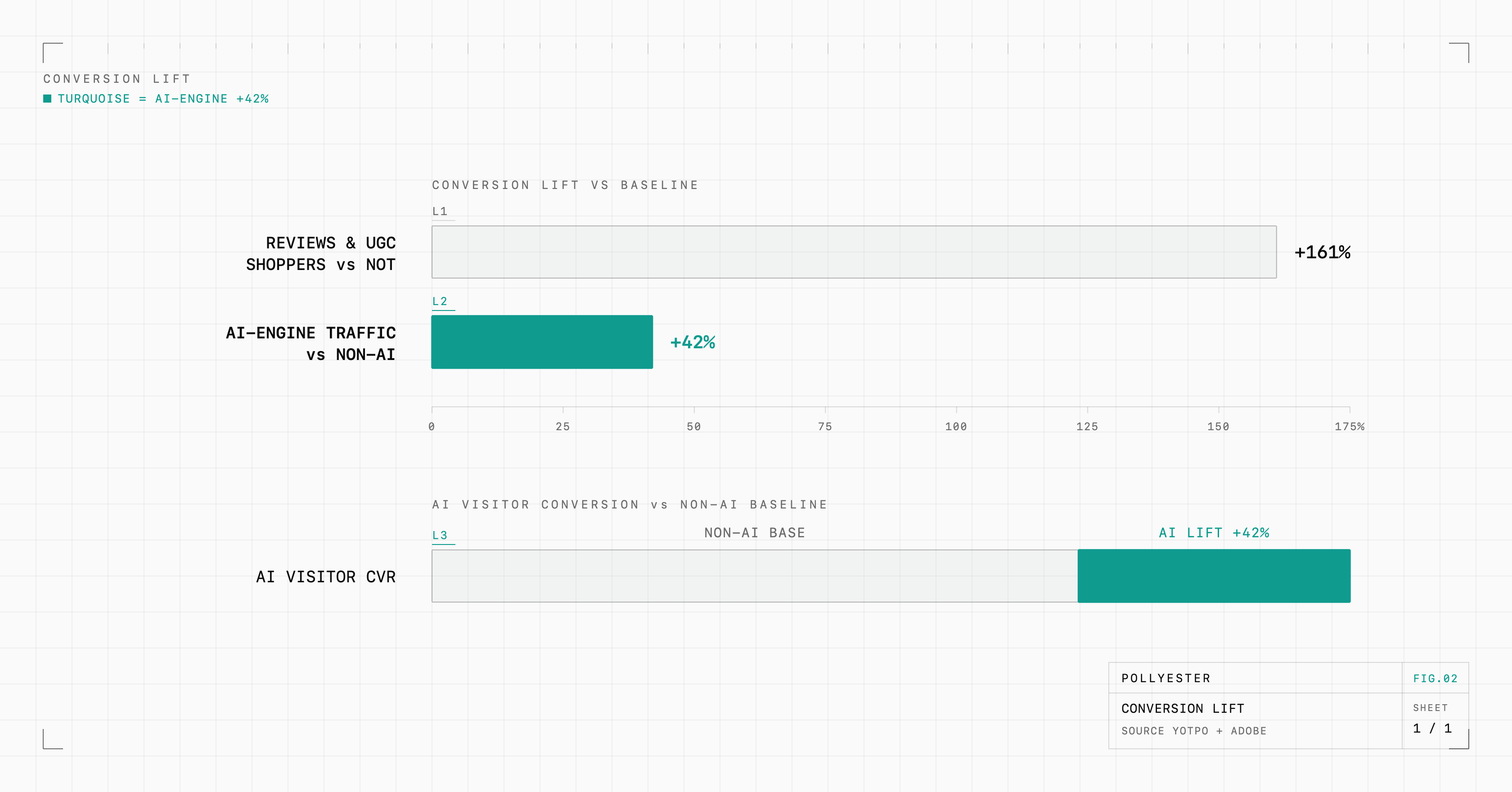
On the human side, shoppers exposed to reviews and user-generated content convert about 161% higher than shoppers who aren't (Yotpo). On a product page doing 2% conversion, that lift is money pulled from traffic you already pay for, not from a bigger ad bill. And the fit language does double duty by steering shoppers into the right size, which pulls against that $2.5M in returns.
On the machine side, this is where the recommendation gets earned. Ask an AI for "the best true-to-size chino" and it surfaces the brand where that phrase shows up often and positively in real reviews (Yotpo).


The traffic that comes back through that door is not soft. By early 2026, visitors arriving from ChatGPT and Perplexity converted 42% better than non-AI traffic, a full reversal from a year before (Adobe). That's a high-intent shopper who was handed your name inside the answer, and what put your name there was a sentence a customer wrote about fit.
The reviews sit on your product pages and in your data, earning both the human sale and the machine recommendation. Nothing's rented, and nothing resets when you pause spend.
The flow feeds two readers at once
Half of getting recommended is being legible. The other half is having something worth reading, and a flow that only counts stars gives you neither. Capture the words your customers actually use, at the moment they can feel the product, and one flow feeds the shopper on your product page and the model deciding whether to name you in the answer. That's an asset, and it compounds.