Build the agent-ready core
MCP, ACP, UCP: What an Agent-Ready Catalog Actually Needs
Four commerce protocols in about a year. Most of it is a logo on a slide. Here's the part that changes your business.

Four new commerce protocols showed up in about a year, and picking one has started to get talked about like it's a strategy. It isn't. A protocol is plumbing. The real question is older and simpler. When a machine reads your catalog, can it tell what you sell, trust your price and stock, and buy without a person in the loop. That's what all the acronyms are dancing around, and your data answers it, not the standard you sign up for.
So let's clear the table.
The acronyms, said plainly
Four names do most of the shouting: MCP, ACP, UCP, AP2. They fall into two piles.
MCP, the Model Context Protocol, is the read layer. It's how an AI reads your catalog, your inventory, and your prices in real time. Anthropic built it, the Linux Foundation now governs it, and Shopify stands one up for every store on the platform (Shopify). Think of it as the library card that lets an agent walk your shelves and see what's actually there right now.
The other three are about closing the sale. ACP, the Agentic Commerce Protocol, is OpenAI and Stripe's way of running checkout inside the assistant. UCP is Google and Shopify's version of the same idea. AP2 is the payment rail underneath, and all three US card networks are already live on it, Visa through TAP and Mastercard through Agent Pay, both AP2-compatible (Forrester). Different names, same job: let the buy button live somewhere other than your website.
That's the whole soup. One protocol for reading you, a cluster for paying you.
Your data answers it, not the standard you sign up for.
Adopting a protocol is not a strategy
Here's where the hype needs a cold shower. None of these standards care whether your product data is any good. They're the pipes. Whether anything useful flows through them depends on what you put in.
And the next buyer is increasingly an agent, so the traffic is starting to show up. AI-referred visits to US retail sites grew 805% year over year on Black Friday 2025 (Adobe Analytics). More telling than the volume is the quality flip. A year earlier those visitors converted worse than everyone else. By early 2026 they converted 42% better, stayed 48% longer, and brought in 37% more revenue per visit (Adobe). McKinsey clocks AI-generated recommendations converting around 4.4x better than traditional search (via MetaRouter). The catch is real: the base is still tiny, a sliver of total ecommerce sessions today. It's a small channel on a steep curve, worth getting ready for and not worth panicking about.
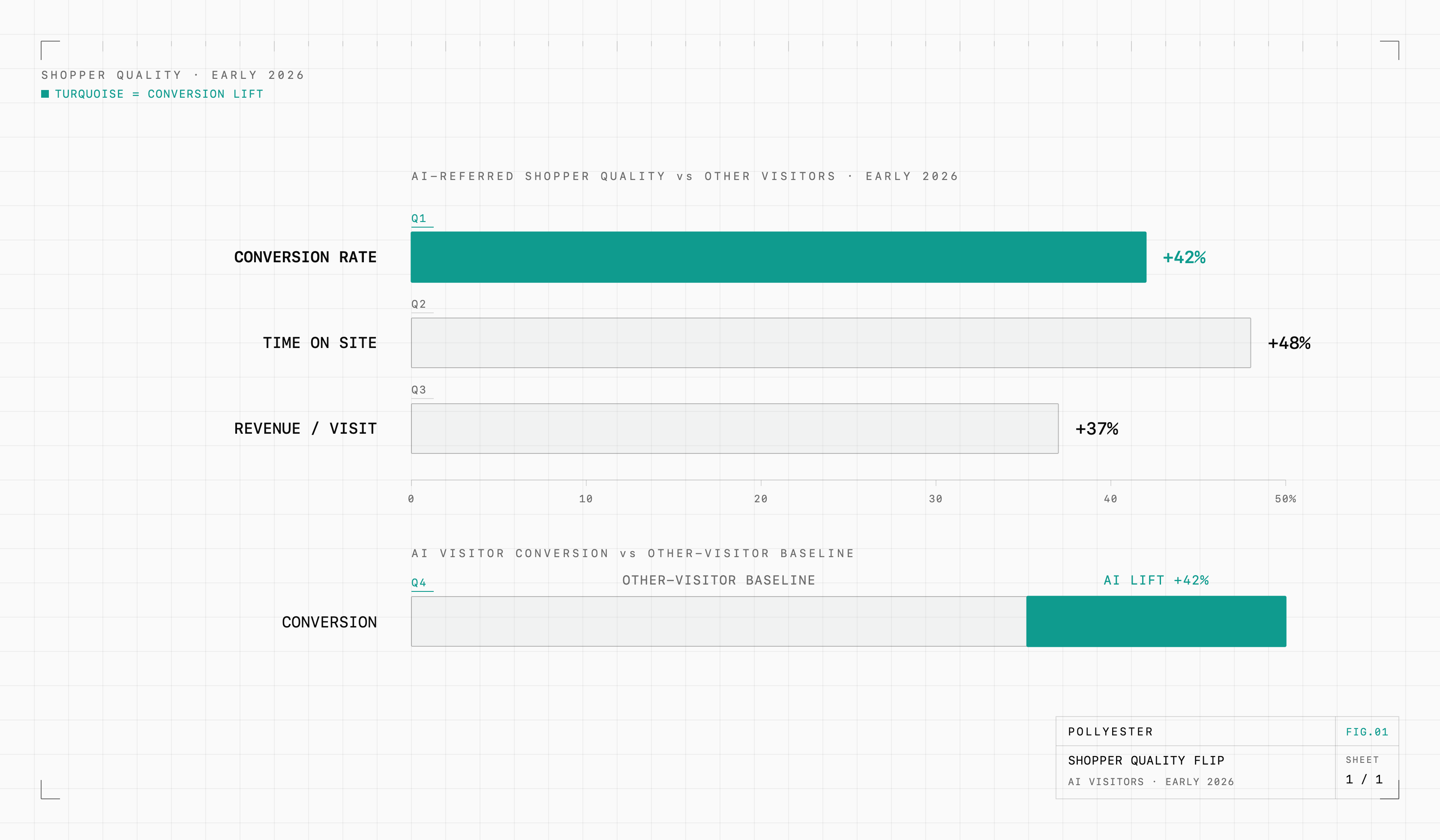
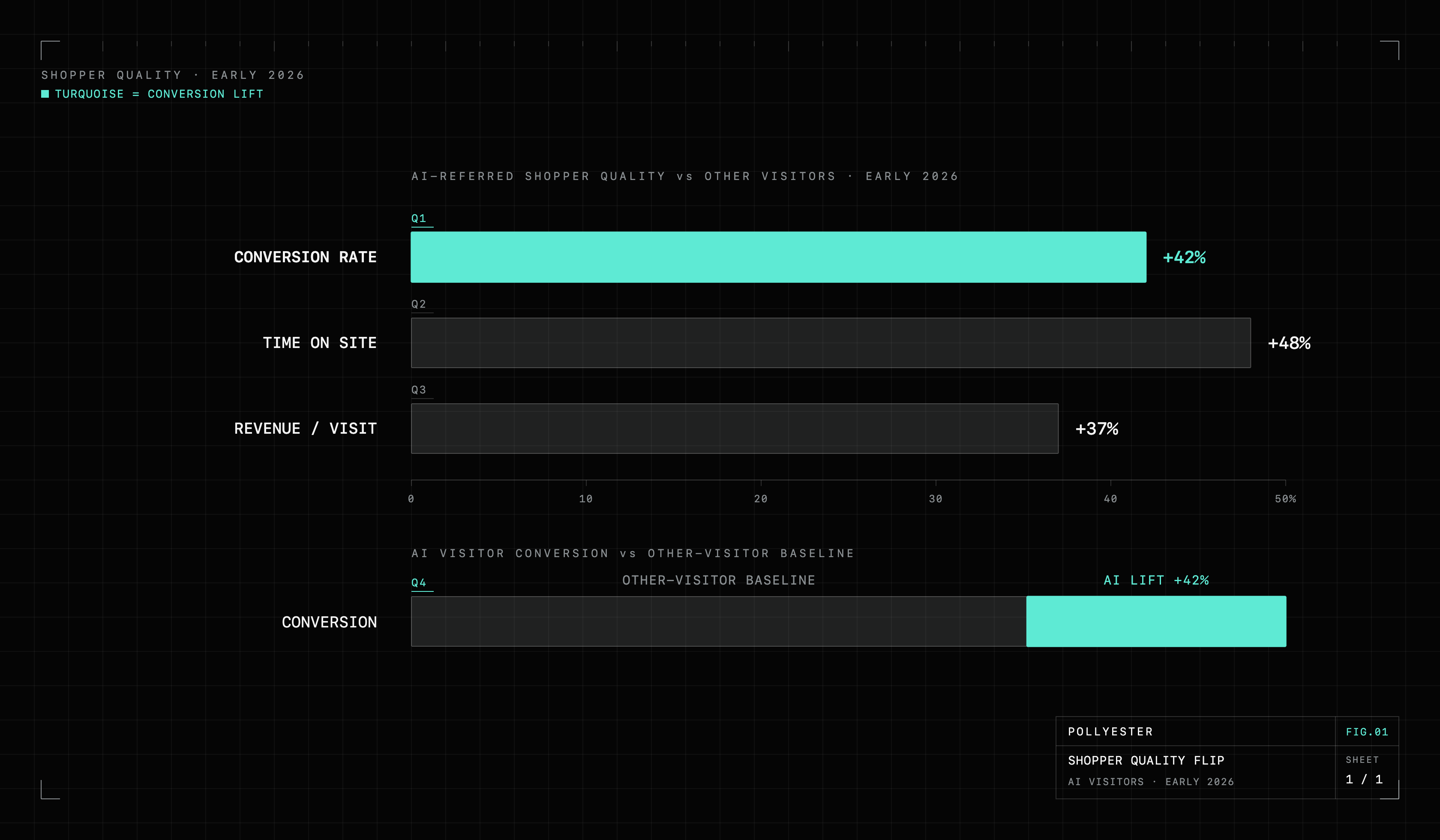
The reason the quality flipped is the part worth sitting with. When an assistant picks between two brands selling the same cold brew, it doesn't read your homepage copy. It weighs availability, price, quality signals, whether you're the primary seller, and whether checkout is wired up (OpenAI). All of that is your data, not your brand story.
What an agent-ready catalog actually needs
Three things, and they're unglamorous, which is why most brands do them badly.
Complete, structured product data. An agent won't fill in the blanks for you. It wants the facts stated plainly: a real title, description, price, availability, a GTIN (the product's barcode number), and the attributes a shopper would actually filter on. This isn't cosmetic. 42% of shoppers already abandon a purchase over missing product information, and poor data quality costs the average business around $15M a year (Mirakl, via MetaRouter). A clean catalog pays off in the channels you already run, long before an agent ever reads it.
Price and stock that are right this minute. The model rewards showing what's actually available, and it remembers the merchant who says "in stock" and then sends a cancellation. When your stock levels are accurate, that now helps decide whether an agent picks you at all.
A catalog any machine can read. Your product data needs to live in a system that can hand it to any machine that asks, and MCP is the current way to answer the door. The point is to make the record machine-legible, not just human-readable. If your product data only exists as web pages built for human eyes, an agent can't use it. Adobe found that most retail sites still aren't readable this way (Adobe), which is exactly the opening.
Now the caution flag, because it's fresh. OpenAI shipped Instant Checkout inside ChatGPT in September 2025 with names like Glossier, SKIMS, and Vuori (OpenAI). By March 2026 they were scaling it back, after only about a dozen of Shopify's millions of merchants had gone live, and pivoting toward retailer apps instead (Digital Commerce 360). The buy button moved, and then it moved again.
When the system doing the learning sits with a vendor and the learning stays with them, you end up renting your own advantage back.
Own the part that survives the next rename
That retreat is the whole lesson. Any brand that rebuilt itself around one assistant's checkout spent months building on sand.
So build the other way. Put your catalog in a system that can connect to whichever agent channel wins, and treat those channels as swappable — a composable-lite stack your team can run, not a sprawl only a contractor understands. Keep your own searchable copy of your product data in a system you control, so you never need a vendor's permission to make your catalog findable. And keep a thin layer between your store and any agent network, so moving from one to the next is a settings change instead of a rebuild.
This is the same discipline that keeps you out of a vendor's cage everywhere else. When the system doing the learning sits with a vendor and the learning stays with them, you end up renting your own advantage back. MIT's 2025 study found 95% of company AI pilots delivered no measurable impact on the P&L, and the gap was almost always workflow and integration, not the model itself (MIT, via Fortune). Owning your data is how you land in the other 5%.
The math is boring and it favors you. Agent-referred shoppers convert 42% better and spend 37% more per visit. On a thousand of those sessions that's real money, and you only collect it if the agent can read your catalog cleanly. Getting there means a complete catalog with honest stock that any machine can read — the work to build the agent-ready core. It's the cheapest project with the biggest payoff on your list this year.
The one thing that stays valuable
The protocols will keep changing names. There will be another one, and another after that, each with a new group behind it and a fresh deck. The one thing that holds its value across all of them is a clean catalog you own that machines can read, because every one of these standards, the ones here now and the ones coming, is just a different door into the same product data.
Get the data right and it's ready for whichever agent shows up, through whichever protocol wins. That's the build.