Get Chosen
Getting Chosen When You Can Legally Ship to Nine States
The AI that wins in spirits isn't a sommelier bot. It's compliance the agent can't skip. A teardown of where an over-eager checkout turns into an illegal sale.

Wine ships direct to consumers in 48 states. Spirits ship to nine (Sovos). Almost every pitch you're getting for an AI that shops and checks out for your customer is built on the first number, and none of them mention the second. That gap is where a clean demo turns into a sale you have to cancel, and in this category a cancelled order is the good outcome.
You already know that map. The people selling you a shopping agent haven't looked at it.
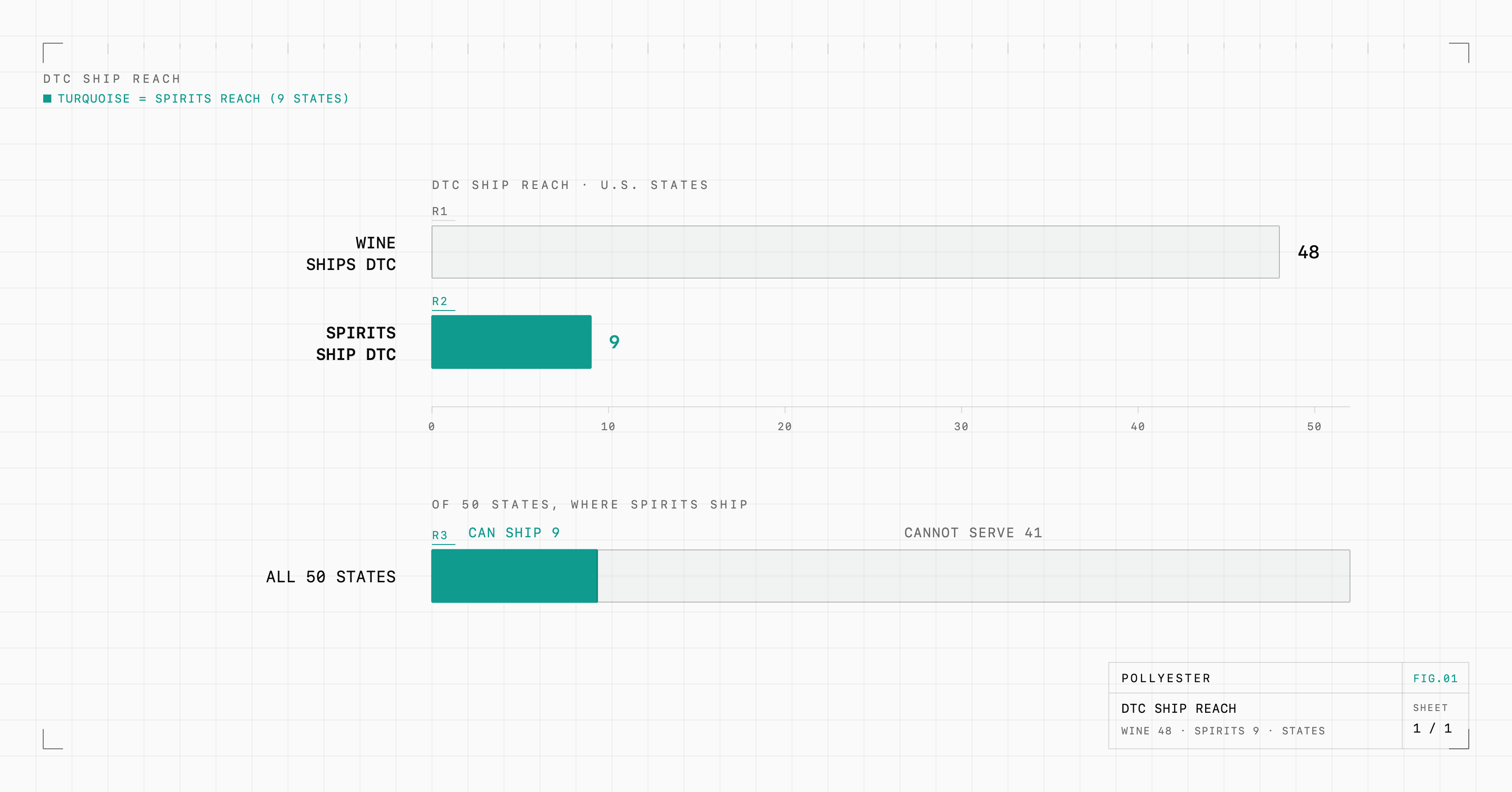
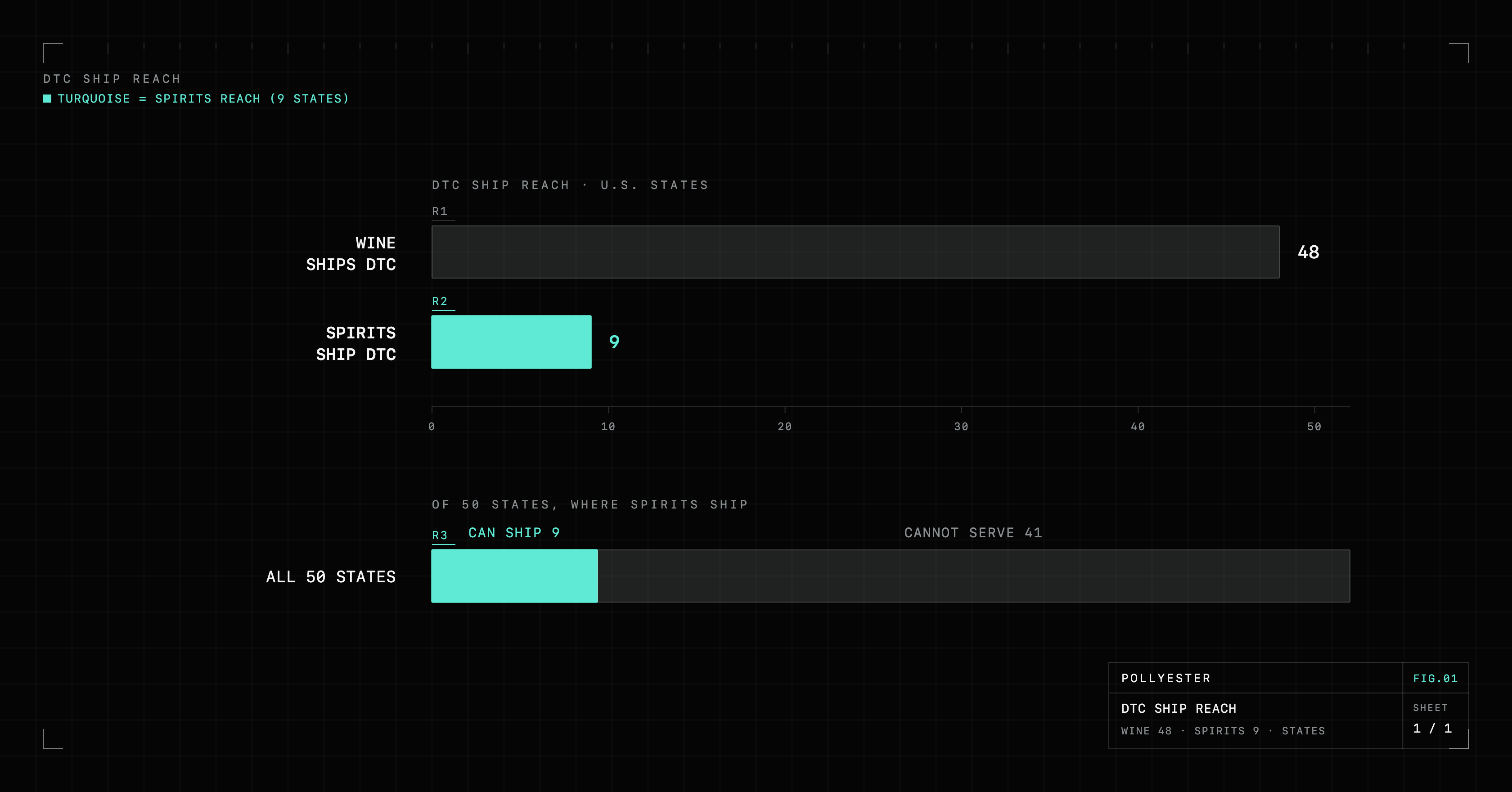
The pitch you're getting was written for someone else
Here's what's true about AI shopping, and it's worth preparing for. Traffic from AI answer engines is climbing fast, up 805% year over year on Black Friday 2025, and those shoppers buy at a higher rate once they land on your site (Adobe, via MetaRouter). Ask a model for "a good rye under $60" and it won't hand back a page of links. It names two or three bottles, and more and more it offers to check out right there.
None of that changes your real problem. US alcohol e-commerce ran about $74B in 2025 (Sovos), and spirits DTC volume declined that year (Sovos). The growth story you're being sold is real for beauty or pet or apparel, where the ceiling is how much demand you can create. In spirits your ceiling is the law. An AI that surfaces your bottle to a shopper in a state you can't ship to hasn't done you a favor. It promised a customer something you can't legally send, and it handed you a problem.
A generic shopping agent is built to win the shortlist. In spirits that isn't enough, because the order still has to be one you're allowed to fulfill.
In spirits your ceiling is the law.
The move that pays is the one the machine can't skip
So reframe this before you spend a dollar. In spirits the AI worth paying for isn't the part that chats with the customer. It's the part that sits between the customer and checkout and stops an illegal order before it goes through.
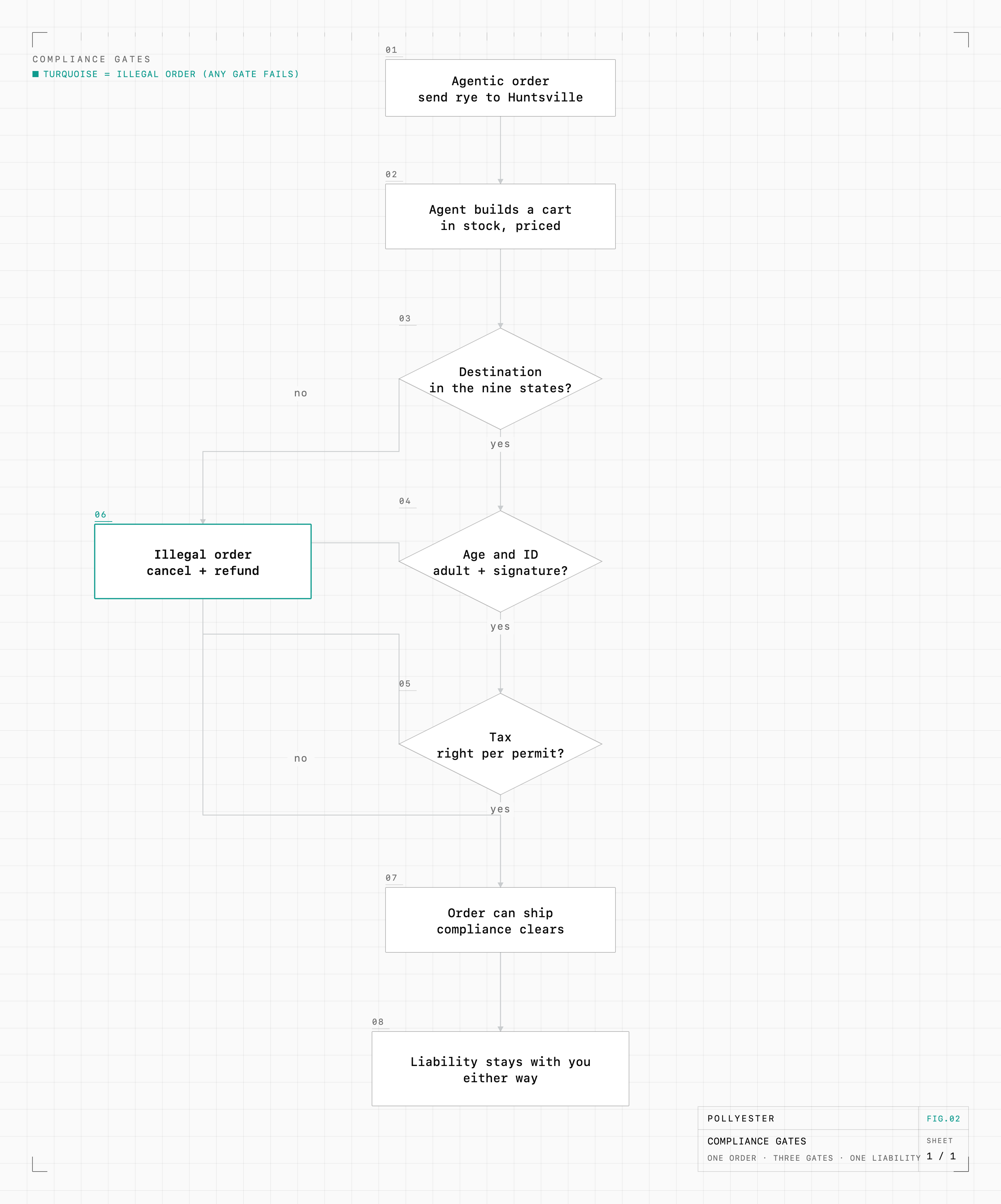
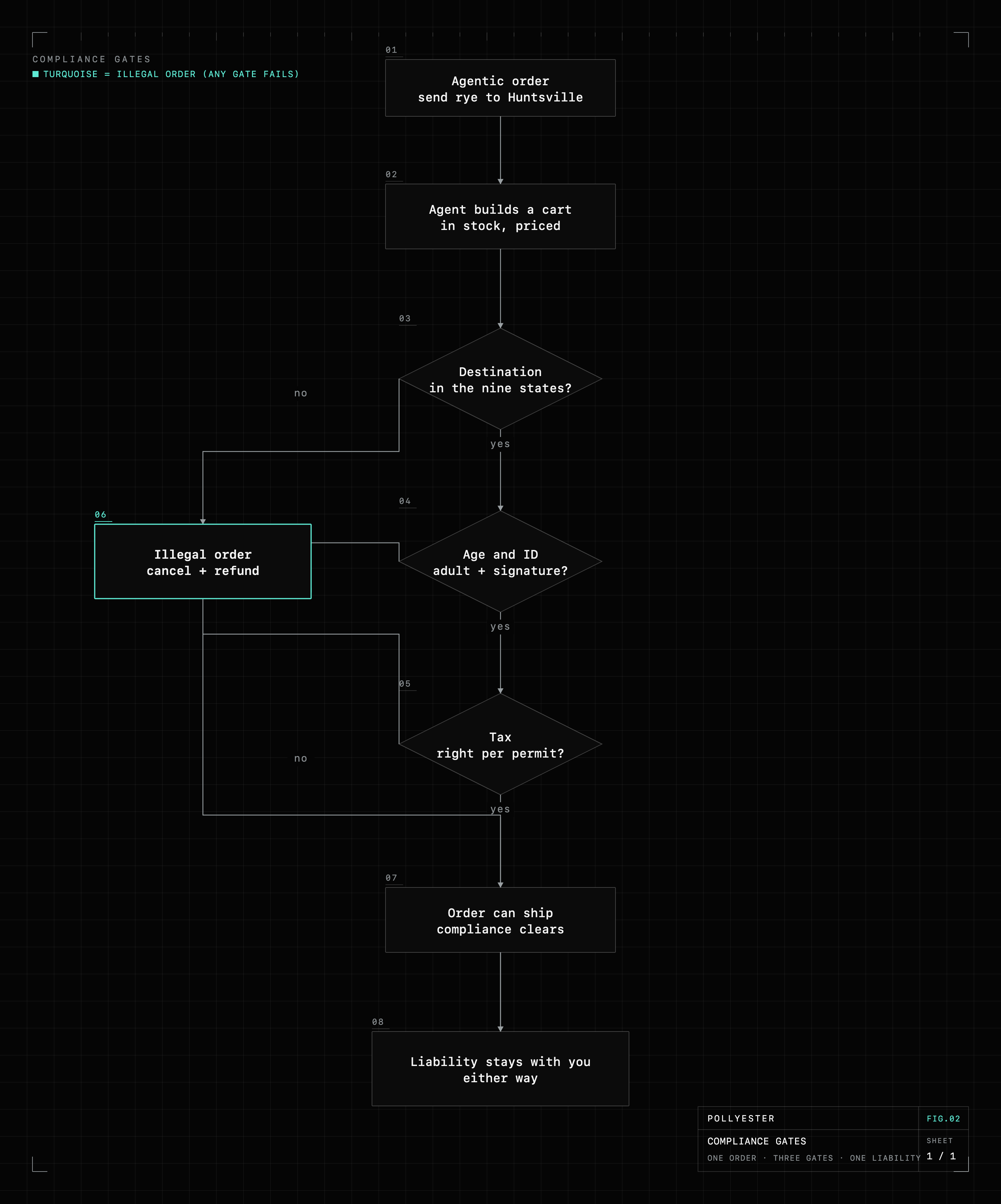
That means the software has to get three things right on every order, before any recommendation matters. It has to confirm the buyer is of legal age and get an adult signature at delivery, check that the shipping address is in a state you actually hold a permit for, and charge the right excise and sales tax for that state, since your permit decides what you can even collect. Get those wrong and the sommelier chat sitting on top is just decoration on a liability.
This is the unglamorous work, which is why most of the category will skip it and buy the chatbot instead.
Get those wrong and the sommelier chat sitting on top is just decoration on a liability.
The teardown: one order, four places it breaks
Walk a real order through an AI checkout that's eager to close, and watch where it breaks.
A shopper tells an assistant: "Send my brother a bottle of rye for his birthday, he's in Huntsville." The agent does the easy part well. It reads your product data, sees the rye is in stock, sees the price, and puts it in a cart. This is what these models are good at, and it's the part every demo shows you.
Break one: the destination. Huntsville is in Alabama, and Alabama is not one of the nine states spirits ship to DTC. A generic agent treats a spirits address the way it treats a t-shirt address, as a shipping-cost lookup, and it will quote delivery to a place you legally cannot serve. If your product data doesn't carry the legal-ship map as a rule the system has to follow, nothing catches this. The order gets built, you catch it later by hand, and you eat the cancellation.
Break two: age and ID. Alcohol needs the buyer verified as an adult and an adult signature at the door. AI checkout has a real weakness here. Fraud tools lean on how a real person moves through a page, the small behavioral signals, and an AI agent strips those out by design, which is part of why fraud in these checkouts is still unsolved (CNBC). The moment an agent breezes through a purchase is the moment you most need proof of a real adult buyer, and it's the moment that proof is hardest to get.
Break three: tax by jurisdiction. Spirits carry excise and sales tax that change by state and sometimes by locality, and the permit you hold for a given state governs what you owe and collect there. An agent that treats the sale as ordinary retail has mispriced the order or under-collected tax on a controlled product. That's not a rounding error, it's a tax filing problem.
Break four: who's on the hook. Right now the merchant still owns the order, the payment, and fulfillment. The buy button moved into the assistant, but the license and the liability stayed with you (OpenAI). So every one of those breaks lands on your account, not the assistant's.
Add it up. A generic agent that treats a spirits catalog like any other catalog will quote shipping to the 41 states you can't legally serve. The conversion lift the vendor promised means nothing on an order that can't ship, and it costs you more than a lost sale, because now there's a charge to reverse and a controlled shipment you have to stop before it moves.
Why this is settled law, not a nice-to-have
None of this is a temporary quirk that better models will smooth over. The structure is deliberate and old. After Prohibition the country built the three-tier system, where producers sell to distributors, distributors sell to retailers, and retailers sell to you. Direct shipping is a narrow exception layered on top, granted state by state, permit by permit. The 2005 Supreme Court decision in Granholm opened the door for wine and set off twenty years of case law that spirits largely sat out (Sovos). That's why the map reads 48 for wine and nine for spirits. It wasn't an oversight, it was fought over for two decades.
A model can't reason its way past a state law. It follows the rules you've built into your data, and where you haven't built one, it guesses. That's the whole point. In this category the compliance work is the product, and the recommendation is what you're allowed to do once the compliance clears.
There's a second reason to own this rather than rent it. The place these agents live isn't stable. OpenAI wound down its native in-chat checkout in early 2026 after only a few dozen merchants went live, and pivoted toward retailer-run apps instead (Digital Commerce 360). If you'd wired your compliance rules into one vendor's buy button, you'd be paying to rebuild them now. Build the legal-ship map, the age check, and the tax rules into your own product data and order system, and they travel with you across ChatGPT, Perplexity, whatever ships next, and your own site. None of it depends on a vendor who might shut the whole thing down next quarter.
The last problem, not the first
Sell the demo and you sell yourself a lawsuit. The sommelier bot that suggests a smoky Islay for the ribeye is the fun part, and it's the last problem to solve here, not the first. It earns its place only after the software can prove, on every order, that the buyer is of age, the address is legal, and the tax is right.
Discernment in this category is knowing that order: compliance first, recommendation second. Do it the other way and a good recommendation just helps you break the law faster, one order at a time.