Grow the Customer
The Model Is a Commodity. The Judgment Isn't.
Predictive churn is a toggle now. What separates you is what you do the moment it fires.

Predictive churn used to be a data-science project. You'd hire someone, they'd pull a year of orders, build a model, and six months later you had a score nobody trusted. Now it's a checkbox. Klaviyo sits on order data from more than 180,000 brands and ships a per-customer churn prediction straight off your Shopify connection, retrained every week (Klaviyo Help Center). The brand down the street has the same checkbox. So does the one that launched last quarter.
So the model stopped being the advantage the second everyone got it.
In pet, retention is the whole game
You already feel this if you sell pet food. The money isn't in the first order, it's in the reorder that shows up every month without a media buy behind it. Chewy did $11.9B in revenue with Autoship running at 83.3% of sales and $591 in net sales per active customer (Chewy 8-K). That's the shape of the category. Pet food subscription churn runs 6 to 10% a month, and replenishment models hold on far better than curation boxes (Eightx). The customers are there to be kept, and the next generation buys this way by default. 69% of Gen Z pet owners buy direct, against 18% of boomers (Packaged Facts).
Now put those two facts together. Retention is where the business lives, and the tool that predicts it is available to anyone with a Shopify store. A churn score can't separate you from a competitor who's looking at the same score. The prediction is table stakes now.
Two people can carry the same risk score and need opposite moves.
The value moved to the two ends the tool doesn't touch
A churn model gives you one thing, a number for each customer. It won't tell you whether that number is any good, and it won't tell you what to do about it. Those are the two questions that decide the outcome, and neither one comes in the box.
The number is only as good as the data behind it. Most growth-stage brands keep their order and customer history scattered across a store, a subscription app, a helpdesk, and a spreadsheet somebody updates by hand. Feed a model that mess and it will flag the wrong people with total confidence. Gartner expects 30% of AI projects to get shelved after the pilot, mostly because the data underneath wasn't ready (Gartner, via Tech Startups).
Then someone has to make the call. Which customers are worth a move, what you say to them, who you leave alone. That's the whole job, and it's the part no vendor can sell you, because it runs on your margins and your catalog, not their software.
What judgment actually looks like
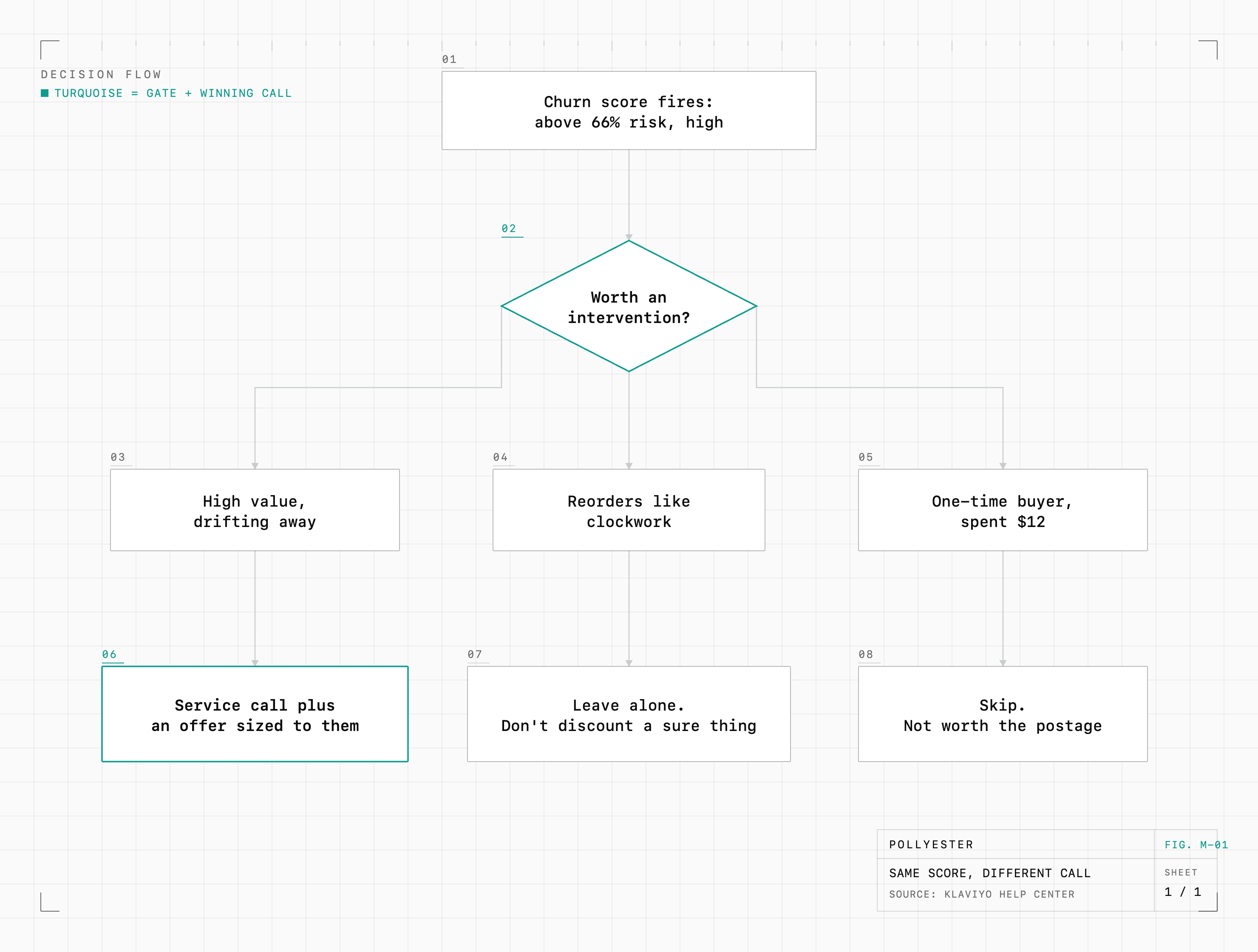
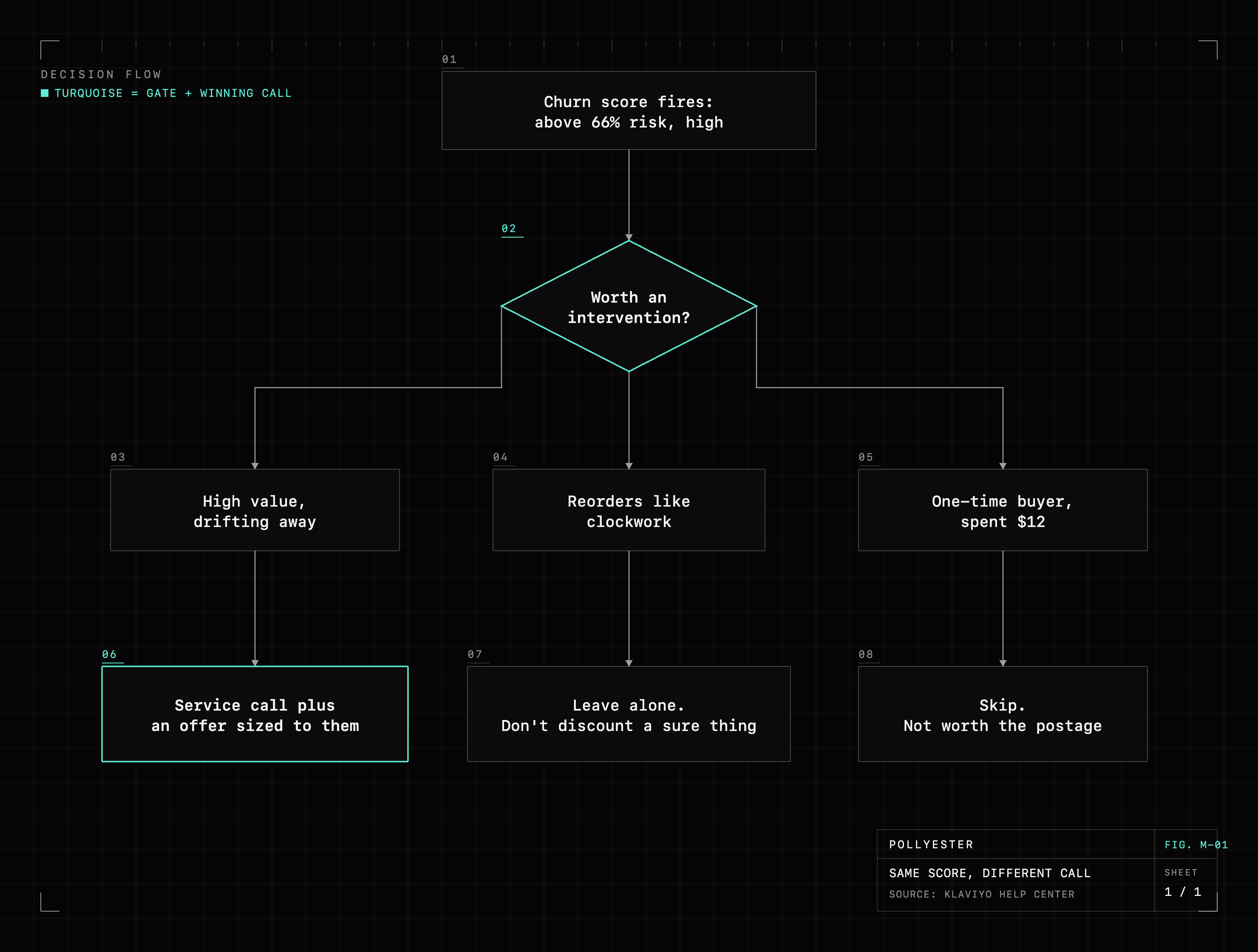
Here's the trap the toggle walks you into. Klaviyo flags anyone above a 66% chance of not buying in the next 90 days as high risk (Klaviyo Help Center). The obvious move is to fire a 20%-off win-back at every name in that band. Trouble is, a lot of them were going to reorder anyway, so you've paid to discount a sure thing, at scale.
The better question is who's actually worth the offer. That's the customer whose behavior changes because you reached out, and who's worth enough over their life to cover the margin you give up. Two people can carry the same risk score and need opposite moves. A high-value customer drifting away is worth a service call and an offer sized to them. Someone who reorders like clockwork should be left alone. A one-time buyer who spent twelve dollars may not be worth the postage. Same score, different call, and that's where the return is.
This is where the prediction earns its keep instead of decorating a dashboard. Automated flows already drive about 41% of email revenue off roughly 5% of sends, at around 18 times the revenue per recipient of a campaign blast (Klaviyo). The automation was always the workhorse. A good score points it at the people where it pays.
Part of the judgment is knowing what to leave off. Not every retention feature a vendor demos is worth turning on. The message that writes itself for each customer sounds impressive until you notice it's going to people who'd have come back on their own. Copy without a real signal under it is faster spam.
Most of the money chasing it disappears, because the data underneath was a mess and the AI was decoration.
The real numbers are boring, and that's the tell
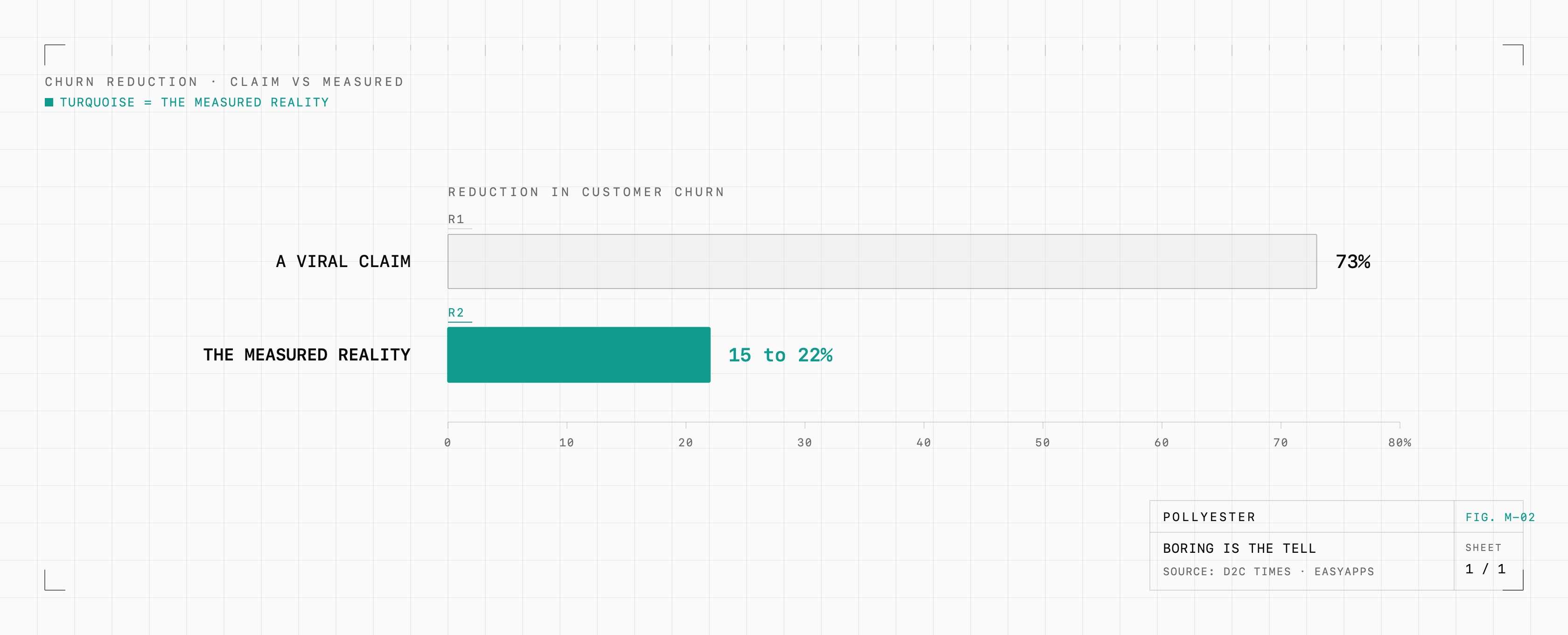
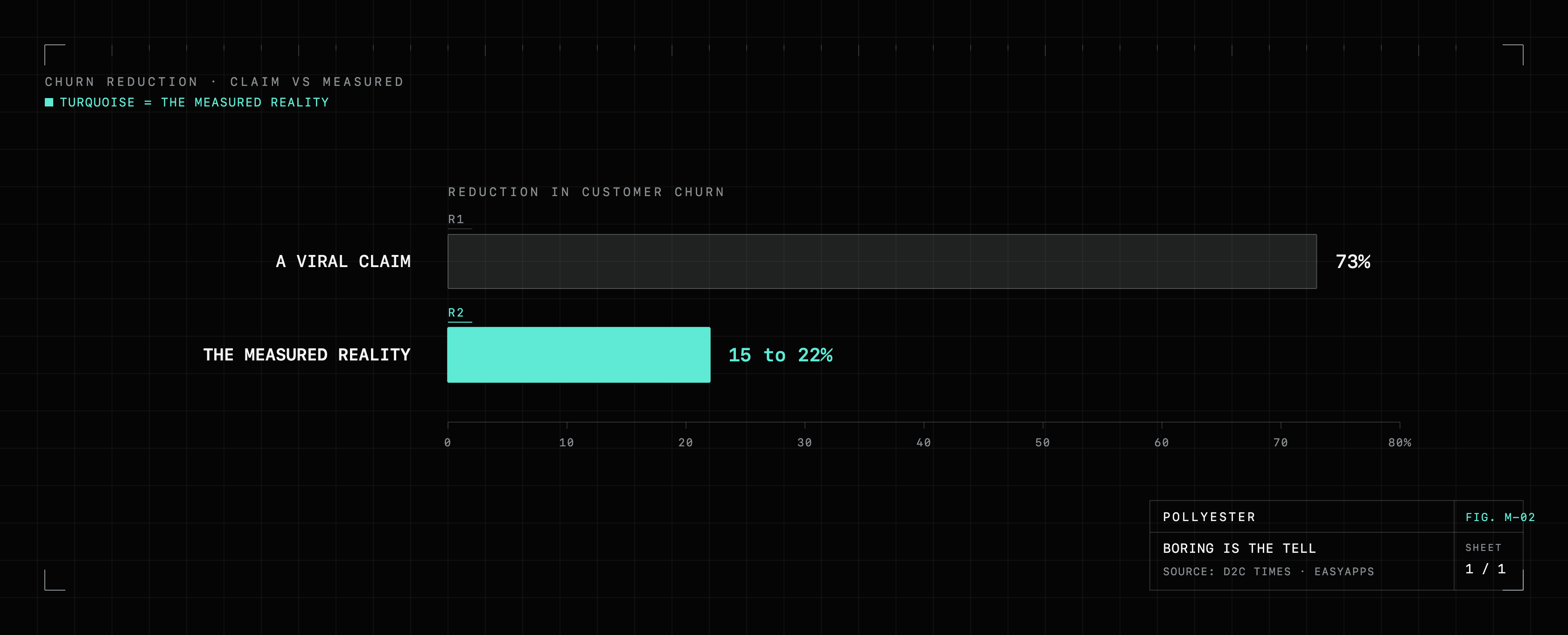
Search "predictive churn DTC" and you hit a wall of confident claims: 487% retention growth, a brand that cut churn 73% in six months, 91% prediction accuracy from tracking customers' social media activity and life events (D2C Times). Look closer and the named brands aren't findable, the percentages have no denominator, and no churn model hits 91% on a real growth-stage catalog. "487%" isn't a number anyone who's run a P&L would recognize.
The real numbers are duller. Acting on churn risk scores tends to cut churn 15 to 22% (easyAppsecom). Personalization done well adds 10 to 15% in revenue (McKinsey). Boring is the tell that it's real.
And dull is plenty. Say your pet food subscription loses 8% of subscribers a month. That works out to an average subscriber life around 12 months. Cut that churn by 18% and you're at about 6.6% a month, which pushes the average life past 15 months. Same customers, same acquisition cost you already paid, roughly 20% more revenue out of them before they go. You didn't buy a single new customer to get it.
Set that against the wider record. MIT's State of AI in Business 2025 found that 95% of enterprise AI pilots delivered no measurable impact on the P&L, and that more than half the budgets went to sales and marketing while the returns that did show up came from quieter back-office work (MIT, via Fortune). The retention win is real. Most of the money chasing it disappears, because the data underneath was a mess and the AI was decoration.
The part that doesn't come in the box
Acquiring a customer now runs $68 to $84 and climbing, up around 60% over five years as privacy changes and crowded ad auctions took their toll (Retainful; Phoenix Strategy Group). When the front door costs that much, the customers you already have are the asset. The old Bain line still holds: a 5% lift in retention moves profit somewhere between 25 and 95% (HBR, via LoyaltyPass).
That's why the model going free is good news, not a threat. The prediction was never the hard part. The hard part is clean data going in and a real decision coming out, and both of those are judgment, not software.
Growth stopped being about buying more customers. It's about keeping the ones you already paid for. AI makes that possible. It doesn't make it automatic.