Grow the Customer
A Churn Score Is Worthless Until It Fires Something
A churn score sitting in a dashboard changes nothing. Wire it to a win-back sized to the customer about to leave and it starts paying for itself. Here's how.

A churn score you only look at is a cost. Klaviyo computes it for you, retrains it every week off your Shopify orders, and paints your customer list green to red. Left in a dashboard, it's a number you pay for that changes nothing. It starts earning the moment a customer crosses into the high-risk band and that kicks off a win-back built to bring them back.
Most pet brands stop at the dashboard. The high-risk band lights up, someone nods at it in the Monday meeting, and nobody built the thing that's supposed to happen next. So nothing happens. The customer who was about to lapse lapses on schedule, and the score was right, which somehow feels like the model did its job.
The value was never in the score
The model is a commodity now. Klaviyo sits on order data from a vast base of Shopify stores, so its predictions on churn risk, next-order date, and predicted lifetime value come free off a Shopify connection. That used to be a data-science project. Now it's a toggle everyone has.
What isn't a commodity is the wiring and the judgment that separates you. Somebody has to build the flow that fires when risk spikes, size the offer to the customer, and decide who to fire it at and who to leave alone. No toggle does that part for you.
What isn't a commodity is the wiring and the judgment.
Map the bands to different moves, not one blanket flow
Start with the risk score Klaviyo actually gives you. High risk is a customer the model flags as unlikely to order again inside the window you care about. Pick the probability cutoff that defines your high-risk band, and that's a real threshold you can build a trigger on.
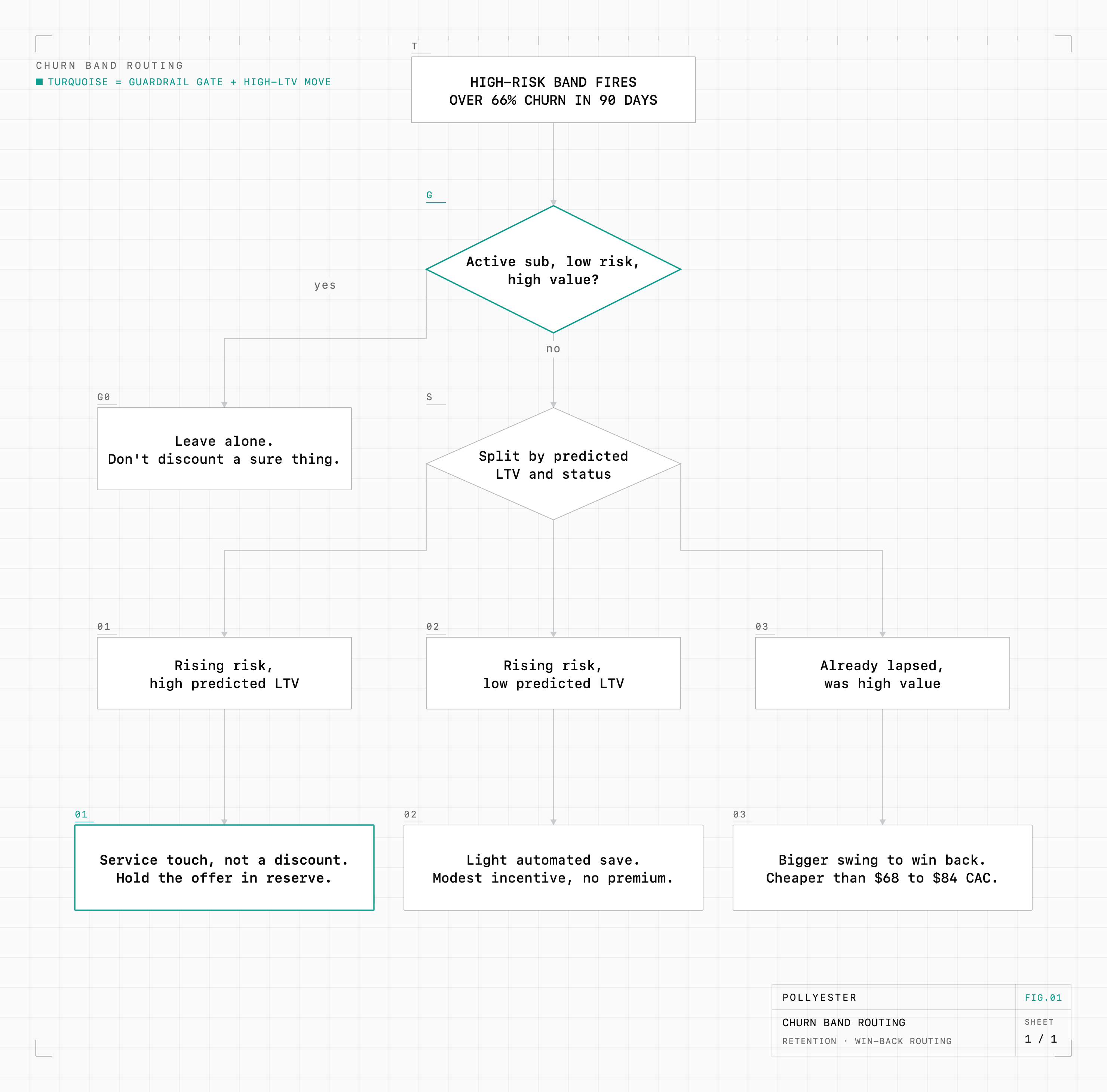
The mistake is wiring one win-back to the whole band and calling it done, usually a blanket 20% off. That code goes to everyone in the band regardless of who they are, so you hand margin to customers who'd have come back on their own, and undersell the ones worth ten times the coupon. Split the band by what you already know:
- Rising risk, high predicted LTV. This is the customer worth protecting. Don't lead with a discount. Lead with a service touch, a real one from a person, or a replenishment nudge timed to when they actually run out. Hold the offer in reserve.
- Rising risk, low predicted LTV. Fine to automate a lighter, cheaper save here. A modest incentive, no human time, no premium. If they go, they go.
- Already lapsed, was high value. This is the one worth a bigger swing, because winning them back is cheaper than acquiring a stranger to replace them.
Same score, three responses, each sized to what the customer is worth. That sizing is what makes the flow pay for itself instead of quietly costing you.
Size the offer to predicted LTV, not to the risk
Klaviyo hands you predicted lifetime value next to the churn score. Use it as the ceiling on what you're willing to spend to save someone.
The logic is plain. A customer with $600 of predicted value ahead of them is worth a real intervention, up to a person's time and a phone call if it comes to that. One with $60 ahead of them is worth an automated email and no more. Put both on the same 20% code and you overspend on the cheap customers while shortchanging the expensive ones. Predicted LTV keeps the offer honest.
Wire replenishment timing to the next-order date
In pet, a lot of churn isn't a decision. It's a stockout. The customer meant to reorder, the bag ran low on a Thursday, they grabbed something off a shelf to bridge the gap, and now your reorder email lands a week after they already solved the problem.
The next-order-date prediction fixes the timing. Instead of a fixed 30-day reminder that's right for nobody, you fire the replenishment nudge a few days ahead of when that specific customer runs out. For a consumable this is most of the battle, because the customer wasn't unhappy. You were just late.
In pet, a lot of churn isn't a decision. It's a stockout.
The guardrail: leave the sure things alone
Here's the discipline part. Not everyone in the high-risk band deserves an intervention, and some of your best customers deserve to be left alone.
The customer on active autoship, reordering like clockwork, high predicted value and low churn risk, does not need a win-back. Send one anyway and you annoy them at best. At worst you teach a loyal buyer that pausing makes a discount appear, so now your steadiest revenue waits for a coupon. You paid to discount a sure thing and made it less sure.
So build the exclusion in before anything else. Active subscription, low risk, high value: do not touch. The restraint is where the money is.
The proof is boring, which is how you know it's real
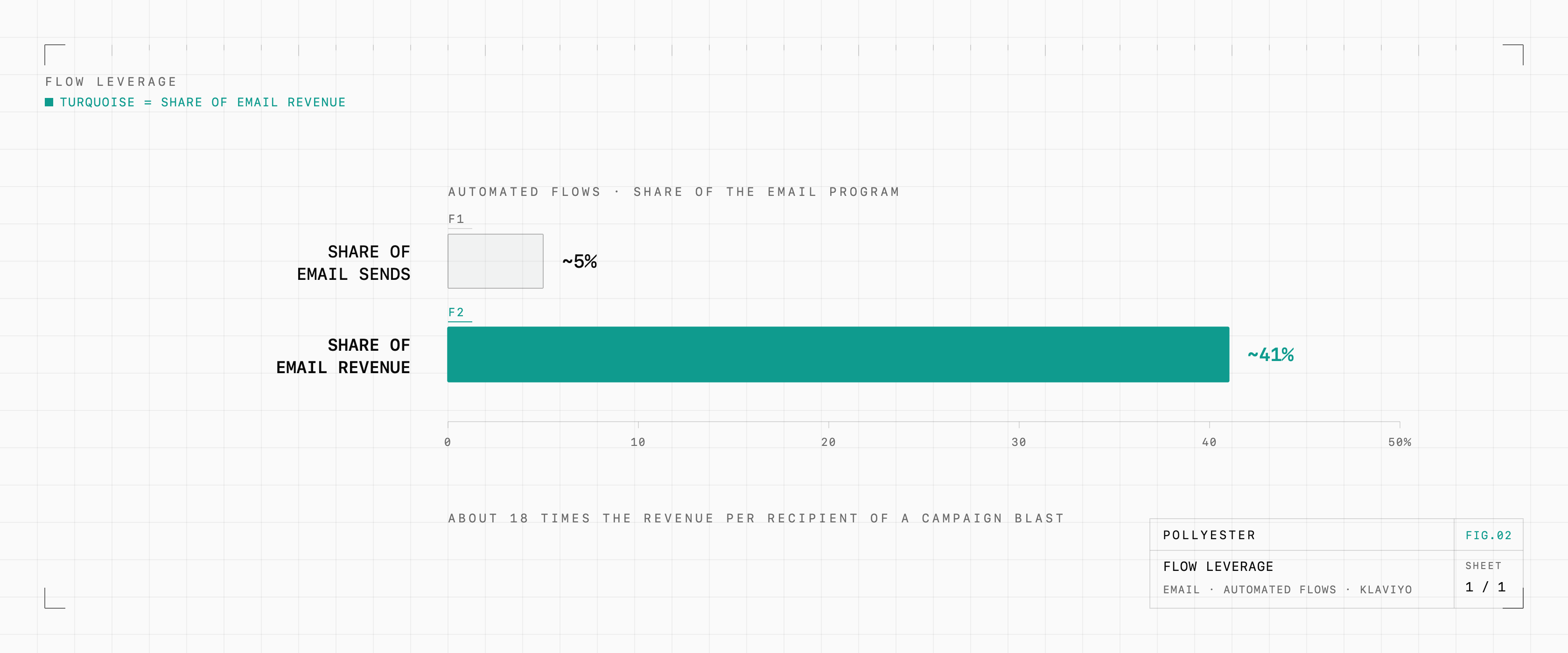
Automated flows already carry retention. They're a small slice of your total sends and a disproportionate share of email revenue, earning far more per recipient than a campaign blast. The machinery to save customers is already there. Prediction aims it at the right people at the right moment.
The lift from doing this well is modest and unglamorous: a meaningful dent in churn and a meaningful lift in revenue, the kind of gains you get from aiming existing machinery a little better rather than from magic. Those are the honest numbers. When a case study promises 487% retention growth or 91% prediction accuracy off a customer's "social media activity and life events," with no brand you can name and no denominator, you're looking at the demo, not the business. A churn model does not hit 91% on a growth-stage pet catalog. The real wins are unglamorous, and that's the tell that someone shipped it.
Put the boring numbers against pet's actual math. Replenishment models hold on far better than curation boxes, but subscription churn is still real. Say you've got 10,000 active subscribers and churn runs around 8% a month — pick your own rate, the shape holds. That's 800 customers walking out the door every month. Cut that by roughly 18% by acting on the risk scores and you keep about 144 of them. Chewy does $591 in net sales per active customer a year, so a retained pet subscriber is real money, not a rounding error. Those 144 a month compound into a far bigger base by year end, on traffic you already paid for.
Point it where the intervention changes the outcome
Prediction doesn't replace the retention program you already have. It aims it. The score, the next-order date, the predicted LTV, none of them move anything until they're wired to a flow, a fulfillment trigger, and an offer that fits the customer in front of you.
So point the model at the customers where an intervention changes what happens next, and leave everyone else alone. The score was never the hard part. Knowing who to spend on is.