Get Found
Stop Doing GEO. Fix the Data Underneath It.
Every AI channel comes down to one question: can a machine read your product, trust it, and act on it. Spend on that, not the scoreboard.

You're getting pitched GEO three times a week. Generative Engine Optimization, sold as a new discipline with its own retainer and a dashboard that scores how often ChatGPT names you. Most of it is your product data with a new logo on the invoice.
That's not a knock on the goal. Getting found is moving from a page of blue links to an answer the machine writes for the shopper, and being named inside that answer is the new version of ranking, and your share of that answer is a number you can put on the P&L. The goal is real. What should slow you down is the packaging.
The tell
Google's John Mueller said the quiet part out loud. "The higher the urgency, and the stronger the push of new acronyms, the more likely they're just making spam and scamming" (TheAdSpend). Read the pitches in your inbox against that line. They lead with a new acronym and a countdown, warn you that you're already behind, and show no evidence the vendor has ever moved a single citation.
The market even has a name for what most of this produces now. AI slop, 2026's buzzword, the state where every company publishes the same advice in the same breathless tone and nobody stands out (SEO.com). The GEO retainer is often that, sold back to you as a service.
So the useful question isn't "is GEO worth it." It's "what is GEO actually made of, once you strip the acronym off."
Most of it is your product data with a new logo on the invoice.
What's under the acronym
Every honest case study lands on the same short list. Structured product data the machine can read. A price and a stock count that are true right now. And being worth citing. Practitioners who've done the work keep saying it plainly: this is mostly technical hygiene and real authority, the SEO fundamentals re-weighted for a reader that happens to be a model (Digiday).
The fundamentals didn't get replaced, they got re-weighted, because the reader changed. A shopper will overlook a messy product page and buy anyway, but a model reading your catalog wants certainty, not a guess. It reads the machine-readable version of your page, the title, the price, whether the item is in stock. Where your data is thin, you get skipped.
That's the whole game, and it's unglamorous, which is exactly why it gets dressed up in new language.
What actually moves a citation
Three things do most of the work.
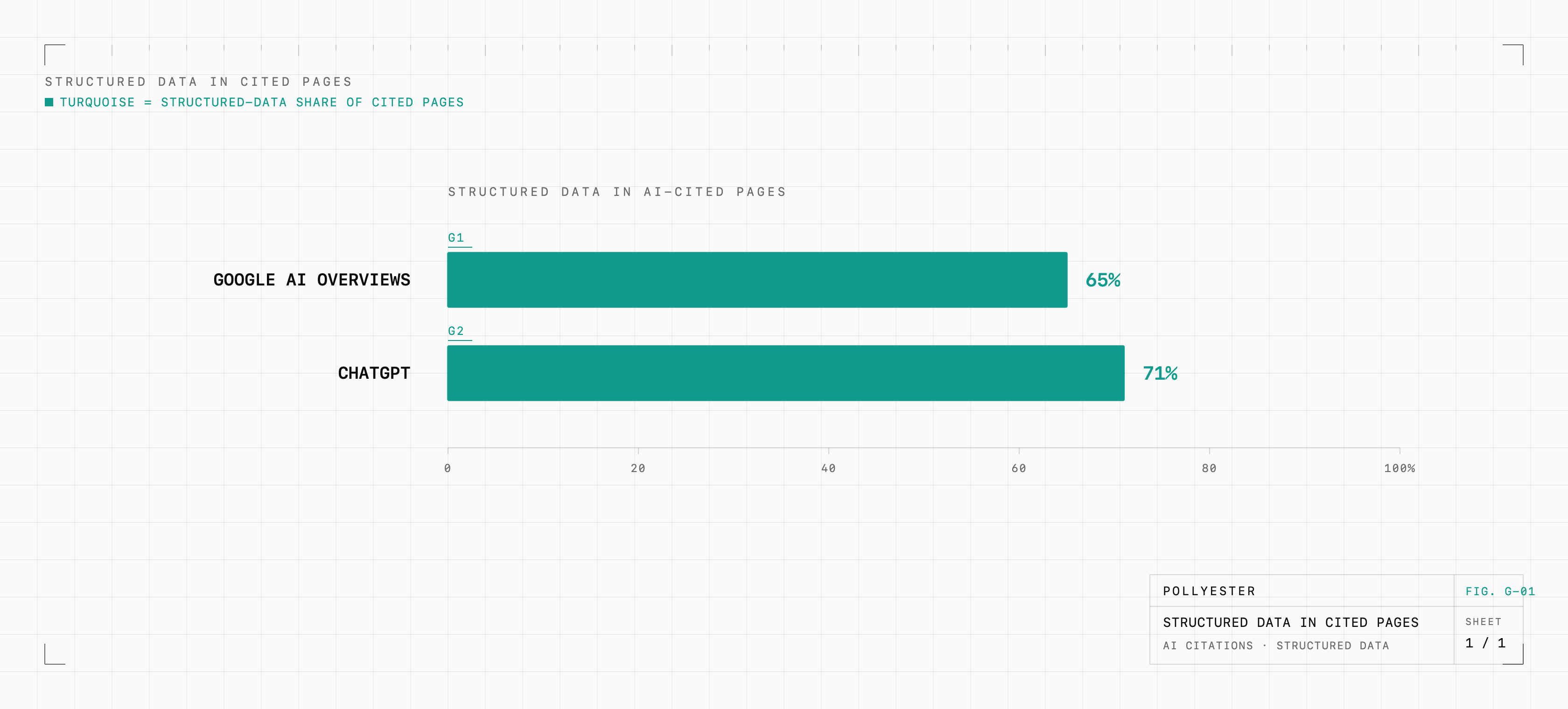
Structured product data. This is the machine-readable version of your product page, the part a person never sees. Of the pages Google's AI names, 65% carry it, and 71% of the pages ChatGPT cites do (Alhena). One analysis found it lifts how discoverable a page is to these models by around 67% (digidop). The catch is that a generic version gives no lift. The engine wants it rich and consistent: the product ID, real attributes, the price, the availability, the return policy, all matching what's on the page.
A price and stock count that are true. This is the part vendors don't mention, because there's no dashboard to sell for it. When a model sees a price or an in-stock claim that turns out to be wrong, it flags the source as unreliable and drops it (productlasso). One stale feed and you're out of the answer entirely. And 42% of shoppers already abandon a purchase over missing product information, while poor data quality costs the average business around $15M a year (Mirakl, via MetaRouter). The same broken record is costing you sales you can already see.
Being worth citing. No brand in the case studies got named on its own copy alone. It took reviews, roundups, and the places real people talk. Most of what a model names comes from a small set of sources, and Yext looked at 6.8 million citations and found 86% come from places you control directly, your own site at 44% and your business listings at 42% (via eseospace). You don't need a big budget to be citable, you need your own house in order first. One more thing matters: pages refreshed inside about 60 days are roughly 1.9x more likely to get named (Shopify).
Notice what's missing from that list. A file called llms.txt that vendors sell as the secret key to ChatGPT. Google's own 2026 guidance says you don't need it to show up in its AI features (Google Search Central). It's a cheap signal at best, not a strategy.
One stale feed and you're out of the answer entirely.
Why the boring work pays twice
Here's the part that makes this worth doing now instead of later. The volume is still small. AI platforms send under 1% of most sites' traffic today (Search Engine Land). If you were only chasing the traffic, you'd wait.
But it's the highest-intent 1% you'll see. AI-sourced traffic converts far better than regular search, because the model has already pre-qualified the shopper before sending them (Digital Agency Network). Think about what a small shift there is worth. Say a store converting at 2.0% gets to 2.5%. That's 25% more revenue on the same traffic, and nothing else changed. Winning a slice that converts better than your baseline while it's still cheap to win is that kind of math.
And the asset doesn't only work in one place. The clean, current, richly-attributed product record that gets you cited by ChatGPT is the same record that ranks you in Google Shopping, feeds Amazon, and keeps your paid campaigns from bidding on out-of-stock items. You fix it once and it pays in every channel you already run. That's the difference between buying a tool and building something you keep.
Now the cold shower, because being honest about this is the whole point. The checkout land grab is not settled. OpenAI launched buying inside ChatGPT, then pulled it back within weeks (CNBC). Google walked its own AI answers back on shopping queries, from about 29% down to 3%, because the answers weren't turning into sales (Omnibound). Betting your quarter on any one company's buy button is a gamble. Getting the data record right underneath all of them is not, because it's the one thing every version of this needs.
The move
You don't buy a GEO tool. You get your product record right, structured, accurate, and honest about price and stock. Then it works across ChatGPT, Perplexity, Google, Amazon, and whatever ships next, because they all ask the same question of your catalog.
We've run commerce from both sides of the table, as operators and as the agency, so we'd rather move orders and lower your blended cost to acquire a customer than hand you a ranking to frame. What our Get Found work leaves behind is a clean product record, a content system that keeps it current, and dashboards that read straight from it.
Get the record right. The shortlist takes care of itself.