Get Found
We Ran a 90-Day 'AI Visibility' Retainer. The Dashboard Went Up. Orders Didn't.
A beauty brand's visibility score nearly quadrupled in a quarter and the P&L didn't move a dollar. Here's the receipt, and the two things underneath that would have.

A beauty brand's visibility score nearly quadrupled in a quarter and the P&L didn't move a dollar. Here's the receipt, and the two things underneath that would have.
The visibility score went from 12 to 41 in a quarter. Revenue from AI moved by almost nothing. Both numbers were real, and that's the whole problem.
This was a skincare brand a few months into a contract with a vendor selling AI visibility, GEO in the trade. You know the pitch. You pay a monthly retainer to get "cited by AI," you get a dashboard that climbs every week, and you forward the green arrow to your board. And it did climb. Every check-in had a bigger number than the last. The operator sent us the login because something felt off. Orders were flat, the score was up and to the right, and nobody could explain the gap.
We could. Once you see what the score was actually counting, the gap makes sense.
Winning a question where you're the only possible answer moves the dashboard, but it doesn't bring you a customer.
The scoreboard measured mentions, and nothing after that
The dashboard tracked one thing: how often a model named the brand when you asked it a question. That's it. It didn't track whether the mention put a product in front of a buyer, whether it led to an order, or whether the model could even read the brand's product data well enough to recommend it over a competitor. The number went up because mentions went up, and mentions are cheap.
Here's what makes flat orders sting. Shoppers who arrive from AI tend to convert better than almost any channel you have. They land already deep in research, comparing specific products, closer to a decision than a cold search visitor, and the tracking that once showed AI traffic converting worse than average has watched it cross over to converting better as the behavior matured. The intent is real and it's high, so a score that climbs while orders sit still means real demand is walking past the register.
The score was gamed on prompts the brand already won
We pulled the list of questions the vendor was measuring against. That's where it fell apart.
The wins were almost all questions that already had the brand's name in them. "Where can I buy [Brand]'s vitamin C serum." "Is [Brand] cruelty-free." A model answers those by reading the brand's own site, which is easy, and the brand was already the only right answer. Winning a question where you're the only possible answer moves the dashboard, but it doesn't bring you a customer.
The questions that bring you someone new look different. "Best vitamin C serum for oily, acne-prone skin under $40." "A vitamin C serum that won't pill under sunscreen." Those are the ones where a buyer who doesn't know your name yet gets handed a shortlist of two or three brands. On every one of those, the brand didn't show up at all.
The reason was sitting there the whole time. The product feed was a mess. The same shade got described three different ways across the catalog, prices hadn't matched the site in weeks, and half the range was missing the details a model needs to match a product to what someone asked for. The vendor never touched it, because the feed wasn't on the scoreboard.
You don't need a bigger budget to get picked, you need your own record in order first.
The receipt
Here's where the retainer went. Content written and rewritten to reinforce questions the brand already won, plus the monthly fee for the dashboard itself. Real work, real invoices, all aimed at a number that was never going to show up in the P&L.
Here's what the dashboard hid. A model doesn't reward you for being mentioned. When it picks between two brands selling the same thing, it weighs availability, price, quality signals, and whether your record reads as trustworthy, according to OpenAI's own description of how it chooses. That's your product data, not your homepage copy. If your feed is stale or contradictory, the model just leaves you off the list. Google says it plainly: a stale price or a wrong stock number gets a brand flagged as unreliable and dropped.
The check we run before anyone signs one of these retainers is one question in three parts. Is the product feed complete, is it current, and is it honest about shade, price, and stock. That one record sits under every place an AI recommends you, and it's cheap to check.
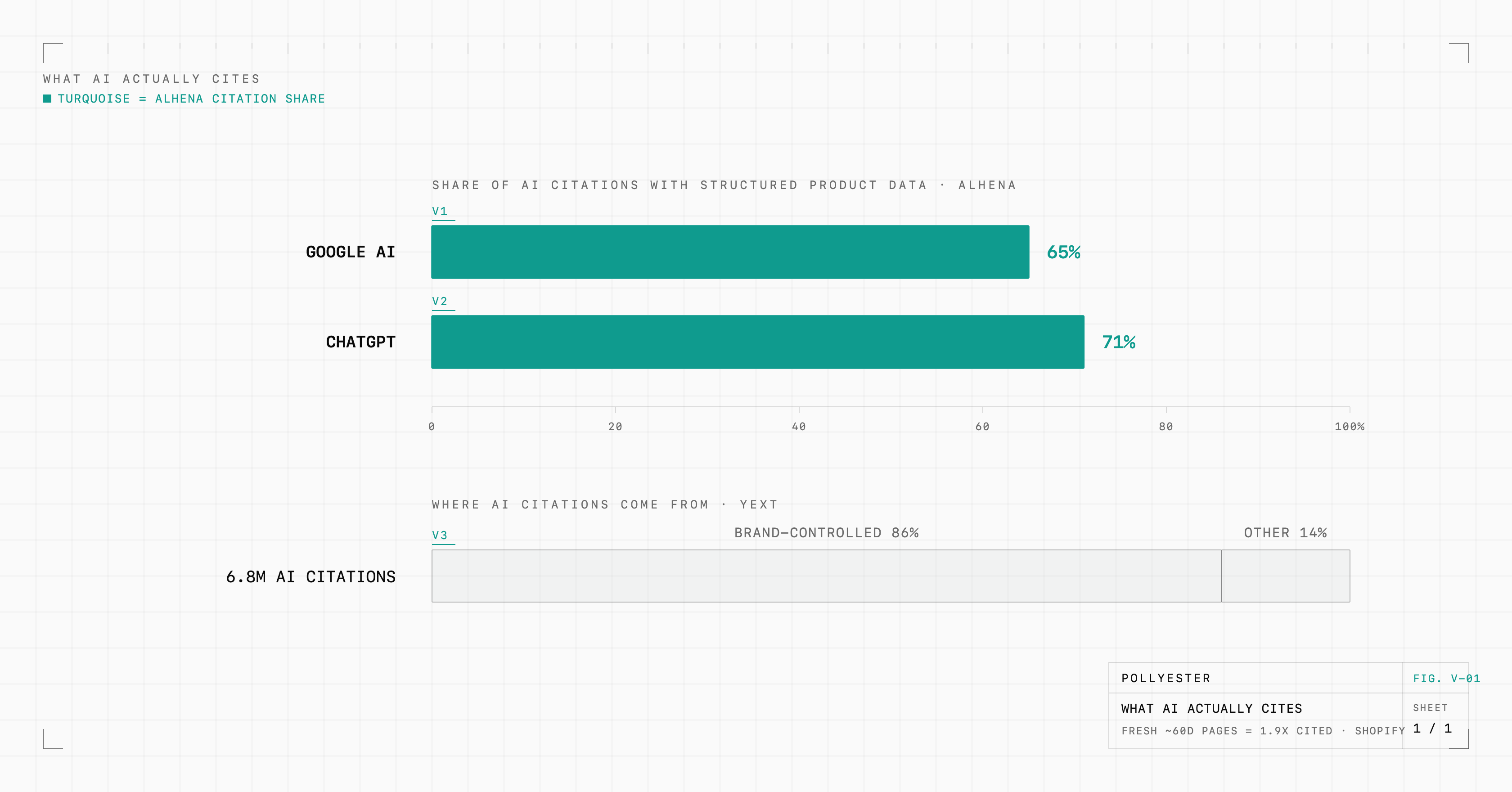
The research backs this up. The structured product data on a page shows up in 65% of what Google's AI cites and 71% of what ChatGPT cites, per SE Ranking, but generic tags do nothing on their own; the details have to be filled in and consistent. Yext looked at 6.8 million AI citations and found 86% came from sources a brand controls directly, its own site and its listings. You don't need a bigger budget to get picked, you need your own record in order first. Freshness matters too. BrightEdge found pages updated within about 60 days are roughly 1.9 times more likely to be cited, so a feed you let go stale quietly loses ground.
None of this is exotic. It's unglamorous work, which is exactly why it's easier to sell a dashboard instead.
Beauty's tell
Beauty makes the case cleaner than most categories, because discovery here already moved, and it moved to the creator and the review. TikTok Shop grew more than 60% year over year and became the UK's number four beauty retailer. A shopper finds a serum in a creator video, then asks a model to compare it to two others. Both of those places read the same thing when they decide whether to recommend you: your structured product record.
So a shade-accurate feed does real work here. It's your pitch, delivered to the exact places beauty buyers now decide. And it pays twice. Shade and skin-match mismatch is the number one reason beauty gets returned. A record that's precise enough for a model to match a product to a request is precise enough to stop the wrong shade from shipping in the first place. The same work feeds the places that recommend you and cuts your biggest return driver.
Look at the two paths side by side. The dashboard lifts a score that never turns into an order. Fixing the feed puts you on the shortlist for those category questions, where the traffic is still small, under a fraction of a percent of sessions, but it converts at a higher rate once it lands and it ships fewer returns. That's the one that shows up in the P&L.
Spend on the substrate, not the scoreboard
This is the pattern MIT found across the whole AI wave. Ninety-five percent of company pilots returned nothing, because the money went to the demo and the dashboard while the payoff sat in the unglamorous operational work. This retainer was that same story in one brand.
Fix the feed and the brand has a clean, structured product record that carries across ChatGPT, Perplexity, Google, the creator platforms, and whatever comes next. None of it is tied to a vendor's login you have to keep paying to read.
A dashboard doesn't fix a broken feed underneath it. Spend on the substrate, not the scoreboard. And if a vendor is selling you the scoreboard, that's your answer.