Earn Advocacy
The $53,088 Review
Faking your reviews is now illegal in supplements. It also doesn't work, and the machine reading them is getting better at telling.

Every supplement brand is feeling the same pull right now, and it's rational. Reviews are starting to drive what AI recommends. Ask a chatbot which magnesium to buy and the answer leans on what real customers said, not on your product page. So the move suggests itself: get more reviews up fast, however you can, seed a few, push the good ones, bury the bad ones.
In supplements, that move now carries a price of up to $53,088 per review. And even if it were free, it would still be the wrong call.
Why the pressure is real
The pull is rational because the shift under it is real. Product discovery is moving into the answer. ChatGPT handles roughly 50 million shopping-related queries a day, and 61% of consumers say they've already used it to shop (Dataslayer).
And it reads those words closely. It pulls the specific phrases customers repeat, the "no jitters," the "actually helped me sleep," the "easy on the stomach," and weights them. Ask for the pre-workout that doesn't wreck your gut and it surfaces the brand where that phrase shows up often and positively, from real buyers (Yotpo). Your label can say "gentle formula" all day and it won't move the answer. A thousand customers saying it will.
So the advocacy is worth real money, and unlike an ad auction, you can't outbid your way in. That's why manufacturing it looks tempting. It's also why the regulator drew a hard line through the middle of it.
Your label can say "gentle formula" all day and it won't move the answer. A thousand customers saying it will.
The line, in plain terms
The FTC's Consumer Review Rule took effect on October 21, 2024, on a 5-0 vote (FTC). Here's what it bans, without the legal fog:
- Buying or selling fake reviews, or writing reviews from customers who don't exist.
- Insiders reviewing their own product without saying they're insiders. That covers employees, founders, and their families.
- Running an "independent" review site you quietly own.
- Suppressing negative reviews. This one catches brands that think they're playing clean. Filtering out the one-stars, or leaning on an unhappy customer to take a review down, counts.
Penalties run up to $53,088 per violation, which tends to mean per review. Seed or scrub a few hundred and the math gets ugly fast.
This stopped being theoretical in December 2025, when the FTC sent its first warning letters to ten companies (Inside Privacy). Supplements already sit under the sharpest version of this scrutiny. The FTC polices supplement claims aggressively and holds the category to "competent and reliable scientific evidence" (FTC). You're the most-watched aisle in the store. This is not the place to test the rule.
Even if it were legal
Set the law aside and the strategic case is just as bad. The same models that read your reviews are learning to spot the ones that don't read like people. Thin, uniform, all-five-star review sets look like manipulation, not quality. A real pile is messy. It has three-stars that say the product's good but shipping was slow, real complaints, the range you'd get from a few thousand actual people. A seeded pile is suspiciously clean, and clean is becoming a tell.
A trick that games the answer today gets discounted as the models get better at catching it. You'd be taking on real legal risk to build an asset the machine is learning to distrust. That's the trap in treating this like SEO to be hacked. You're optimizing for a reader whose whole job is to reward the real reviews and catch the fake ones.
A seeded pile is suspiciously clean, and clean is becoming a tell.
The play that pays
The alternative isn't "post honest reviews and hope." It's building the machinery that produces real advocacy at volume, and owning it.
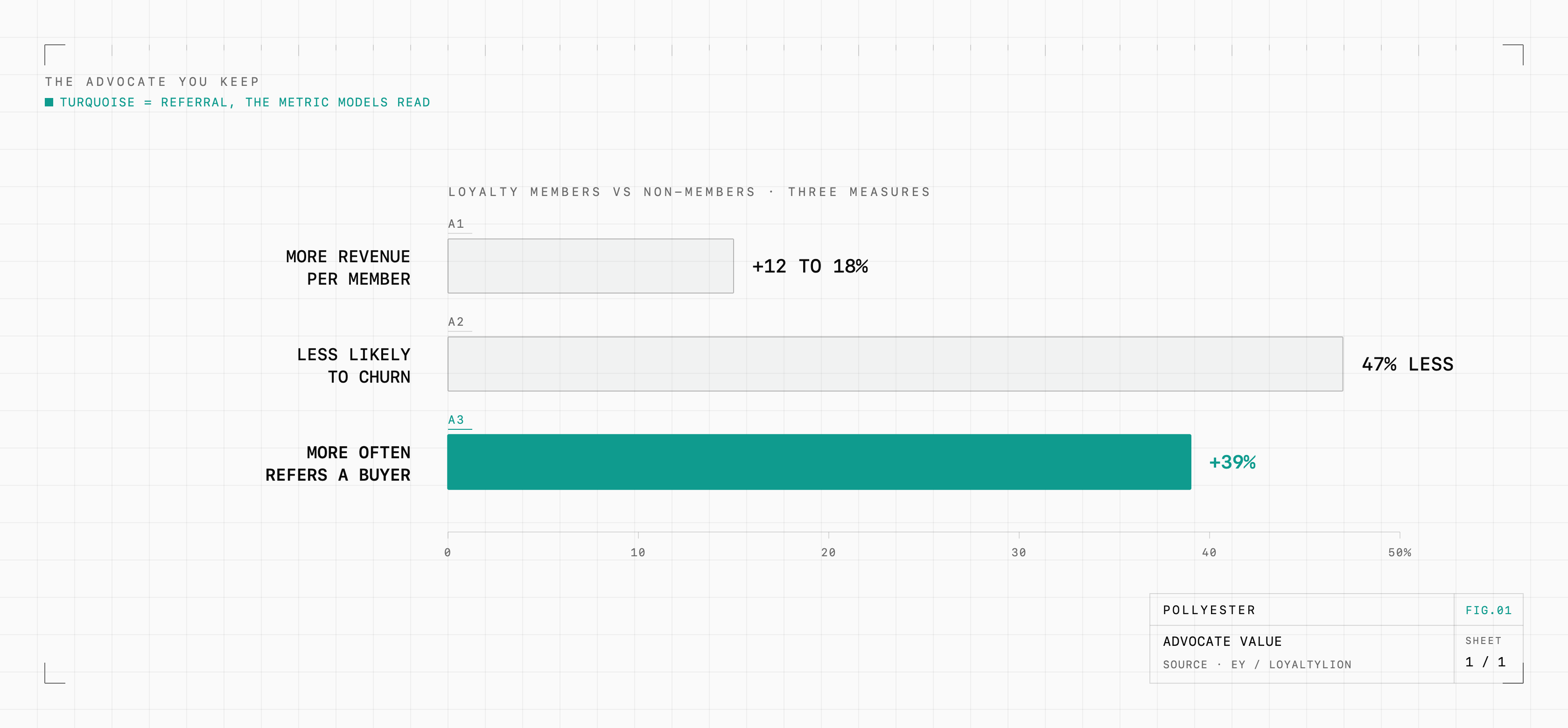
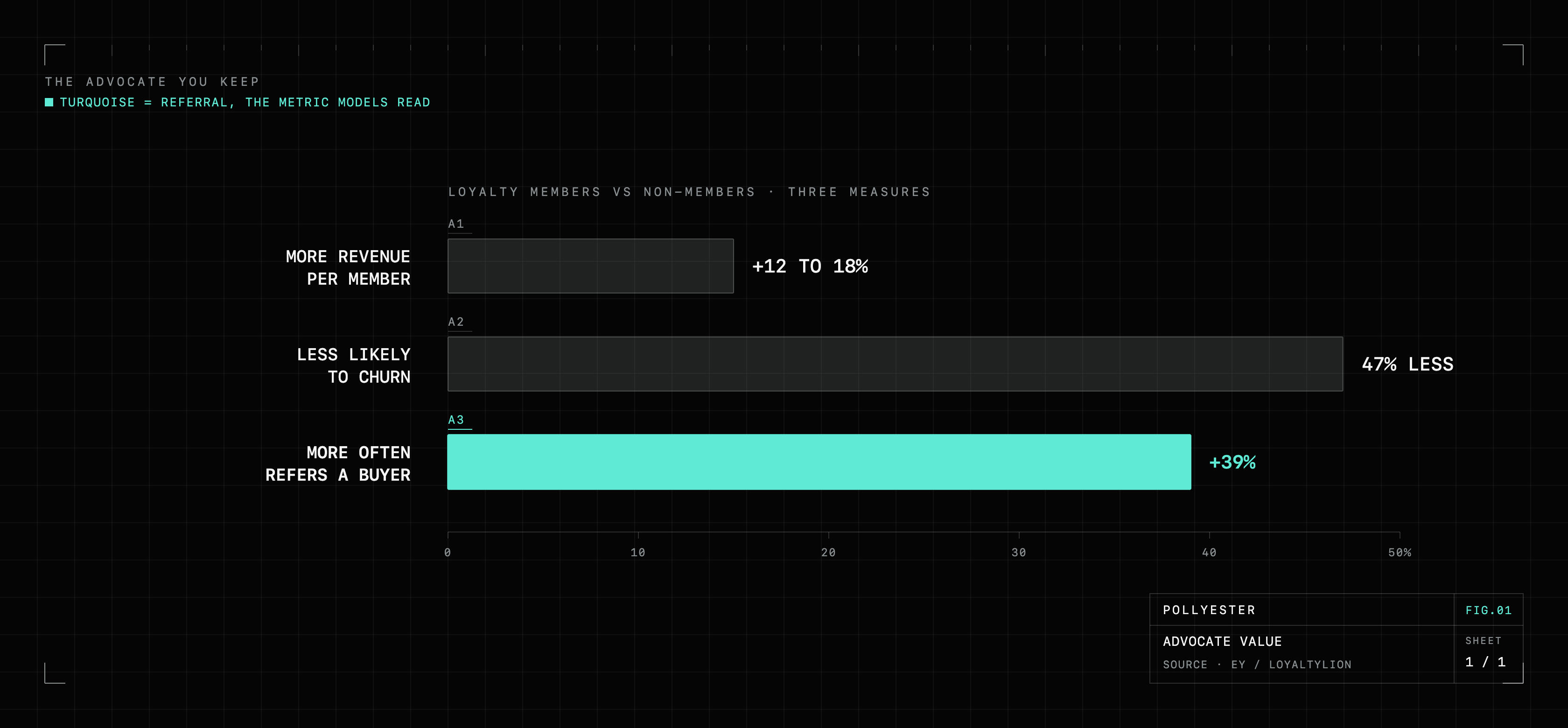
It's three things working together. First, a review flow that asks at the right moment, after the customer has felt the product work, and captures the specific words they use, so those phrases exist for the model to find. Second, loyalty and referral programs that turn one-time buyers into repeat buyers, and repeat buyers into people who bring you the next customer. That part isn't soft. Loyalty members generate 12 to 18% more revenue, churn 47% less, and refer 39% more often (EY / LoyaltyLion via SellersCommerce). Third, a real relationship with the places the models read, the subreddit, the creator, the independent tester, built over time rather than bought.
Here's the business math. Shoppers who see real reviews and customer content convert about 161% higher than those who don't (Yotpo). Referred customers convert at 3 to 5 times the rate of ad-driven traffic (Wharton via Loop.fans). Put a number on it. If a genuine review base moves even a slice of your traffic from 2.0% to 2.5% conversion, that's 25% more revenue on the same visits, with no new ad spend. The seeded pile can never touch that return, because the seeded pile is a liability on your books at $53,088 a line.
This is really retention and community work, with a new consequence attached. The brands that keep customers longer and turn them into advocates are the ones the answer engines quote back to the next shopper. Rent your traffic and there's nothing for the machine to read.
The part worth keeping
Authenticity used to be a nice-to-have, the line a brand wrote about itself on an About page. Now it's two things at once: the legal floor you can't drop below, and the one advantage that keeps paying after you stop spending instead of resetting to zero.
Reviews you can prove came from real buyers are the asset, captured cleanly and sitting on your side of the table, yours to keep. There's no shortcut left to fake around that, and that's the good news. Build the machinery that produces real advocacy at volume, because the work that keeps you out of the FTC's mail is the same work that gets you recommended.