Cost Optimization
Most of Your AI Budget Is Aimed at the Wrong Half of the Business
More than half of AI spend goes to marketing. The return shows up somewhere else. Here's where the money actually is.

More than half of the money brands spend on AI goes to sales and marketing. Almost none of the measurable return does. MIT's Project NANDA studied 300 deployments and found the payoff showed up in back-office and operations, not in the marketing tools where most of the budget landed (MIT via Forbes). You're funding one half of the business and getting paid by the other.
That gap is the whole story. The same study is behind the number everyone quotes: 95% of enterprise generative AI pilots delivered no measurable P&L impact, against $30 to 40 billion spent (MIT via Fortune). People read that as proof AI doesn't work. That's not what happened. The money went to the wrong place.
Why the glamour half gets the money
The marketing tools get the budget because that's where the demo looks good. You watch it write ad copy and spin up creative in seconds, someone screenshots it and sends it to the team, and it feels like the future showed up early.
The problem is that the P&L doesn't move in the demo. It moves in inventory, in what it costs to serve an order, in the reconciliation nobody wants to do. That work is dull and nobody screenshots it, so it goes unfunded while the ad account gets another tool bolted on. Your margin can't afford the miss. The median DTC brand runs 60 to 70% gross margin but finishes at a 15 to 20% true contribution margin once every variable cost is counted (Luca). Acquisition is getting more expensive at the same time, with CAC up 40 to 60% from 2023 to 2025 (Swell). When a customer already costs more to win, spending on a marketing AI project that doesn't move contribution margin just puts a second hole in the same boat.
That work is dull and nobody screenshots it, so it goes unfunded while the ad account gets another tool bolted on.
What the 5% actually did
The brands that crossed the line did two things. They pointed AI at back-office operations instead of the ad budget, and they mostly bought tools from outside vendors rather than building their own. Bought solutions succeeded about twice as often as internal builds (MIT via Fortune).
That's an instruction, not a complaint about the technology. AI stays a cost center until a specific number moves; the failure was aiming it at a problem that was never the real constraint, and never tying it to a number. Point the money where it pays back, and buy the boring thing that already works instead of paying to build your own.
In pet, the back office is the business
This lands hardest in pet, because pet's economics are the clearest proof that retention, not acquisition, is where the profit lives. Look at Chewy. It did $11.9 billion in revenue with Autoship at 83.3% of sales and $591 in net sales per active customer (Chewy 8-K). When five of every six dollars come from a recurring order, the business is the reorder, not the first click. The back office is the business.


So the profit sits in a few unglamorous questions. Which customers are about to cancel, and can you reach them before they do? When is each one going to run out, so the reorder shows up on time instead of a week late? And how much of the support queue is the same three requests that don't need a person? Pet food subscription churn runs 6 to 10% a month, and replenishment models churn far lower than curation-based ones (Eightx). That's back-office work, not advertising.
Meanwhile the acquisition creative keeps getting the AI dollars, even though the buyer has already changed underneath you. 69% of Gen Z pet owners buy direct, against 18% of boomers (Packaged Facts). The new customers are already showing up. Keeping them is the part that pays.
If a use case can't show you a before number and an after number, it belongs in the 95%.
The boring wins, and the line each one touches
Here's what the profitable half looks like in practice, and why each piece belongs on a spreadsheet.
Support automation cuts cost-to-serve. This is cost optimization at its most literal: AI resolving routine support tickets cuts support cost 30 to 40% (Triple Whale). In a subscription business, most of what comes in is "change my delivery date," "skip this month," "update my address." That's the volume you can take off a person's desk, and it maps straight to support cost per order.
Forecasting cuts the two most expensive mistakes in inventory. AI cuts forecast error 20 to 50% and stockouts up to 65%, which trims warehousing cost 10 to 40% (LatentView). A stockout on a food subscription doesn't just miss one order. It's the reason a customer starts looking at the competitor, and in a business where the reorder is everything, that's the churn you can least afford. Overstock is the same line from the other side, capital sitting in a warehouse and getting marked down later.
Reconciliation and returns triage remove ops labor that never justified a headcount. AI can now handle the freight audit, the vendor comparison, and the returns triage someone used to do by hand between other tasks, because the return often shows up in operations rather than the ad account. Returns eat 8 to 15% of an order once you count shipping back, processing labor, and write-offs (Saras Analytics). It's dull work, and every bit of it lands on a real cost line.
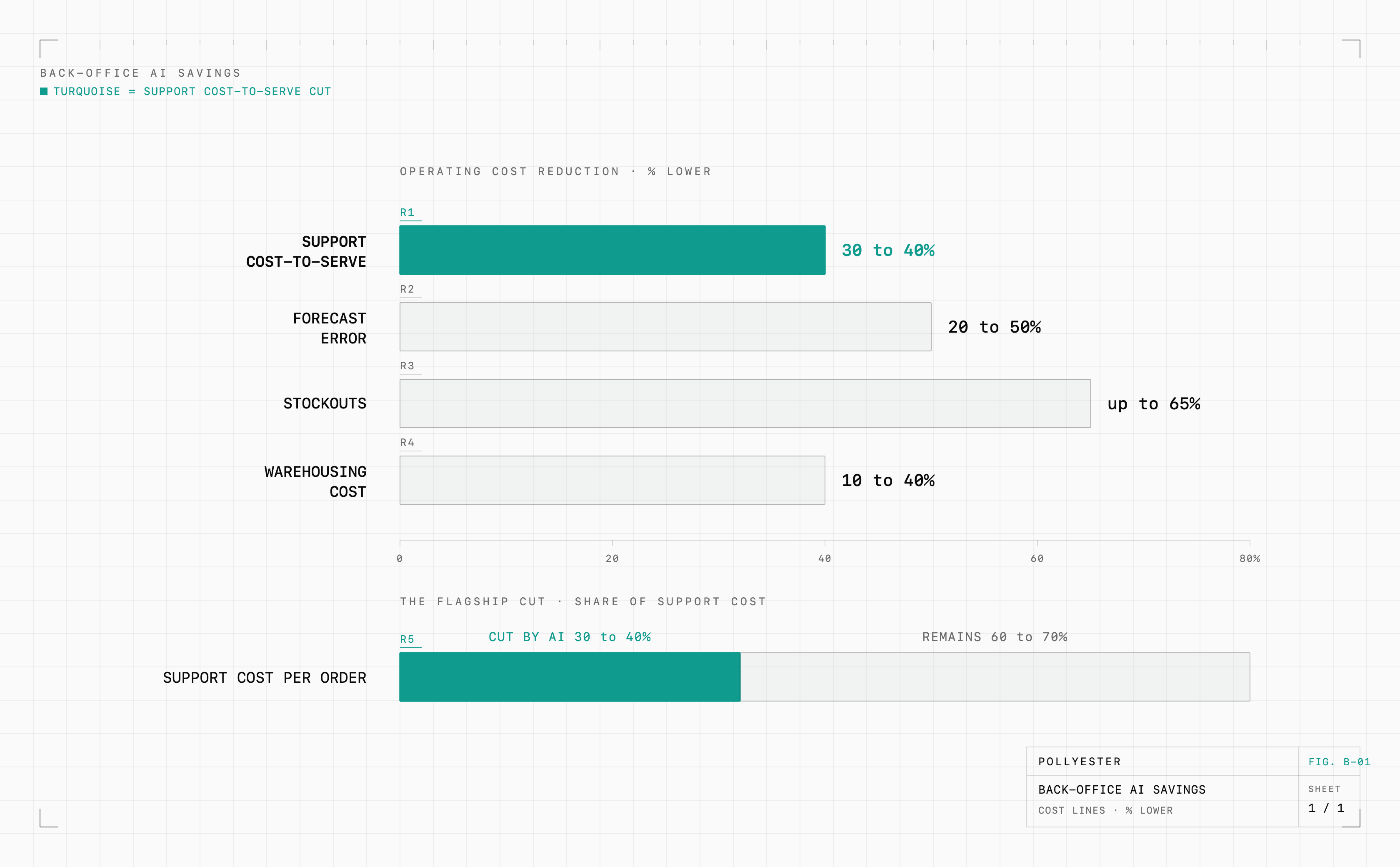
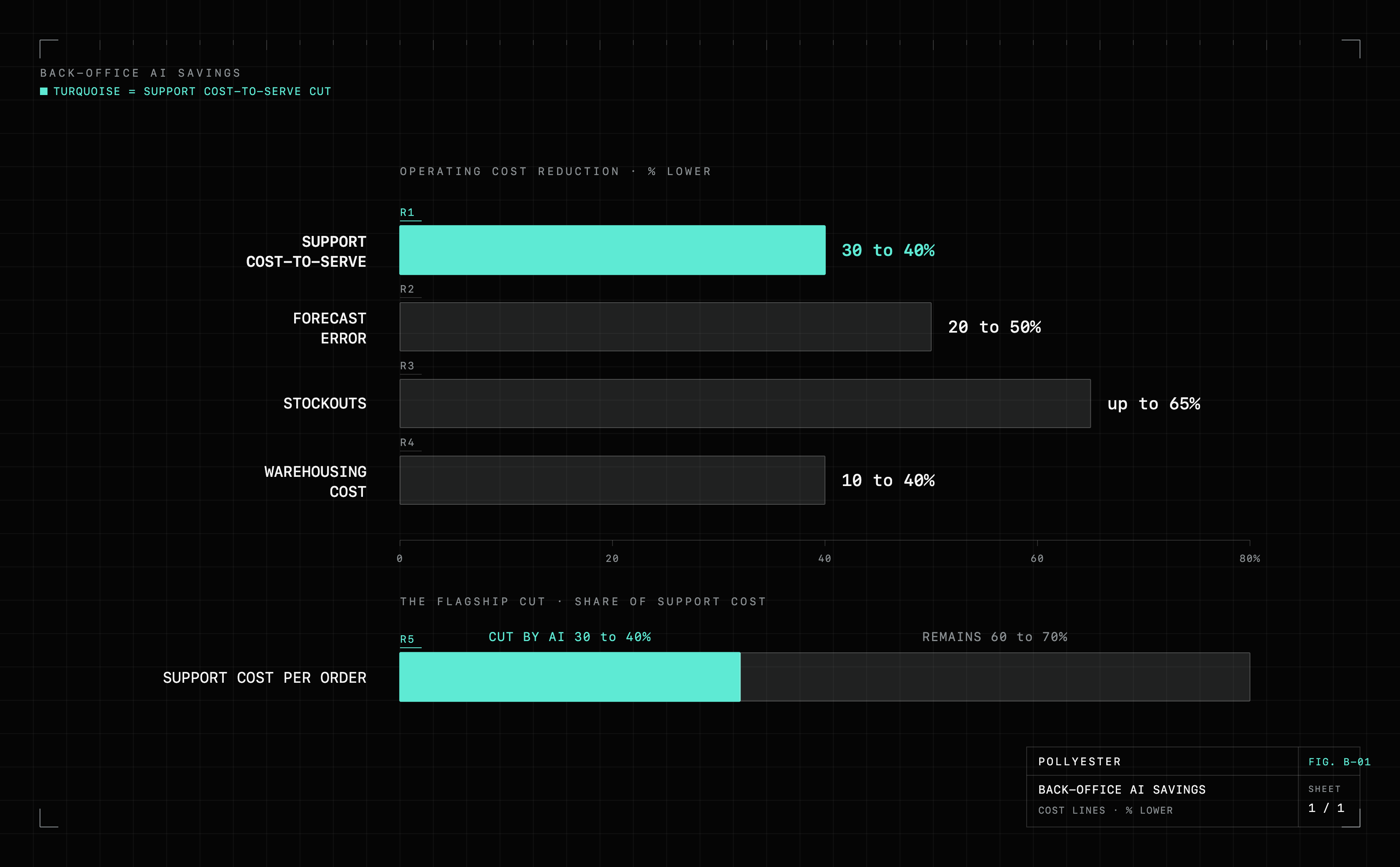
Notice the pattern. Every one of these has a before number and an after number: support cost per order, stockout rate, return processing cost. That's the test — underwrite each project in one number before it gets funded. If a use case can't show you that pair, it belongs in the 95%.
Run the math on the boring half
Take a pet brand doing $20 million with support running around 5% of revenue, so a million dollars a year. Cut cost-to-serve 30% on the routine tickets and you're keeping a few hundred thousand dollars that used to leave the building. Now put the same dollars into churn timing on an 83%-Autoship model. Moving monthly churn from 8% to 7% doesn't sound like much until you compound it across a year of recurring orders, and it lands as more revenue on customers you already paid to acquire. That's what it looks like to spend on the half of the business that shows up on the P&L.
The marketing tool might make a better ad. But better ads bring in customers you're already losing out the back at 8% a month, and each one costs more to win every year. The math only works if you fix the leak first.
Spend where the money is
The instruction is simple, even if it runs against where the budget drifts on its own. Point the AI dollars at the half of the business that shows up on the P&L, buy the proven thing instead of building a science project, and tie every piece to a line you can already name, so the savings keep compounding after the work is done.
In pet, that half is almost never the ad account. It's the reorder, the support queue, and the shelf. Spend the budget where the money is, not where the demo looked good.