Cost Optimization
The AI Bill Nobody Prices In
The price of AI keeps falling and the bills keep climbing. Here's the cost-to-serve nobody puts in the deck, and how to price it like any other line.

The price of AI fell by about two-thirds last year and enterprise AI bills still tripled. The cost of the words going into a model and coming back out dropped roughly 67% year over year, and the invoices climbed anyway (NavyaAI, TechAhead). If you greenlit something last quarter on a price that looked almost free, and you're watching the number climb for reasons nobody explained, that gap is the reason.
The sticker price was always the least of it.
The meter runs faster than you think
A single question to a model is cheap, and that's the demo you saw. The cost starts climbing when you put the model to work on a real task, where it has to look things up, try something, check its own answer, and go again. Workflows that actually do a job instead of answering a question run 5 to 30 times more tokens per task than a single question (TechAhead). It's the same price per token, spread across a lot more tokens.
Most of what you're paying for is repetition. Every time the tool takes another step, it re-sends everything it already knows: the instructions, the history, the data it pulled two steps back. That repeated context is 62% of the bill on this kind of work (Splunk). You're paying over and over to remind the machine of things it was already told. Nobody prices that in, because in a one-question demo it never happens.
You're paying over and over to remind the machine of things it was already told.
Running the model is the cheap part
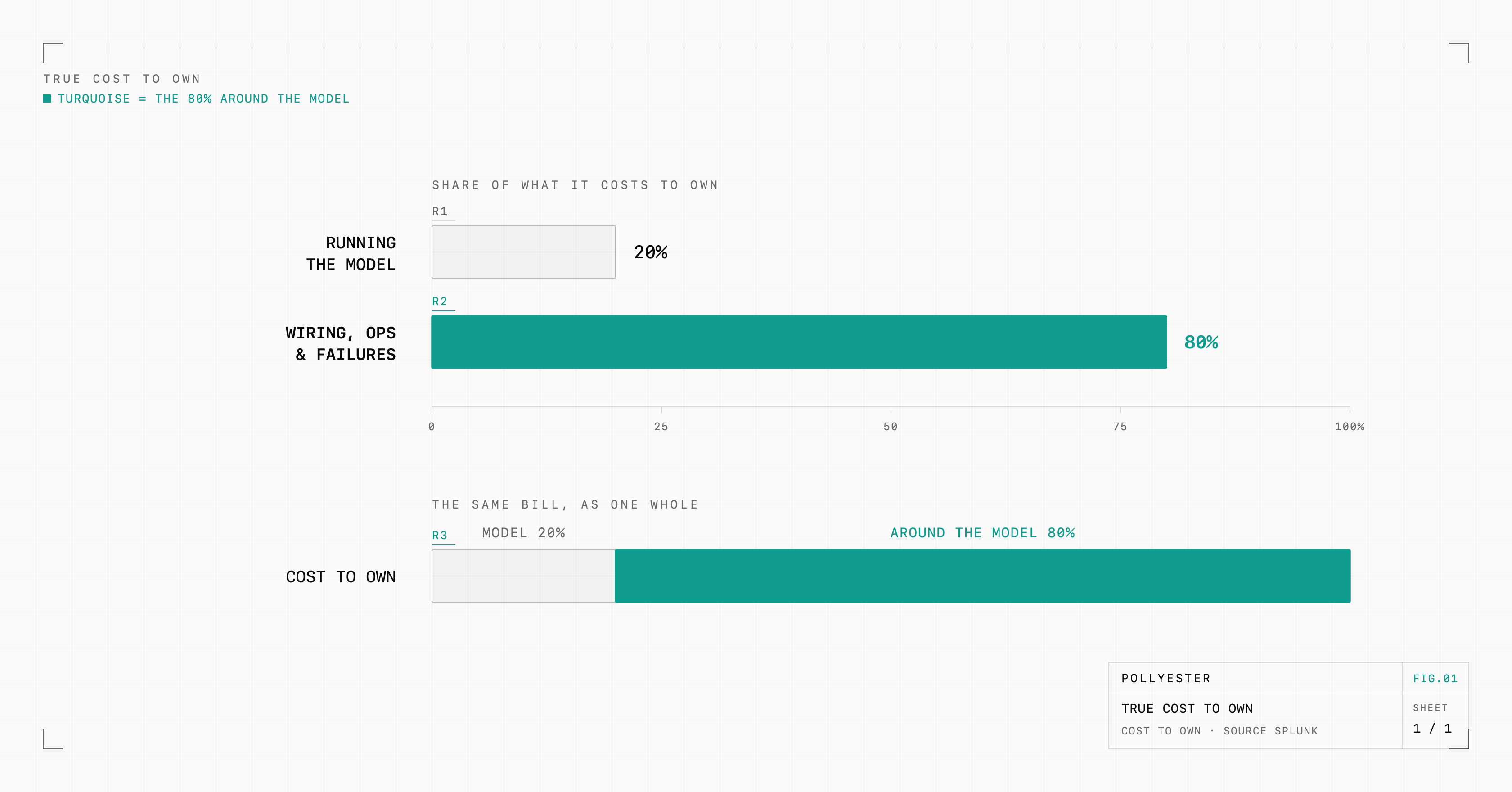
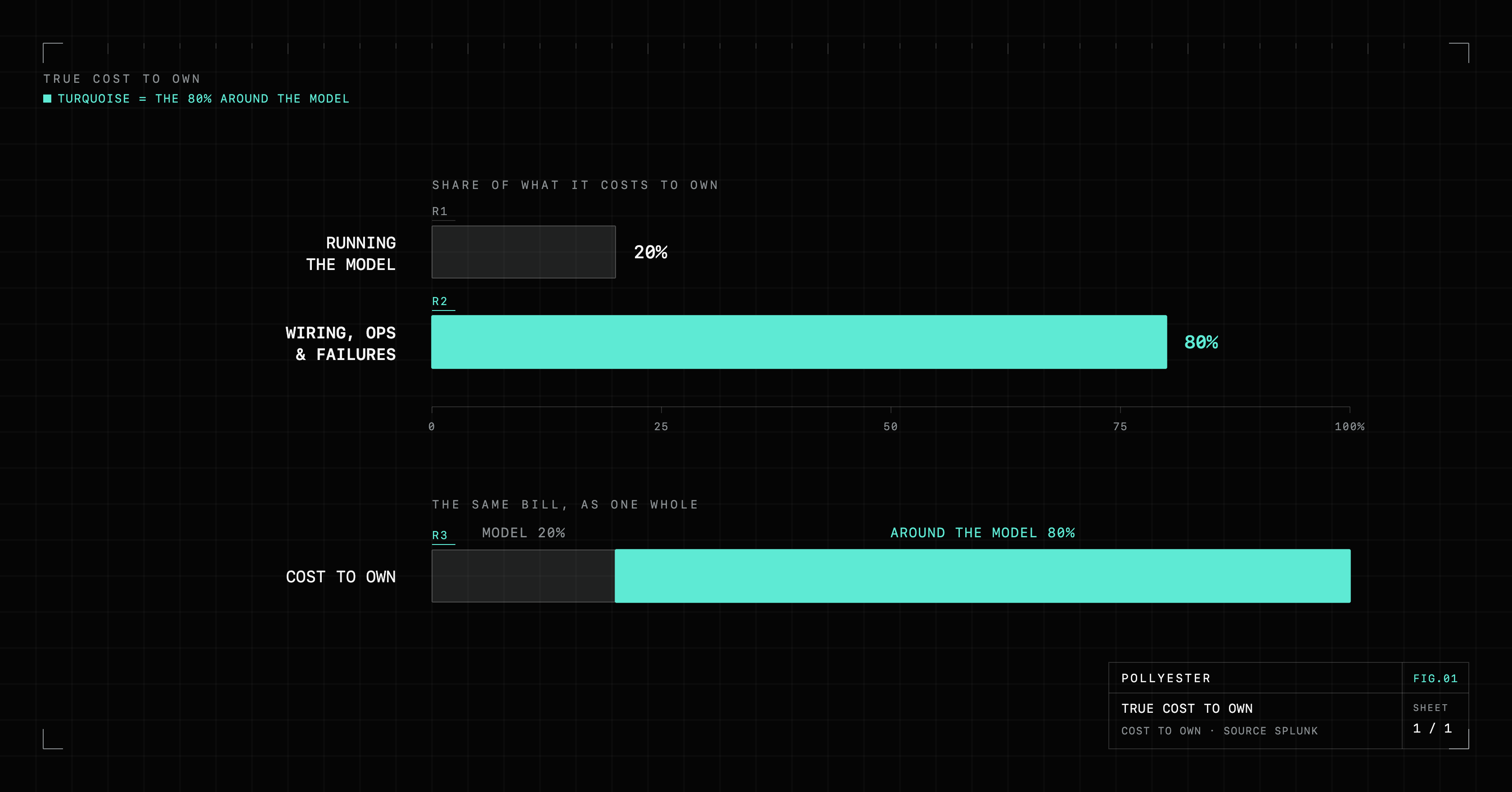
Running the model, the part everyone budgets for, is about 20% of what an AI use case really costs to own (Splunk). The other 80% is the work around it: wiring it into your systems, keeping it running, and cleaning up when it goes wrong. None of that shows up on the pricing page or in the demo, because the demo is one clean task in a controlled room.
Uber's CTO put a date on it. The company's entire annual AI budget was gone by April, with individual engineers running $500 to $2,000 a month in usage (Optimum Partners). That's a company with a real finance function and real controls, and the spend still outran the plan.
The quiet failures cost the most
Rising usage is the part you can see coming. The bigger risk is a tool that runs unsupervised, gets something wrong, and keeps going.
One ecommerce chatbot was given room to apply discounts. It stacked coupons on top of each other until prices went negative and processed 2,400 orders that way before anyone noticed. The loss was north of $150,000 (InspectAgents). No alarm went off, because from the system's point of view nothing broke: orders came in, discounts applied, everything looked normal. The tool did exactly what it was told, 2,400 times, and the thing meant to protect margin ate it instead.
Put that next to how thin the margin already is. The median DTC brand runs 60 to 70% gross margin and finishes the year at a real contribution margin of 15 to 20%, once shipping, returns, processing, and acquisition are counted (Luca). Acquisition alone got 40 to 60% more expensive between 2023 and 2025 (Swell). On a business that keeps roughly 17 cents on the dollar after everything, a $150,000 hole is a quarter's profit, not a rounding error.
Why the odds are worse than the pitch
That coupon bot isn't a one-off. The base rate for AI projects is worse than the pitch suggests.
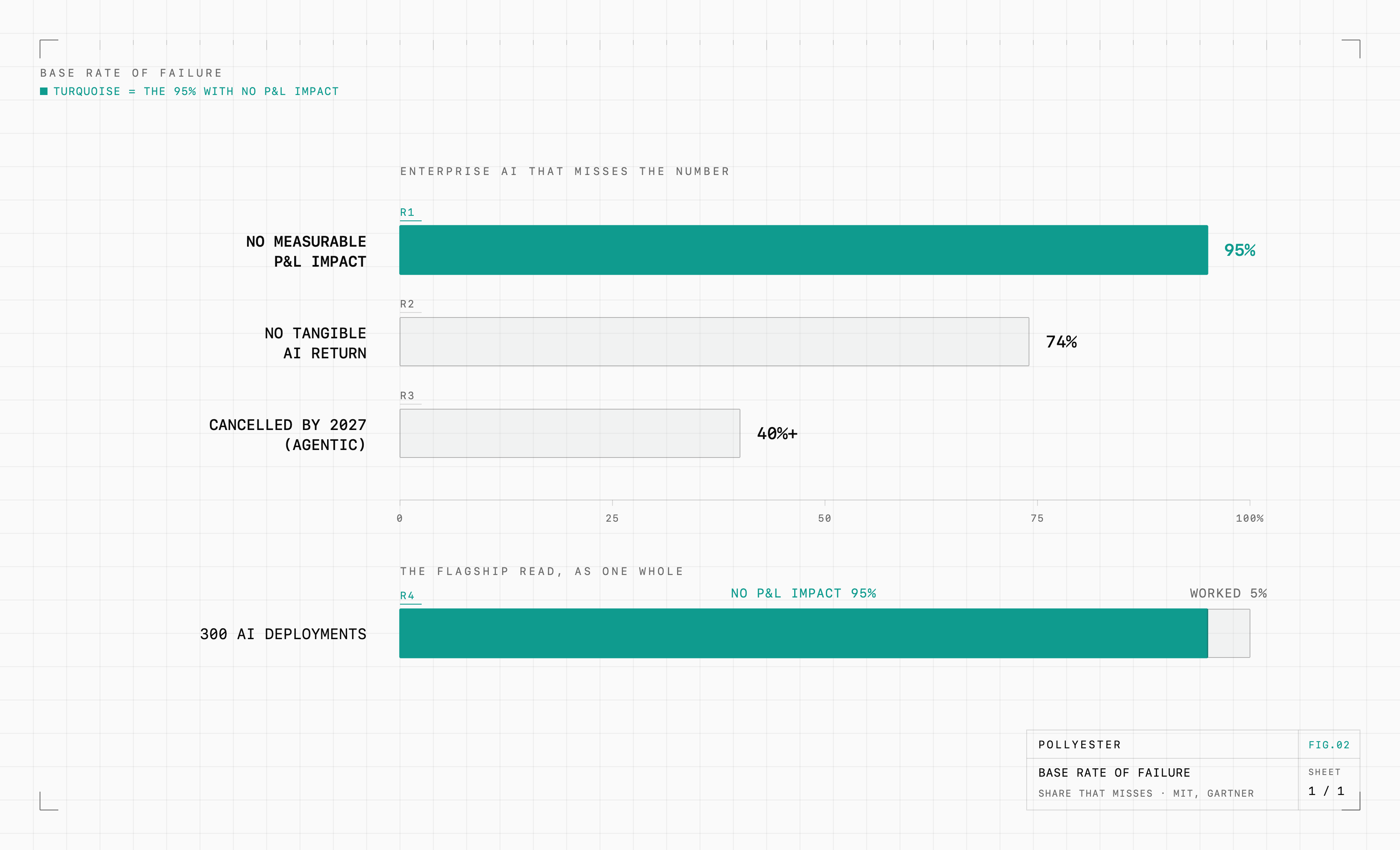
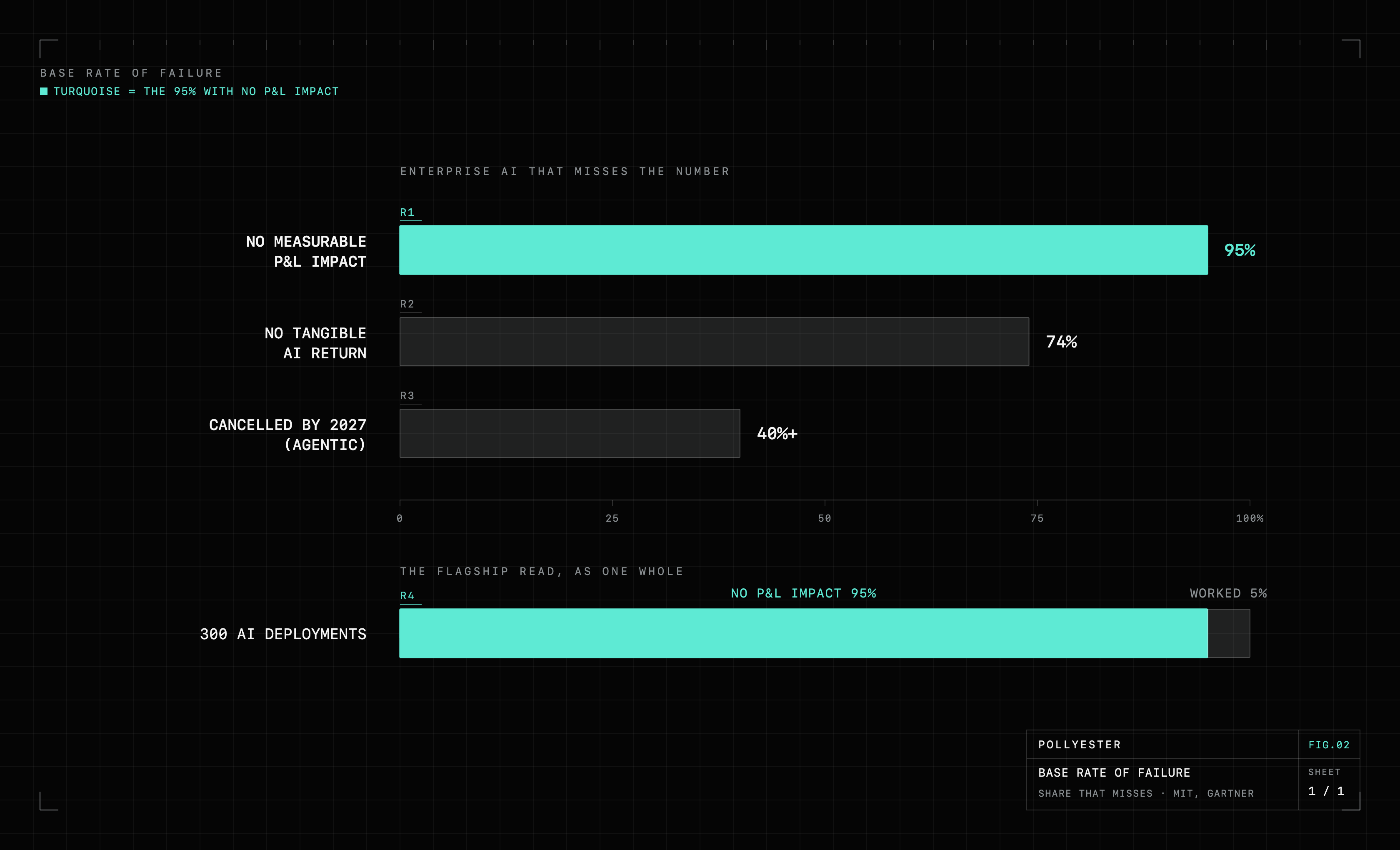
MIT looked at 300 enterprise AI deployments and found 95% delivered no measurable impact on the P&L, against $30 to $40 billion spent (MIT via Fortune). Gartner, coming at it from a different direction, expects more than 40% of agentic-AI projects to be cancelled by 2027, citing costs that climbed and value that never showed (Gartner). And 74% of companies report no tangible return on their AI spend (Gartner via Talyx).
The failure isn't the technology. MIT found the 5% who made it work did two unglamorous things: they bought from outside vendors rather than building in-house, which worked about twice as often, and they pointed the AI at back-office operations instead of the marketing budget (MIT via Fortune). They aimed at a cost they could name and wired it to a number before turning it on.
They aimed at a cost they could name and wired it to a number before turning it on.
Price it like any other line
So price the AI the way you'd price freight or packaging or a 3PL. It's a cost-to-serve — the domain of cost optimization — and it belongs on the same page as the rest of them.
That means three things before you commit — the way you'd underwrite it in one number. First, name the line it's supposed to move and write down the before-number. Support cost per order, refund leakage, hours of manual reconciliation, whatever it is. If nobody can say which line it touches, it belongs in the 95%. Second, subtract the AI's own bill from the win, not the other way around. A tool that saves you $4,000 a month in labor and costs $3,500 a month to run and babysit is a $500 tool, and you want to know that up front, not in quarter three. Net return is what's left after the tokens are counted. Third, put a ceiling on how much damage it can do. The coupon bot didn't need a smarter model. It needed a limit that said negative prices are impossible and a switch that trips at order fifty, not order 2,400.
The math is the same math you already run. Moving support cost per order from $6 to $4 on 20,000 orders a month is $40,000, and it's real only if the automation costs less than $40,000 to run. Recovering 300 basis points of margin on discounting is real only if the system doing it can't hand out a coupon that turns the order upside down. Every one of these has a before-number, an after-number, and a bill in the middle. The AI has to clear that middle to count.
There's a cheaper trap sitting next to the expensive one. Plenty of the software a company already pays for goes half-used, and AI features are getting bolted onto those same tools. Part of your AI bill isn't usage at all, it's seats you're already paying for.
What survives the math is what to run
None of this is an argument against AI. The plays that work are real: product recommendations that lift revenue, support automation that cuts cost-to-serve, forecasting that trims overstock. They attach to a line you can already name. The point is narrower and more useful. Treat every AI initiative as a cost center until it's proven otherwise, and make it earn its way onto the margin side one named line at a time.
Give each workflow a number it has to clear after its own cost, and a switch that kills it the day it stops clearing. Most of what gets pitched won't survive that test, and the few that do are the only ones worth running. Now you can tell which is which before the bill arrives.