Grow the Customer
Stop Discounting the Customers Who Were Going to Stay Anyway
LTV:CAC can read healthy while half your retention spend goes to customers who were never leaving. Here's the number that catches it.

Half the discounts your retention program sends go to customers who were going to reorder anyway. The win-back flow fires, the 20% off lands in their inbox, and they spend it on the order they'd have placed at full price. You didn't save anyone. You paid a sure thing to do what it was already doing.
That leak is invisible in the metric most retention programs run on. And in food and beverage, where the entire model rests on people reordering, it's the most expensive thing you're not measuring.
A 3:1 that looks fine
LTV:CAC is the number everyone watches, and for good reason. Acquiring a customer now runs $68 to $84, up about 60% over five years (Retainful), so the base you already have is the asset, not the auction. Three to one is the rule of thumb most brands govern by. Hit it and the dashboard says you're fine.
Here's the question 3:1 never asks: did the money you spent on retention change anyone's behavior? The ratio counts every reorder from a discounted customer as a win. It can't separate a customer you brought back from a customer who was never leaving. So a program posts a healthy ratio while quietly spending margin on people who'd have stayed for free.
Reorder rate has the same blind spot. If your at-risk segment reorders at 45% with the offer, that reads like a save. But if the same segment reorders at 40% with no offer at all, the offer moved five customers and discounted forty-five. You paid for all forty-five to find out.
A program posts a healthy ratio while quietly spending margin on people who'd have stayed for free.
The number that catches it
Switch the metric you govern by to contribution-margin LTV. Not lifetime revenue. The margin left after every variable cost to serve that customer: fulfillment, shipping, returns, payment processing, and the discounts you handed them along the way. That last one is where the retention program shows up on the P&L, and it's exactly the cost LTV:CAC hides.
Run the math on a single save. A $40 box at 25% contribution margin leaves you $10. Send 20% off and the discount is $8, so that order now clears $2. If the customer was going to reorder at full price, you didn't protect $10 of margin. You turned it into $2. Do that across half an at-risk segment that was staying anyway and your "retention win" is an 80% haircut on your best customers.
The problem isn't discounting. It's discounting the customers who were going to stay anyway. Contribution-margin LTV is what tells them apart, because it charges every offer against the margin it ate, whether or not the offer did a thing.
Spend the margin where it moves someone
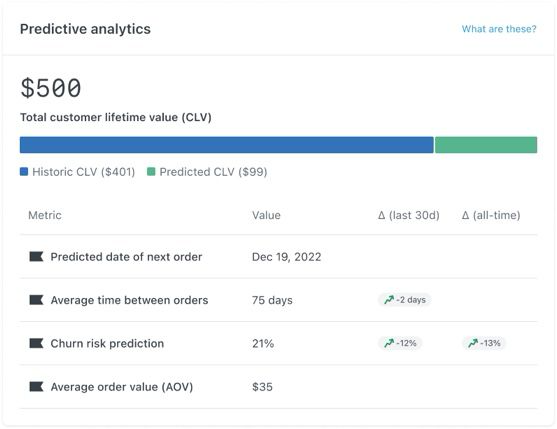
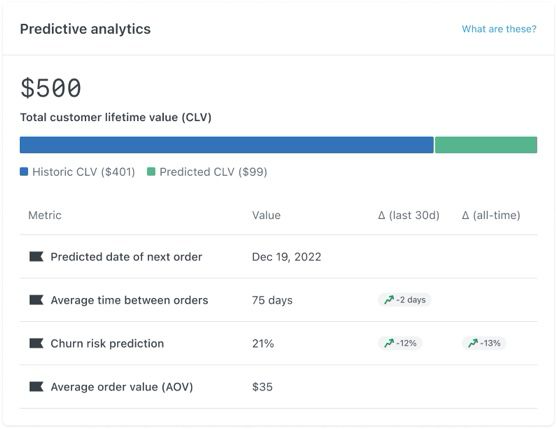
The tools to do this used to need a data team. Not anymore. Klaviyo now scores every customer on predicted value, churn risk, and next-order date straight off your store data (Klaviyo). The score isn't the win. What you do with it is.
Segment on two things at once, predicted value and churn risk, instead of either alone. That gives you four groups, and each gets a different move. The only group that should ever see a margin-eroding offer is high value and genuinely on its way out, because that's where a discount changes the outcome. Low value and high risk gets a cheap nudge or nothing, since saving them costs more than they're worth. The two low-risk groups never get money. They weren't going anywhere.
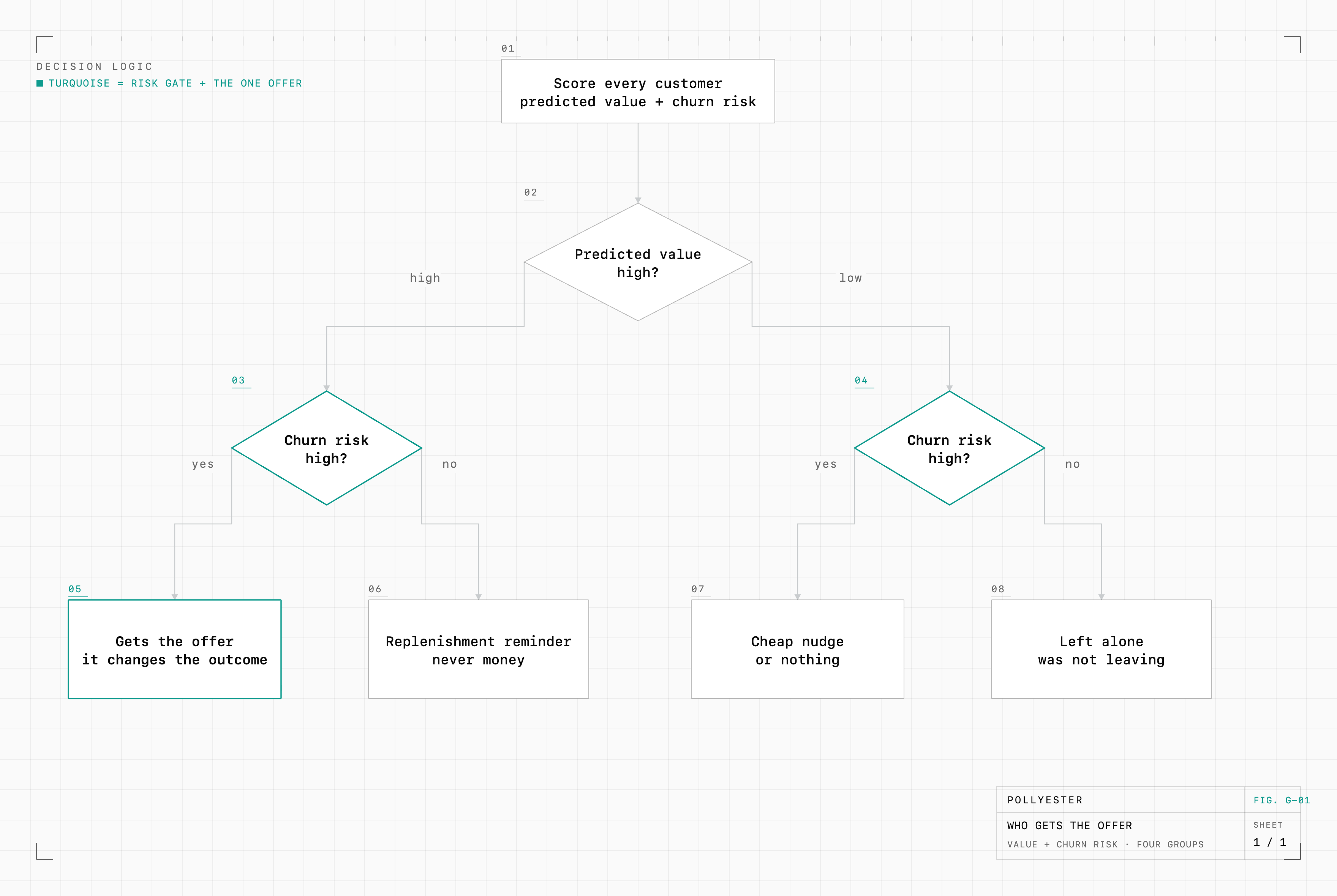
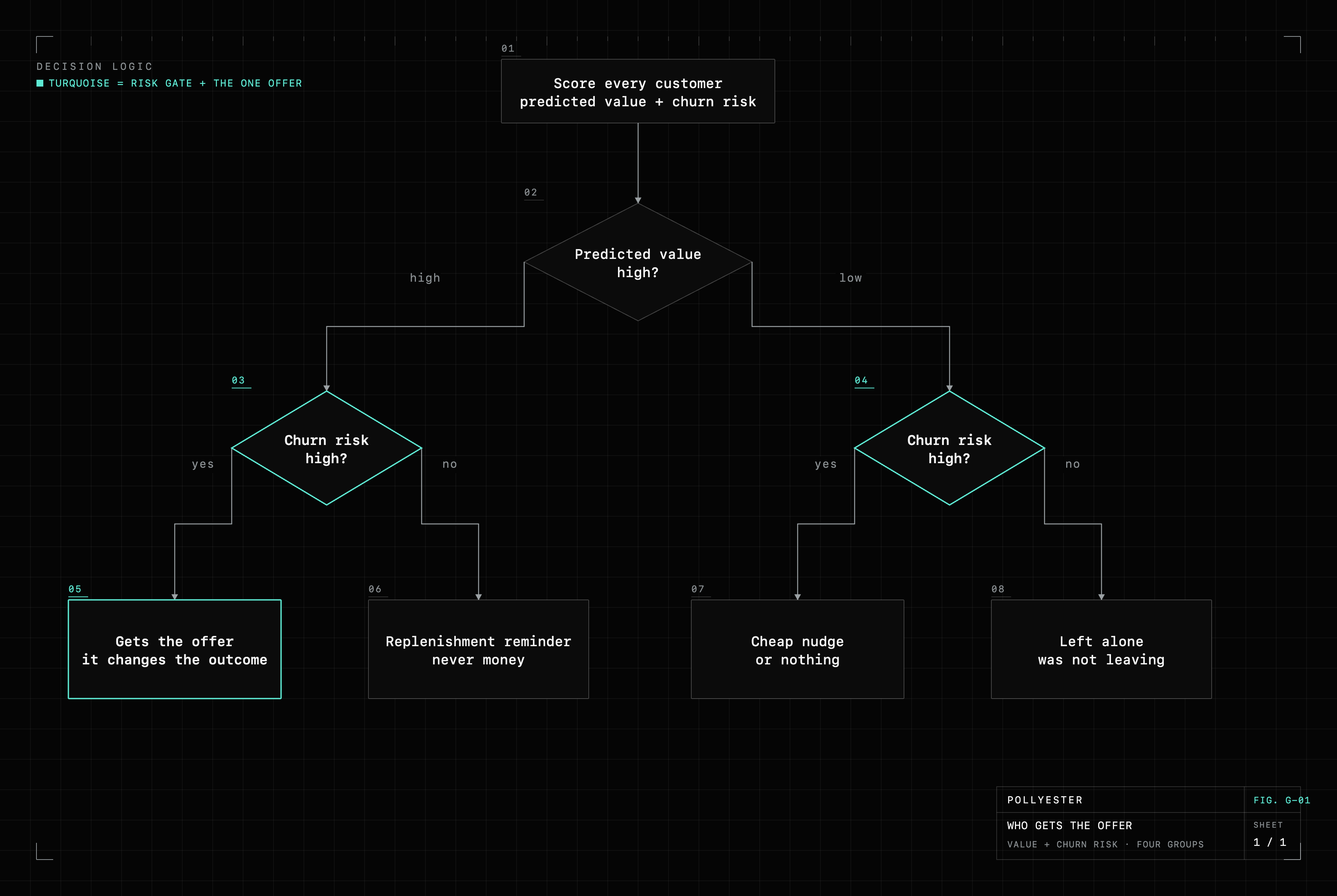
The high-value customer who reorders like clockwork gets a replenishment reminder when her box is due, or a service touch, not money. She was staying. Sending her 20% off is the leak, dressed up as a flow. Klaviyo's own guidance puts automated flows at roughly 41% of email revenue off about 5% of sends (Klaviyo), so the machinery is already earning its keep. Prediction just aims it at the person it changes.
For the customers worth growing, grow the basket instead of cutting the price. Get the coffee subscriber to add the filters, the supplement buyer to add the second formula. A bigger recurring order builds LTV in a way a discount never will. That's margin you're building, not margin you're giving back.
Sending her 20% off is the leak, dressed up as a flow.
Why the profitable cohort compounds
Protecting the right customers matters more in food and beverage than almost anywhere, because the profitable cohort compounds. A subscriber keeps reordering on a predictable cadence for as long as you keep her. A one-time buyer usually comes back once, if at all. So every subscriber you keep profitable is worth several times a one-time buyer, and the gap widens every quarter she stays. The old Bain line still holds: a 5% lift in retention moves profit anywhere from 25% to 95% (HBR). Waste that margin on the customers who were never at risk, and you've spent the budget that should have protected the ones who were.
Then prove the saves are real. Every save gets measured against a group you held back, or it isn't a save. Take a slice of the at-risk segment, send them nothing, and compare their reorder rate to the group that got the offer. If the two rates match, the offer did nothing, and you gave away the margin for a report that looked good in Monday's meeting. This is the discipline most tool demos skip. It's what separates a win-back you ran from one you can prove paid for itself. MIT found 95% of corporate AI pilots delivered no measurable profit (MIT via Fortune), and this is a big part of why. The number moved on a slide, never in the ledger.
The point
Retention isn't keeping everyone. It's keeping the right ones profitably, and knowing which is which before you spend the margin, not after. The discount should reach the customer on the edge, not the one who was always going to stay. Get the aim right and the same retention budget protects the cohort that carries the business.
The scores, the segments, the test that proves a save is real, and the logic that decides who gets an offer and who gets a reminder all run on your own customer data. Build it right and it keeps paying long after the build is done.