Order Orchestration
From Rules to Policies: Routing That Protects Margin Per Order
Every routing rule you hand-maintain is a margin decision made with a spreadsheet. Set the objectives instead, and let the system defend the margin and the license on every order.

Open the routing logic in your order system and look at what's in there. You'll find a rule that sends anything east of the Mississippi to the New Jersey warehouse, a rule that splits an order when one item runs short at the main warehouse, and a rule someone wrote two peak seasons ago that nobody remembers the reason for. Each one decides how much money you keep on the order, and most of them were written to be easy to maintain, not to protect your margin.
That's the problem worth fixing. The part of your system that quietly sets your margin is the part nobody keeps current.
Static rules ignore your margin, and the law
A "nearest warehouse" rule looks sensible. Ship from whatever warehouse is closest, save on the shipping zone, move on. It falls apart the moment the details get specific. The closest warehouse might be low on the item and about to force a split shipment, or running the carrier lane that's two days behind this week, or carrying the worst pick cost for that product. A rule that only knows distance can't see any of it.
Here's why it adds up. Last-mile delivery is now about 53% of total shipping cost, up from 41% in 2018 (ClickPost, via our fulfillment brief). The routing decision is the shipping cost, and shipping is one of the biggest variable lines between your revenue and your actual profit. The median DTC brand runs a 60 to 70% gross margin and finishes at a 15 to 20% true contribution margin once every variable cost comes out (Luca). So on a $60 order at 18%, you keep about $10.80. A routing choice that adds two dollars of avoidable shipping cost just took almost a fifth of the profit on that order. Multiply that across a peak season and it's a real dent in the number you take home.
In wine and spirits, a static rule can do something worse than lose money. It can make an illegal sale. Wine can ship to customers in 48 states, spirits in only 9 (Sovos, via our verticals brief). US alcohol e-commerce was roughly $74B in 2025 (Sovos), and every dollar of it runs through the three-tier system and twenty years of case law about who can ship what, where, and with which permit. A routing rule that treats a Kentucky bourbon like a California cabernet isn't just inefficient, it's an illegal sale waiting to happen.
The part of your system that quietly sets your margin is the part nobody keeps current.
Move from rules to policies
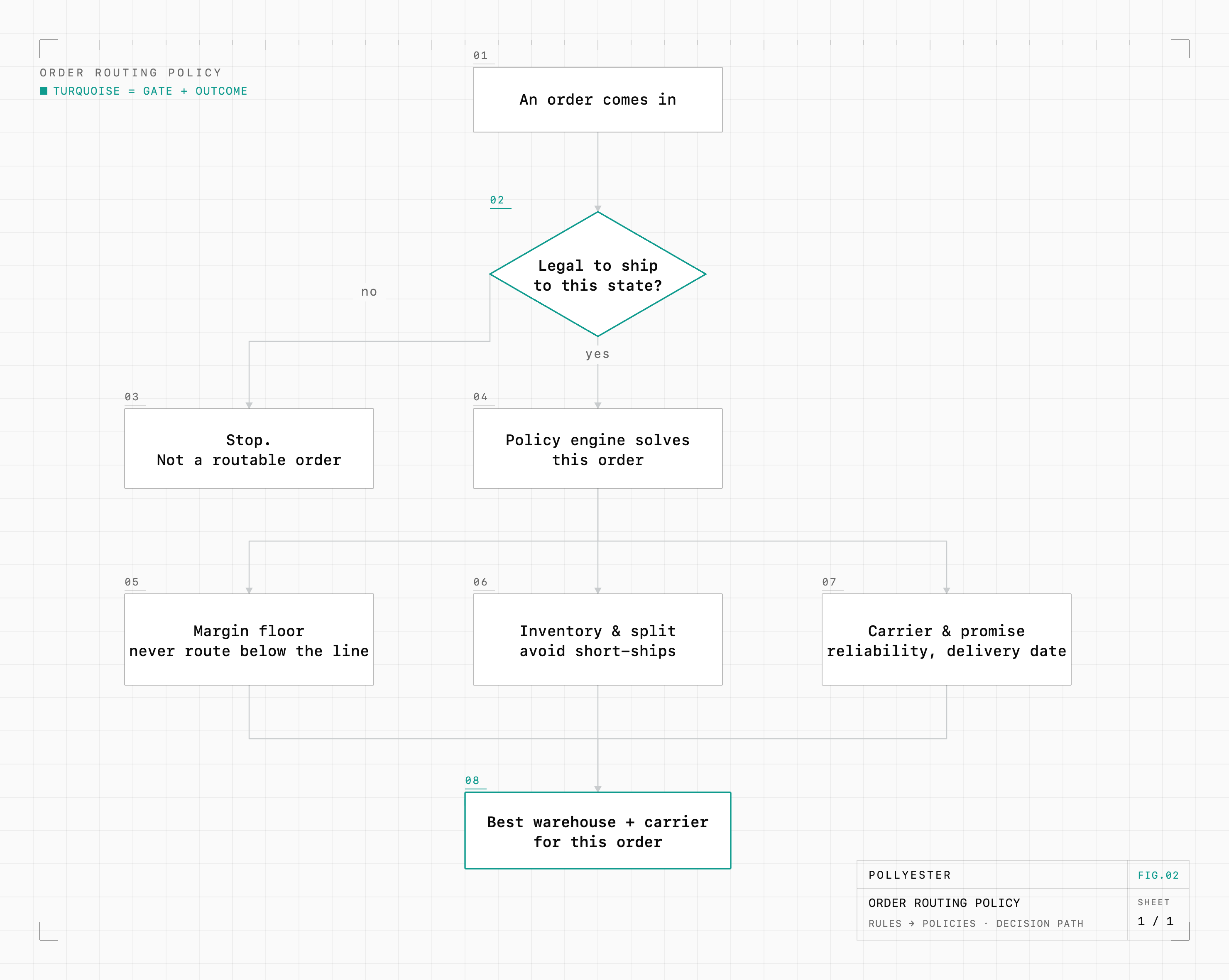
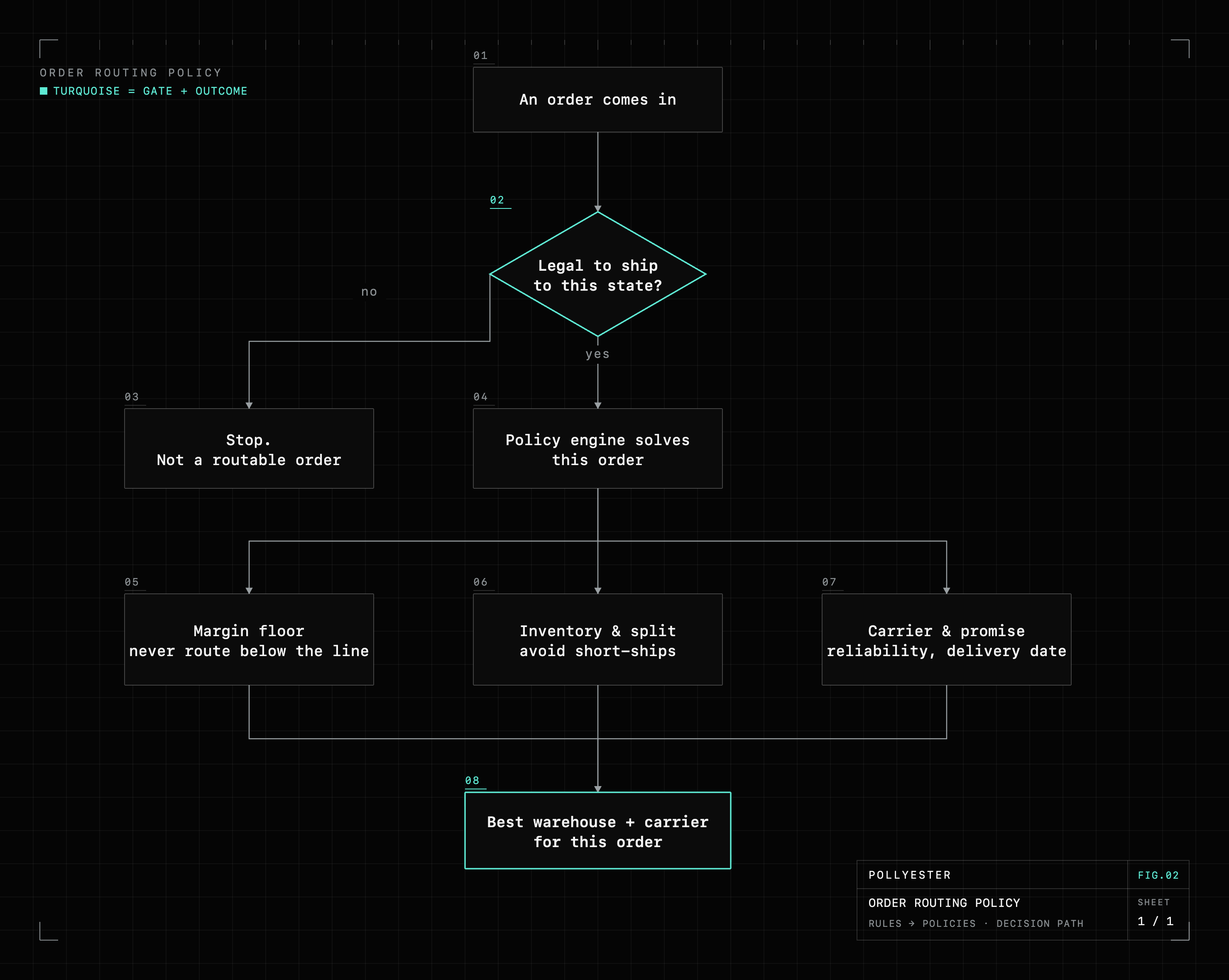
The fix is to stop writing instructions and start setting objectives.
A rule says do this exact thing in this exact case. You maintain a growing pile of them, and every new carrier, warehouse, or state law means someone has to remember to go edit the pile. A policy says here's what we're optimizing for, now find the best answer per order. You set the goals and the guardrails, and the system solves each order against them. Platforms already route on hundreds of conditions at once without anyone writing each one by hand (Pipe17). The technology to weigh cost, inventory, carrier reliability, delivery promise, and margin at the same time already exists. What's usually missing is a clear statement of what you want it to protect.
For a growth-stage brand, the objectives that matter are short and specific:
- A margin floor. Never route an order in a way that drops its contribution below the line you set. That single objective does more for the P&L than any clever exception rule.
- The delivery promise. Hit the date the customer was shown, at the cheapest way of hitting it. Not faster than promised at a premium you didn't need to pay.
- A split-shipment cap. Splitting an order to fill it faster can quietly double the shipping cost. Cap it, and let the system decide when the speed is worth it.
- The legal destination. In alcohol this isn't an objective you weigh against the others. It's a wall. Ship-to-state legality, age and ID verification, permits, and tax by jurisdiction are a hard constraint the system checks before it considers anything else.
That last one is the whole point of the shift. In a rules world, "is this legal to ship here" is one more line someone has to keep current as the state map changes. Miss the update and the system happily books an illegal order. In a policy world, legal shipping is a constraint the system can't violate, no matter what the cost math says. You don't route around the law, you build it into the system, so the sale stays legal by design, compliance the agent can't skip.
Make the policy something your team can read
Here's the part most vendors skip, and it's the part that protects you. A policy is only worth having if the people running the business can read it, test it, and change it.
So the logic gets written in plain terms your ops lead can read, not buried in a model nobody can open. You can run a proposed change against last month's real orders and see the before-and-after on cost, split rate, and on-time delivery before it touches a live order. And when your compliance counsel says spirits can now ship to a tenth state, someone on your team makes that change and watches it take effect, without waiting on a vendor to file it for you.
The alternative is the trap underneath the trap, the reason to own the orchestration layer, not the building. You rent an order system whose routing logic you can't see, can't audit, and can't take with you. When the software setting your margin is something you rent, you're renting your own margin logic back from a vendor every month.
When the software setting your margin is something you rent, you're renting your own margin logic back from a vendor every month.
Why the discipline pays
The numbers on order orchestration are real when the work is done right.
Done right, you see it in throughput. When packing runs on a single connected platform instead of a stack of disconnected tools, the pack table moves faster, because the people working it stop reconciling systems by hand and start filling orders. Spreading inventory across two or three warehouses becomes standard around $10M in revenue (GoBolt), which is right about when "nearest warehouse" turns from a simplification into a leak.
Most of the time it isn't done right. MIT found that 95% of enterprise generative-AI pilots delivered no measurable profit impact (Fortune), and Gartner expects more than 40% of agentic AI projects to be scrapped by 2027. The gap between those outcomes isn't model quality. It's whether the work got wired into how the business actually runs, with a clear objective, or bought as a demo that impresses people in a screenshot. Routing lands on the right side of that line, what survives the OMS demo, because the objective is concrete: protect the margin, hit the delivery promise, keep the sale legal. You can measure all three against your own before-and-after, which is the only proof that counts.
The takeaway
Policies you can read beat rules you can't maintain. Set the objectives, keep the logic in your own hands, and let the system protect the margin and keep every sale legal. The routing decision was always the margin decision. It's time to stop making it with a spreadsheet.