Build the agent-ready core
The Data Is the Moat. The Model Is a Rental.
Every vendor is selling you a smarter model. The model keeps getting cheaper. The only thing that compounds is the customer data underneath it, and most brands don't own theirs.

Every vendor is selling you a smarter model. The model keeps getting cheaper. The only thing that compounds is the customer data underneath it, and most brands don't own theirs.
Every vendor calling you this quarter is selling a smarter model. Faster, cheaper, tuned for beauty, whatever the deck says. Here's what they leave out. The model is the commodity, and it keeps getting cheaper. For an LLM of equivalent performance, the price is falling by roughly 10x a year (a16z's "LLMflation" analysis), and the thing you're being pitched today will cost a fraction of that in six months. What it runs on is the part that holds its value, and that's your customer data. That's the one input that gets more useful the longer you own it, and most brands don't own theirs.
So the real question was never which model. It's whether you own the thing the model reads.
The input nobody can rent for you
Third-party signal keeps degrading. For years you could fill in the picture of your customer with data bought from the open web, or an audience you rented from someone else. That path gets less reliable every year, between privacy rules, platform walls, and browsers that trust cookies less. The data you collect directly, from your own quizzes and orders and reorders, is now the only durable input to any AI that personalizes a page, prices a bundle, or predicts who's about to lapse (industry brief; Research World) — the same record that makes a store built for agents legible in the first place. Everything downstream is only as good as the data feeding it.
Most brands don't own that flow of data. They switch on a black-box feature inside a platform, it learns from their customers, and what it learns stays with the vendor. Read the fine print and the problem is plain: when the vendor keeps the rights to what its system learns from your buyers, you can never train your own. You're paying to make someone else's product smarter about your customers.
You're paying to make someone else's product smarter about your customers.
The advantage moved
For years the edge in commerce was the model, the algorithm, the clever system. That part is for sale to anyone now, and it gets cheaper every quarter. The model is a commodity; the judgment the model can't rent is the part that isn't. What you can't buy off a shelf is the data only you have, the record of who your customers are and what they do. That's the durable edge, and it's an ownership question before it's a technology one.
An AI that makes good decisions needs a few plain things, and they're all about ownership. It has to know which orders, quiz answers, and repurchases belong to the same person. It has to see how each decision turned out so it can learn from it. And it has to know where the data came from. None of that survives if your customer record lives in a tool you rent and can't cleanly export.
The math, in two numbers
First, the market is voting. Retail media built on first-party data is projected to grow from about $60B in 2025 to roughly $100B by 2028 (Moloco; Research World). That's a two-thirds jump in three years, and it points where the spend is heading, toward advertising powered by data the brand actually owns.
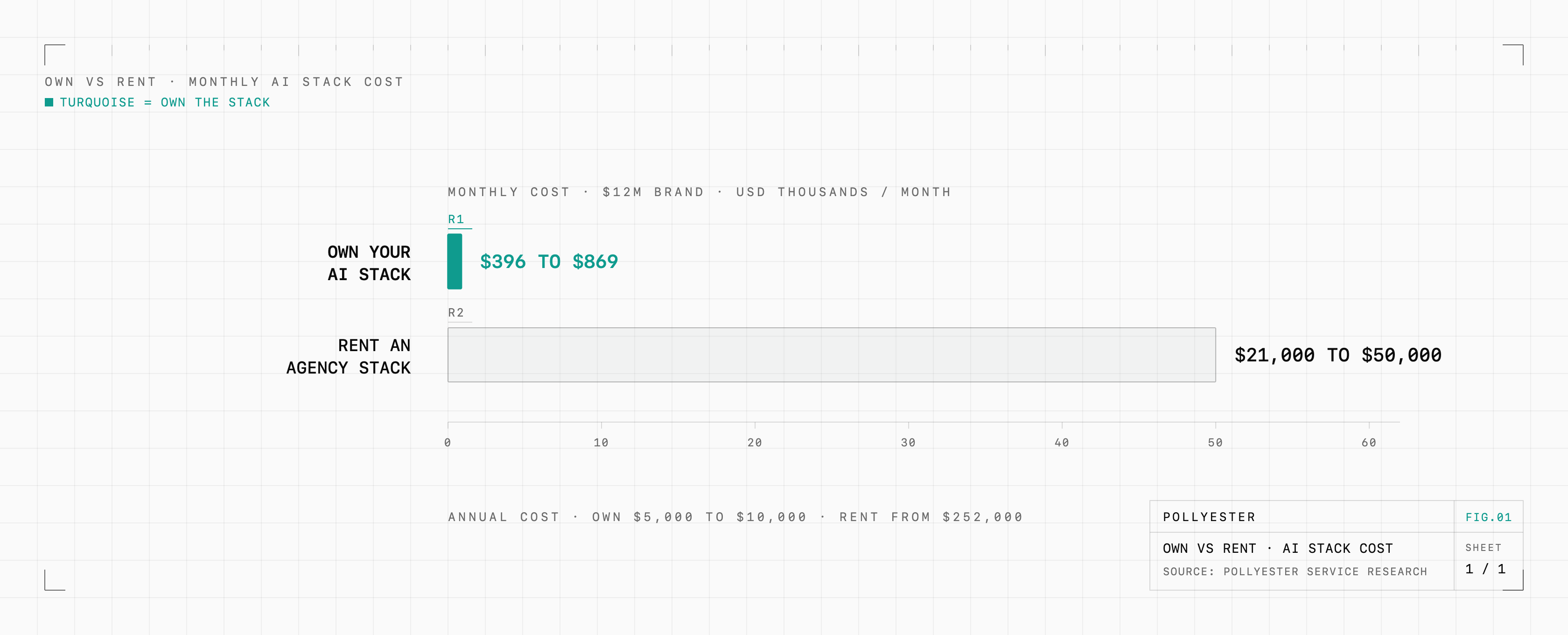
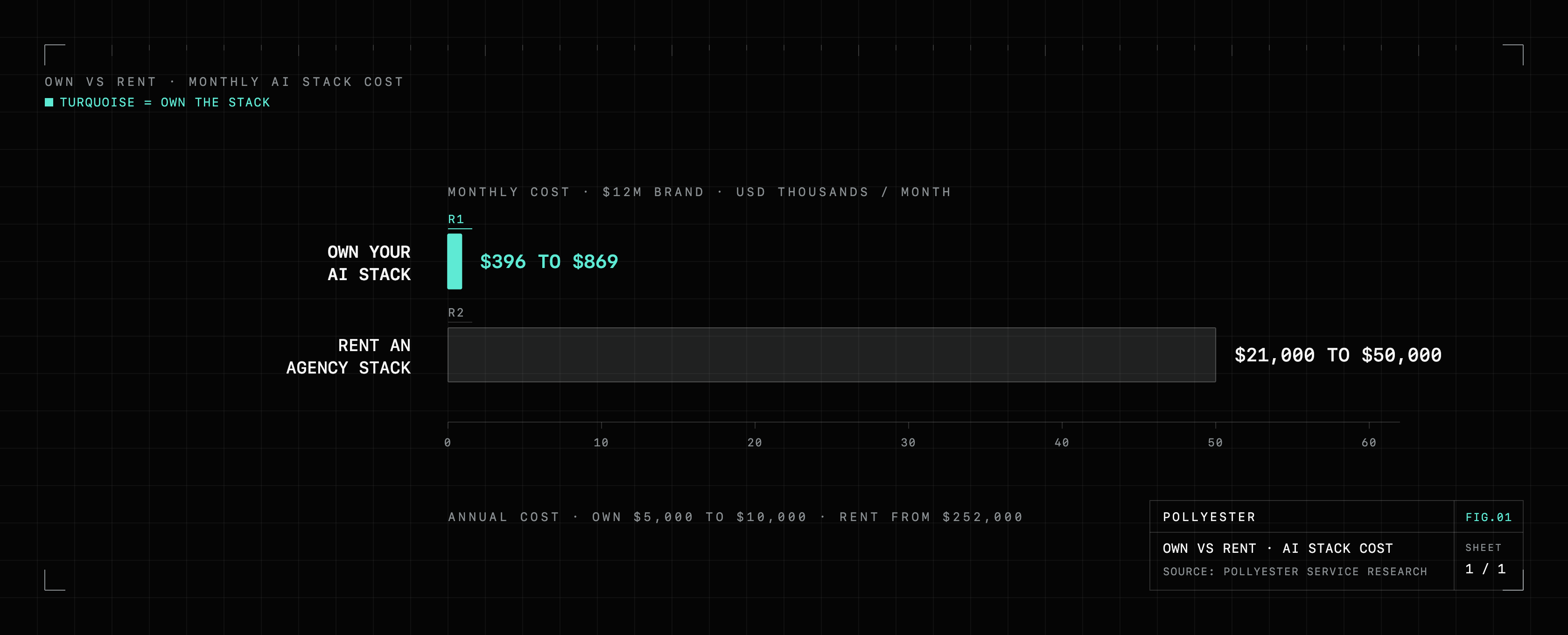
Second, the cost has flipped, and the gap is an order of magnitude. Model prices have fallen so far that a plausible in-house run-rate for a mid-sized brand looks like a few hundred dollars a month in model and infrastructure spend. Renting the same capability, agency retainers plus the people you need to keep them honest, runs into the tens of thousands a month. Owned, that's a few thousand dollars a year against a rented bill in the hundreds of thousands. The owned version gets cheaper as model prices keep falling. The rented one is a bill that renews, and after three years you have a drawer of invoices and none of the asset.
Renting isn't free, it's just later
There's a quieter cost to the black box, and you feel it the day you try to leave. When the vendor keeps what its system learned from your customers, switching means starting over, because your history stays with them. You don't notice it while things are working. You notice it the moment a better option shows up and your business is stuck on the old one.
Owning the flow of your data doesn't mean building everything yourself, and it doesn't mean the most complicated setup a deck can draw. It means holding onto the parts that compound: your data, your direct relationship with the customer, and enough control that no platform or model can hold the business hostage.
You notice it the moment a better option shows up and your business is stuck on the old one.
In beauty, the signal is unusually good
This matters more in beauty than almost anywhere, because the data is richer and more honest than in most categories.
A beauty customer tells you their shade, their skin type, what irritates them, what they bought, whether they came back for it, and how long the tube lasted before they reordered. All of that is first-party signal, and it's exactly what the useful AI runs on. Shade and skin-match tools exist to kill the number-one return driver in the category, the wrong-color guess. Try-on tools measurably lift conversion for the brands that adopt them early, and a fast-growing share of beauty brands now run some version of them.
Here's the part that decides who wins. That shade and repurchase data isn't a one-time input to a try-on widget. It's the ground floor under everything you'll want to build next: the replenishment nudge timed to when the product actually runs out, the restock forecast, the bundle matched to a skin type. When you own the identity and the feedback loop, all of it draws on the same pool of data, and that pool gets deeper every month. When the data sits inside a rented black box, every quiz answer your customer gives is training the vendor's product instead of yours.
Rent the model, own the data
You don't need to build the intelligence yourself. Rent it, honestly, because it keeps getting cheaper and rebuilding it would waste good money. What you can't rent is the data it reads and the relationship with the customer underneath. Own that data and the direct line to your customer, and keep enough control that you can swap in a better model next year without asking permission and without leaving your history behind. That's what it means to build the agent-ready core.
We've run commerce from both sides of the table, paying these invoices as the operator and sending them as the agency, and the lesson held either way. Rent the model. It gets cheaper on its own. The data underneath is the one thing on the books that grows.