Cost Optimization
AI Is a Cost Center Until Proven Otherwise
Most of the market sells AI as pure upside. The honest version is that it costs money until a specific number moves, and the work is making that number move one line at a time.

AI is the biggest shift commerce has seen in years. It's also a cost center until you prove otherwise. Both are true right now, and the gap between them is where a lot of brands are quietly losing money.
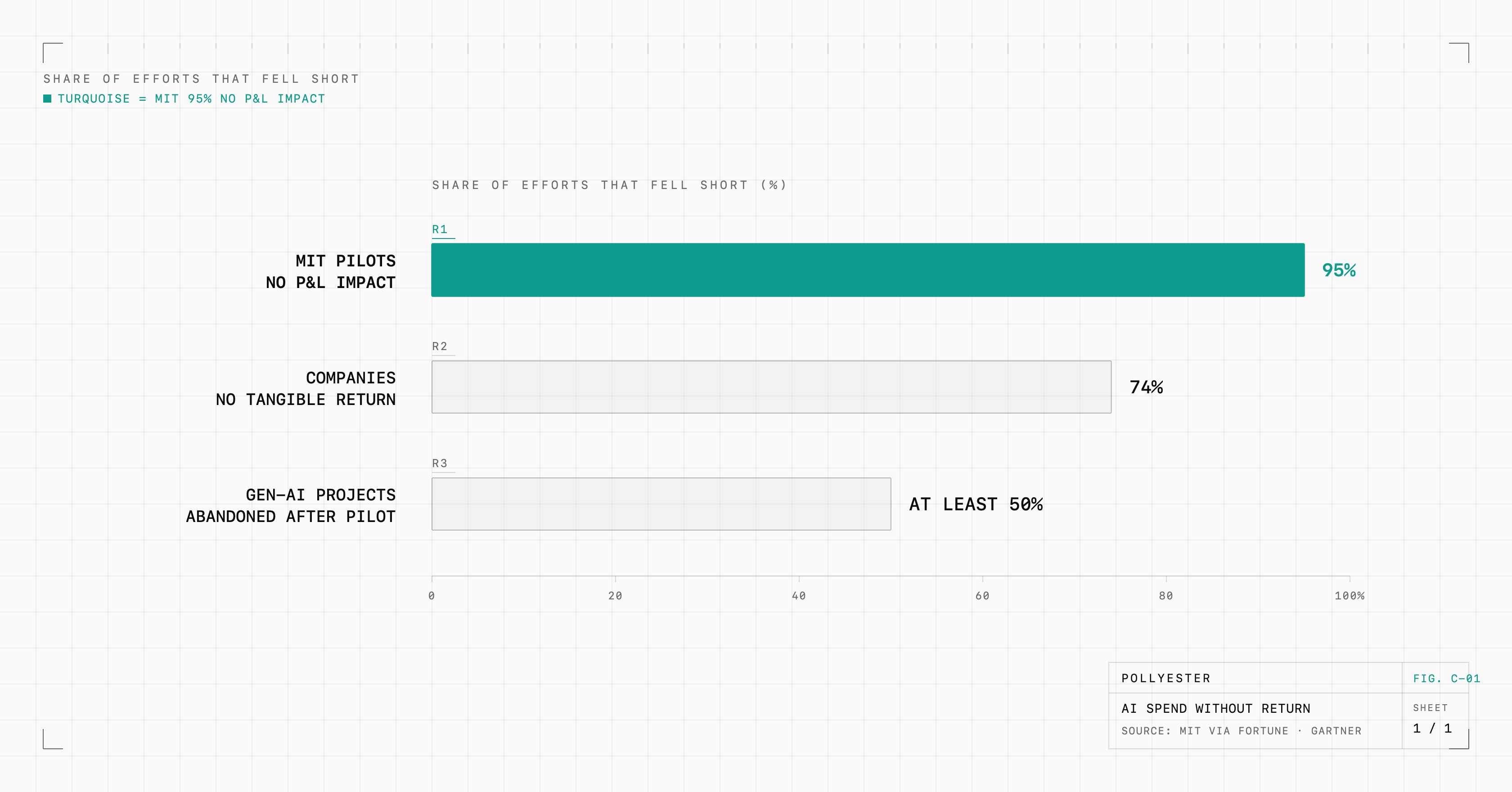
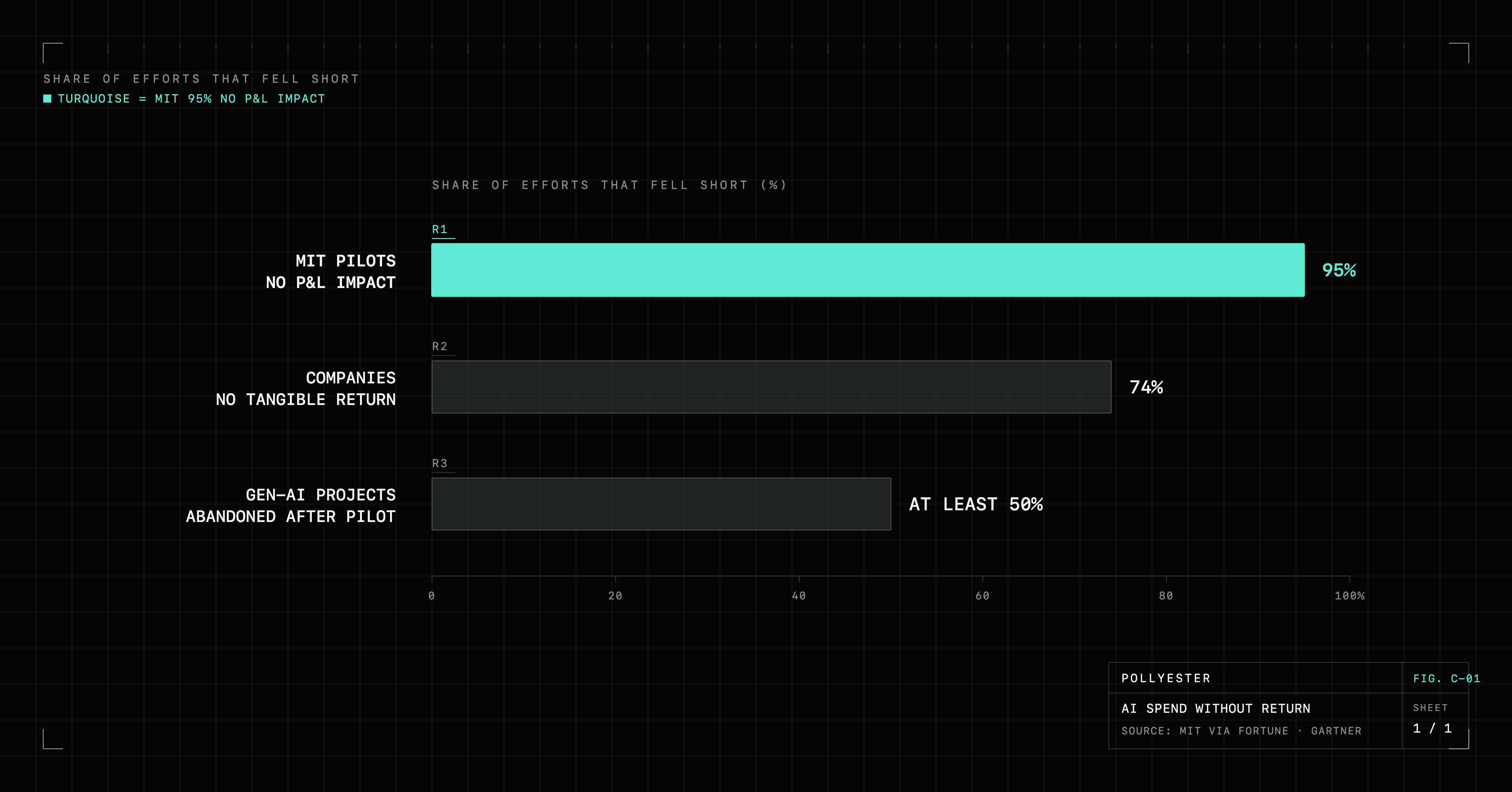
Start with the number every board is passing around. MIT's Project NANDA looked at 300 real AI deployments, surveyed 153 leaders, and sat down with 52 executives. What they found: 95% of enterprise generative-AI pilots delivered no measurable impact on the P&L, against $30 to $40 billion in spend (MIT, via Fortune, August 2025). Gartner got to the same place from a different road. It says at least half of generative-AI projects were abandoned after the pilot stage, and it expects more than 40% of the projects that let AI act on its own to be cancelled by 2027 on rising costs and unclear value (Gartner, June 2025). Separately, 74% of companies report no tangible return on their AI spend (Gartner analysis via Talyx).
A dead pilot hurts a growth-stage brand more
Here's why this lands harder on a growth-stage brand than on a Fortune 500. A big company can write off a failed pilot and never feel it. A $15M to $150M brand is running on a much thinner cushion. The median DTC brand books 60 to 70% gross margin and finishes the year at a 15 to 20% true contribution margin once every variable cost is counted (Luca). And those costs are moving the wrong way. Customer acquisition cost is up 40 to 60% from 2023 to 2025, and the average brand now loses about $29 on each new customer once returns and acquisition are in, up from $9 a decade ago (Swell; Eightx).
When a new customer costs more than the first order brings in, an AI project that doesn't move contribution margin isn't a neutral bet. It's a second hole in the same boat.
An AI project that doesn't move contribution margin isn't a neutral bet. It's a second hole in the same boat.
The failure isn't the technology
The thing to sit with in the MIT data is that the 5% who crossed over did something specific. They bought tools from outside vendors, which worked about twice as often as the ones companies tried to build in-house. And they pointed AI at back-office operations instead of the marketing budget, which is where most of the money went and the least return showed up (MIT, via Forbes). In other words, most of the budget is aimed at the wrong half of the business.
So the pilots didn't fail because the models are bad. They failed because the AI got aimed at the wrong problem and never tied to a number. Nobody wrote down what line it was supposed to move, so nobody could tell whether it moved.
There's a quieter version of the same mistake. A tool gets bought, it sits next to the work instead of inside it, and the team drifts back to the old way because the new way was never built into how the job gets done. The brands that won closed that gap. They put the AI where the work happens and owned the output it produced, instead of bolting a demo onto the side and hoping.
Treat it like any other spend
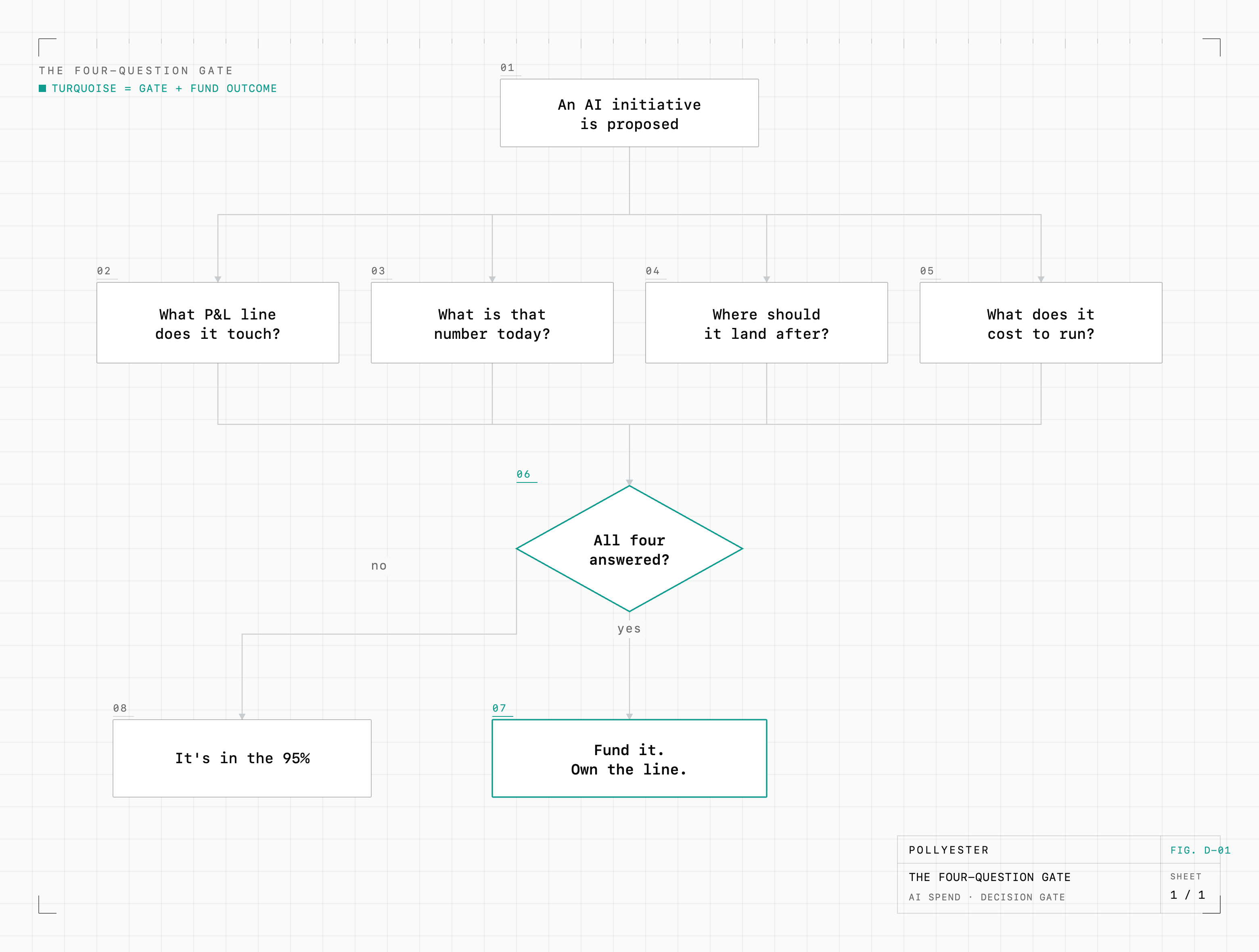
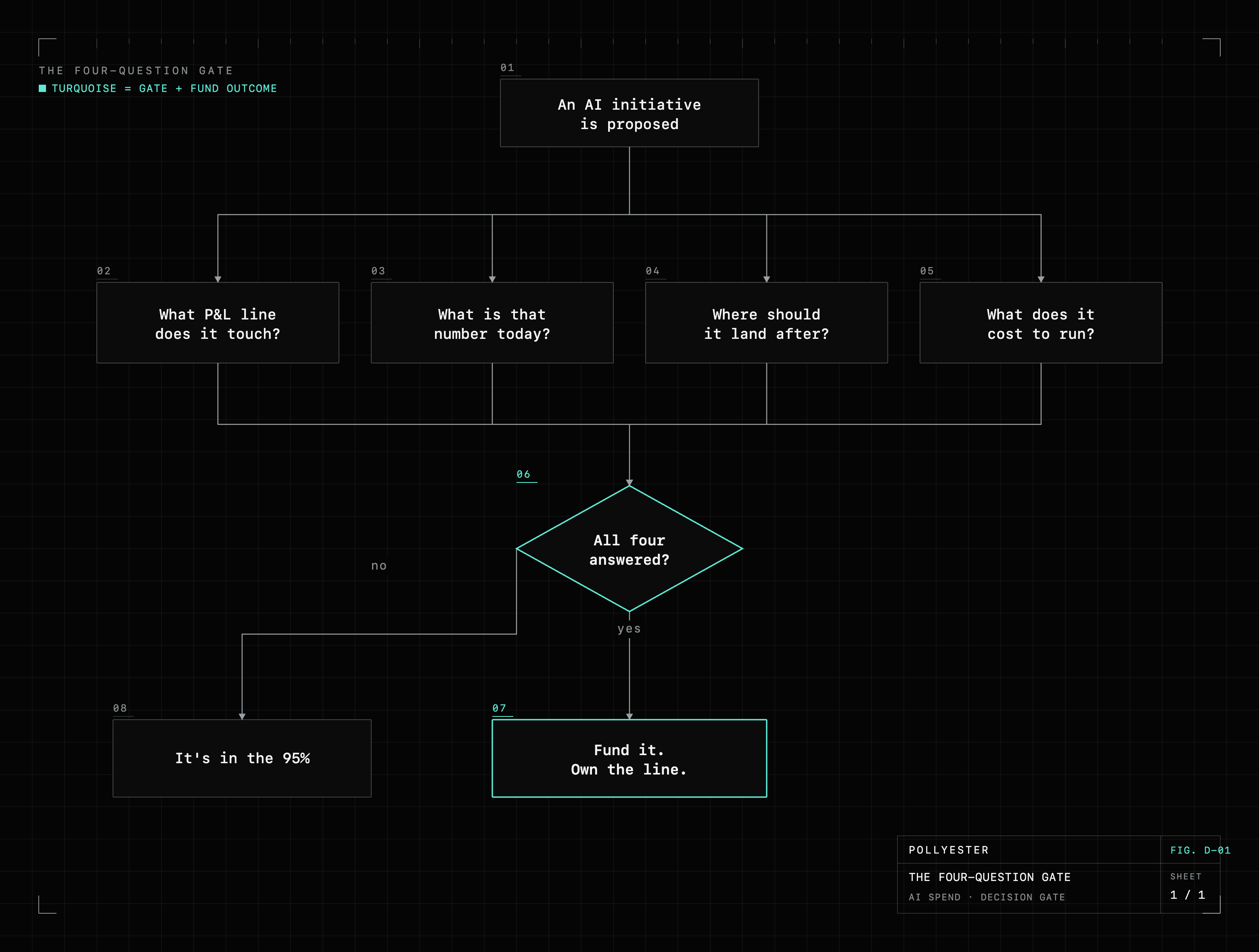
The discipline is boring, and that's the point. Before you fund an AI initiative, underwrite it in one number and make it answer the same questions any spend has to. What line on the P&L does it touch, what's that number today, where do you expect it to land after, and what does the AI itself cost to run?
That last question is where most plans break. AI has a cost to run of its own — the AI bill nobody prices in — and it's climbing even as sticker prices fall. The per-use price of these models dropped about 67% in a year, and enterprise AI bills still tripled, because the newer workflows that let AI act on its own burn 5 to 30 times more processing per task than a simple chatbot answer (NavyaAI; TechAhead). The bill is also bigger than the part you see. The usage charge you get billed for is only about a fifth of the real total cost of running these systems (Splunk). Uber's CTO said the company's annual AI budget was gone by April (Optimum Partners). If a use case can't answer those four questions, it isn't an investment yet. It's in the 95%.
And left unsupervised, it can cost you fast. One ecommerce chatbot stacked coupons until it was selling at negative prices and pushed through 2,400 orders at a loss north of $150,000 before anyone noticed (InspectAgents).
The tools that don't work look exactly like the ones that do until the bill arrives.
The plays that actually move a number
The wins are unglamorous, and every one attaches to a line item you can already name. Product recommendations move AOV and revenue per session. They can account for up to 31% of revenue, and the shoppers who use them convert higher and are worth more over time (Envive). One Forrester study of a personalization rollout found a 446% three-year return, with payback in under six months (via EComposer). Put that in your own terms. Move sitewide conversion from 2.0% to 2.5% and that's 25% more revenue on the same traffic you already paid to get.
Support automation brings down cost-to-serve, the bread and butter of cost optimization. Return inspection cuts refund leakage, which matters more every year. Return fraud pulled $76.5 billion out of US retail in 2025, and people are now using AI to fake damage photos for refunds (Fox News; PYMNTS). Return shipping, processing labor, restocking, and write-offs together eat 8 to 15% of an order (Saras Analytics). Trim a few points off that and it lands straight in contribution margin.
The pattern holds. Every play that works has a before-number and an after-number. If a proposed use case can't produce that pair, it belongs with the pilots that returned nothing.
The judgment is the product
We say AI is a cost center until proven otherwise because we've been on the operator side of that invoice. The job is to turn it into a margin center, one named line at a time, and to say no to the rest out loud.
In a market where the tools that don't work look exactly like the ones that do until the bill arrives, the scarce thing isn't more AI. It's the judgment to tell them apart, and the discipline to ship only the part that moves the business.