Build the agent-ready core
Composable-Lite Beats MACH for Most $15-150M Brands
The full composable rebuild is a real architecture. It's just rarely the one your team can run.

The full composable rebuild you're being pitched is real, it's well-built, and it's probably wrong for your brand. Composable commerce is having its reckoning, and it earned one. The industry even named the hangover: composable regret.
Here's the pitch. Tear out the platform you're on and rebuild on a composable stack. In plain terms, that means breaking your store into a dozen separate tools, one each for catalog, search, checkout, and content, then wiring them together yourself. The industry shorthand for this is MACH. The promise is flexibility and paying only for what you use.
The pitch looks like consensus
On paper, the numbers are on the pitch's side. The MACH Alliance's 2025 research reports 87% of surveyed organizations have widely adopted this approach and expect 61% of their stack to run on it by 2026. When almost everyone in the room has bought in, saying no feels like falling behind.
But adoption isn't fit. That 87% includes enterprises with whole platform teams, and it includes 30-person apparel brands with two engineers. Sold to the second one, breaking the store into a dozen loose parts produces a stack nobody on the team can run. That's where the regret comes from (CMS Critic). Of course, that's exactly what happened to a lot of brands who bought in early.
The barrier was never the technology
The parts work. What most growth-stage brands don't have is the specialized talent to keep eight to fifteen vendors talking to each other, forever. The "pay only for what you use" line runs straight into the licensing, integration, and maintenance bills across all of them. Your engineering backlog grows. Marketing ends up waiting weeks for a change a Shopify admin would have made in minutes (Alokai).
The cost math is worse than the deck shows. Once you count the build, the licenses, the integration work, and the ongoing engineering across every vendor, a composable build costs far more than staying on one platform, and it keeps costing for years. The efficiency gains the deck promises are real, but they show up only for brands big enough to carry the overhead. Below that size, the same setup is just a bigger bill and a slower team.
Below that size, the same setup is just a bigger bill and a slower team.
The honest math on going headless
Headless means the front end your shoppers see is separated from the engine that runs the store, so you can rebuild the storefront without touching the plumbing. It's a credible production architecture at roughly $5M+ GMV. Below that line, do the arithmetic before you sign.
A headless build adds eight to sixteen weeks and $50,000 to $150,000 over a themed build on the same platform (Conversion Design). For a $6M apparel brand, that $100K and four months buys a more flexible storefront and, on launch day, nothing a customer can see. Put the same money into deeper catalog, real product photography, or paid acquisition, and you can move revenue this quarter instead of next year.
Run it as a conversion problem, because that's what it is. If your storefront converts at 2.0% and better merchandising and faster pages take it to 2.5%, that's 25% more revenue on the same traffic. A replatform doesn't touch that number for months, and sometimes it moves the wrong way while the team learns the new stack. At your size, the capital and the calendar are the constraint, so spend both where they show up in the P&L.
There's a second cost that never makes the deck: the standing talent. Once the store is a dozen tools you stitched together, you need someone on hand who understands the stitching, and that person doesn't leave. Either you hire the integration engineer or you keep the agency on retainer. Both are a fixed line item that grows with the number of vendors, and it's the one that outlasts the build.
Once the store is a dozen tools you stitched together, you need someone on hand who understands the stitching, and that person doesn't leave.
What most brands need
For most merchants under $10M, Shopify Plus with an optional Hydrogen front end covers it. Hydrogen is Shopify's own framework for building a headless storefront, so you get the flexible front end without leaving the engine that already runs your store. Call it composable-lite: a flexible front end on a solid engine, not a dozen parts held together by a contractor you'll need on retainer for life. That same lean stack can still answer the protocols an agent-ready catalog needs.


Full MACH earns its keep in a few specific setups, and it's worth knowing whether you're one of them. Several brands run under one roof. Several markets with their own catalogs, currencies, and tax rules. A storefront that's really as much a publishing operation as a store. If that's the business you run, the big build is the right one and you should do it well. If you're one apparel label selling in one market with seasonal drops, it isn't, no matter how good the deck looks.
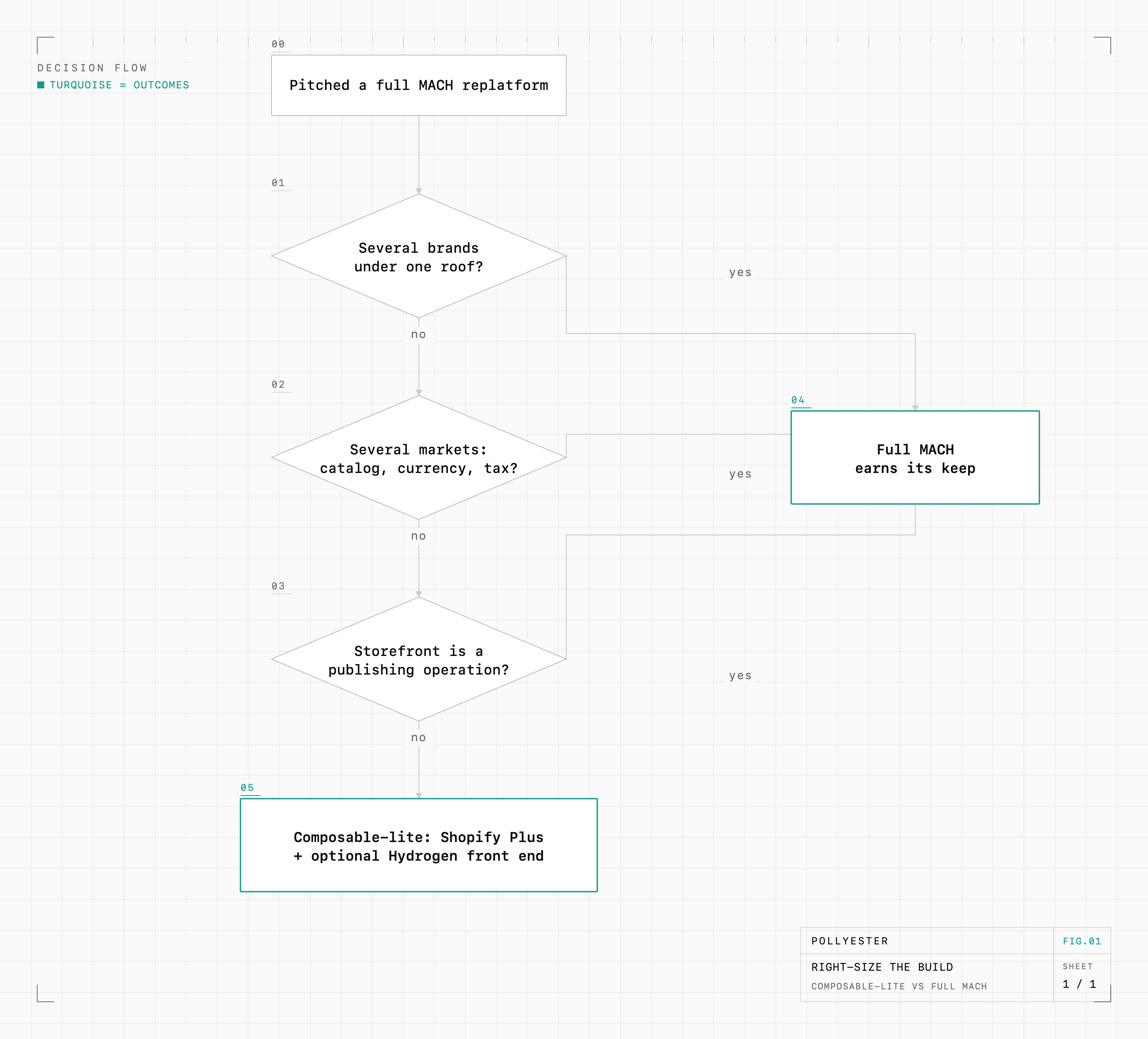
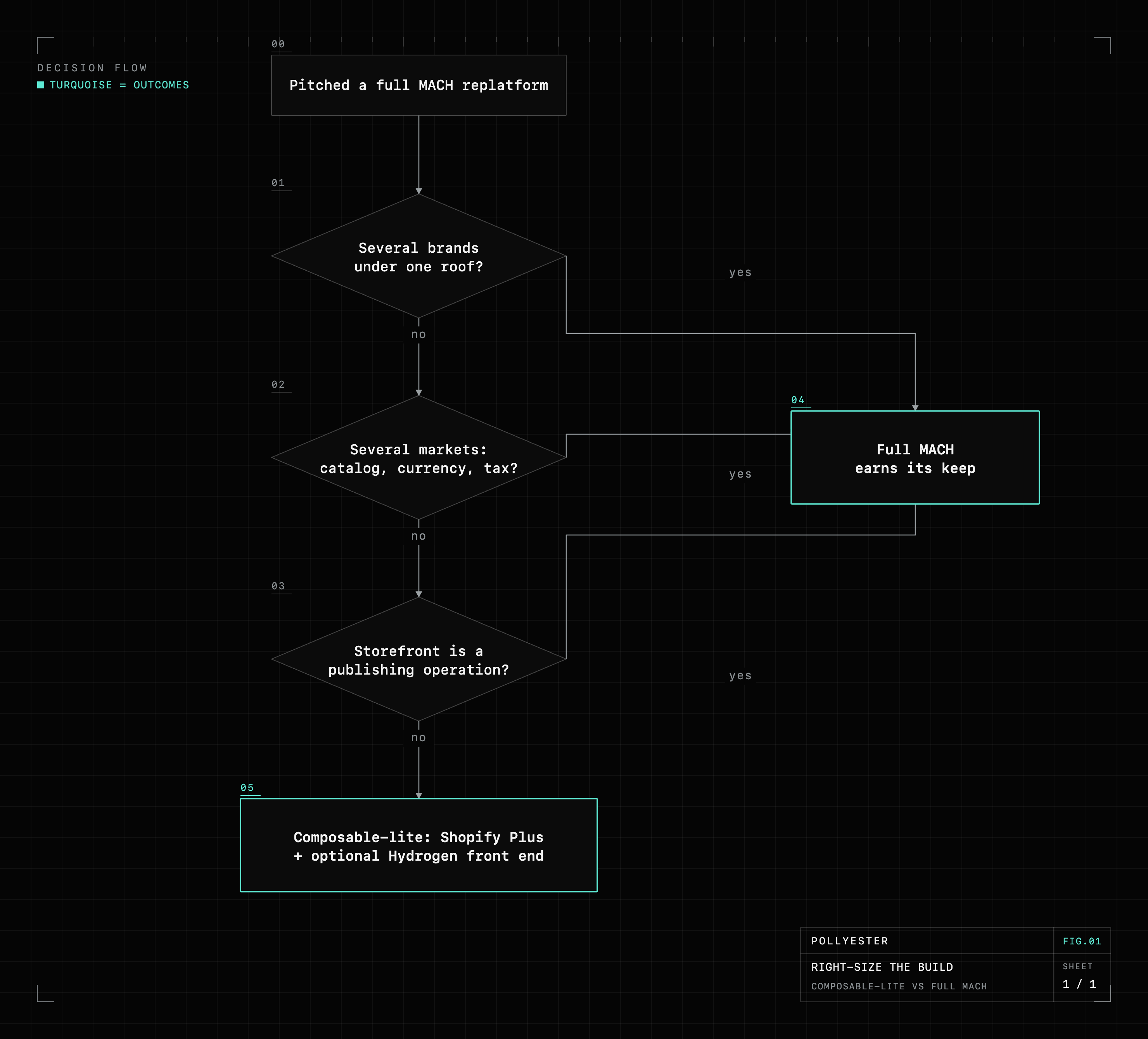
The tell is your calendar, not your ambition. Ask what your storefront actually has to do in the next twelve months. If it's ship four drops a year, keep size and fit clear, load fast on a phone, and merchandise the collection well, a themed Shopify Plus build does all of that and you can change it yourself. If the honest answer involves standing up a second brand or a third market, that's a different conversation, and the extra weeks and dollars start to pay for something real. Buy the architecture the next year demands, not the one the three-year vision flatters.
Own three things instead
There's a quieter cost than the build, and it's the expensive one. You're renting your intelligence layer from a platform that keeps the data, and the data underneath is the real moat. A black-box feature is easy to switch on and painful to leave, because it learns on your customers and the learning stays with the vendor.
So the real ownership test isn't whether you went fully composable. It's whether you kept the three things that matter no matter which platform you're standing on. Keep your data, first and zero-party, in systems you control. Keep the direct relationship with the customer, not a version of it filtered through someone's algorithm. And keep enough portability that no platform, model, or agent network can hold the business hostage — the same portability that lets you sell to the buyer that reads data, not pages without a rebuild.
Own those three and you can change platforms, models, or partners without starting over. That's the point.
Match the building to the operation
Recommending less than you can afford is the honest-broker call, and almost no agency or platform will make it, because their incentive runs the other way. Match the architecture to the operation you have, not the one a slide says you'll need in three years. The intelligence layer keeps getting cheaper and better. What compounds is what you own underneath it, so build there, on the agent-ready core.